

Carpaccio
Health
Nutrition
Nutri-Score
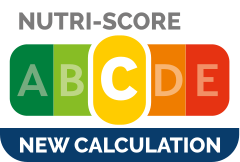 Average nutritional quality
Nutri-Score data warning
Nutrient levels
Fat in low quantity (1.3%)
Saturated fat in low quantity (0.6%)
Sugars in low quantity (0.5%)
Salt in moderate quantity (0.838%)
Nutrition label

Nutrition facts
| Nutrition facts | As sold for 100 g / 100 ml | Compared to: Italian cheeses |
|---|---|---|
| Energy | 402 kcal (96 kcal) | 1,301.732 kJ (314 kcal) |
| Fat | 1.3 g | 24.535 g (-95%) |
| Saturated fat | 0.6 g | 16.186 g (-96%) |
| Carbohydrates | 2.5 g | 1.008 g (+148%) |
| Sugars | 0.5 g | 0.707 g (-29%) |
| Dietary fiber | ? | ? |
| Proteins | 18.6 g | 21.172 g (-12%) |
| Salt | 0.8375 g | 1.062 g (-21%) |
| Sodium | 0.335 g | 0.424 g (-21%) |
| Fruits, vegetables and legumes | ? | ? |
Nutrition facts (Detailed data)
| Nutrition facts | As sold for 100 g / 100 ml | As sold Per serving (legacy) |
|---|---|---|
| Energy | 402 kcal (96 kcal) | 322 kcal (76 kcal) |
| Fat | 1.3 g | 1.04 g |
| Saturated fat | 0.6 g | 0.48 g |
| Carbohydrates | 2.5 g | 2 g |
| Sugars | 0.5 g | 0.4 g |
| Dietary fiber | ? | ? |
| Proteins | 18.6 g | 14.9 g |
| Salt | 0.8375 g | 0.67 g |
| Sodium | 0.335 g | 0.268 g |
| Fruits, vegetables and legumes | ? | ? |
Serving size
Ingredients
Ingredients image

Ingredients list
Ingredient information
Added sugars
Allergens
Ingredients analysis
No ingredients containing palm oil.
Contains non-vegan ingredients.
Unrecognized: es:peso-neto, es:carpaccio-de-vacuno, es:peso-neto, es:peso-neto, es:extracto-natural-de-limon
Contains non-vegetarian ingredients.
Unrecognized: es:peso-neto, es:carpaccio-de-vacuno, es:peso-neto, es:peso-neto, es:extracto-natural-de-limon
Food Processing
NOVA group
 Ultra-processed food and drink products
Elements that indicate the product is in NOVA group 4
How NOVA works
Additives
E202 - Potassium sorbate EFSA overexposure risk: highPreservative
Potassium sorbate (E202) is a synthetic food preservative commonly used to extend the shelf life of various food products.
It works by inhibiting the growth of molds, yeast, and some bacteria, preventing spoilage. When added to foods, it helps maintain their freshness and quality.
Some studies have shown that when combined with nitrites, potassium sorbate have genotoxic activity in vitro. However, potassium sorbate is generally recognized as safe (GRAS) by regulatory authorities.
E250 - Sodium nitrite EFSA overexposure risk: highPreservative
Sodium nitrite (E250) is a salt used for curing and preserving meat products.
It plays a critical role in preventing the growth of Clostridium botulinum, the bacterium responsible for botulism, in cured meats like bacon, ham, and sausages. It also provides the characteristic pink color and flavor.
However, nitrites can react with amines in the stomach to form nitrosamines, which are potent carcinogens. High intake of processed meats containing nitrites is associated with an increased risk of colorectal cancer. Regulatory bodies have set strict limits on its use in food.
E252 - Potassium nitrate EFSA overexposure risk: highPreservative
POTASSIUM NITRATE is a chemical compound with the chemical formula KNO3. The widespread adoption of nitrate use is more recent and is linked to the development of large-scale meat processing. potassium nitrate is still used in some food applications, such as salami, dry-cured ham, charcuterie.
E262 - Sodium acetatesPreservativeSequestrant
SODIUM ACETATE, also abbreviated NaOAc,[8] is the sodium salt of acetic acid.
E301 - Sodium ascorbateAntioxidant
SODIUM ASCORBATE is one of a number of mineral salts of ascorbic acid (vitamin C).
E330 - Citric acidAntioxidantSequestrant
Citric acid is a natural organic acid found in citrus fruits such as lemons, oranges, and limes.
It is widely used in the food industry as a flavor enhancer, acidulant, and preservative due to its tart and refreshing taste.
Citric acid is safe for consumption when used in moderation and is considered a generally recognized as safe (GRAS) food additive by regulatory agencies worldwide.
E331 - Sodium citratesEmulsifierSequestrantStabiliser
DISODIUM CITRATE, more properly, disodium hydrogen citrate, is an acid salt of citric acid with the chemical formula Na2C6H6O7. It is used as an antioxidant in food and to improve the effects of other antioxidants. It is also used as an acidity regulator and sequestrant. Typical products include gelatin, jam, sweets, ice cream, carbonated beverages, milk powder, wine, and processed cheeses.
E407 - Carrageenan EFSA overexposure risk: highCarrierEmulsifierHumectantStabiliserThickener
Carrageenan (E407), derived from red seaweed, is widely employed in the food industry as a gelling, thickening, and stabilizing agent, notably in dairy and meat products.
It can exist in various forms, each imparting distinct textural properties to food.
However, its degraded form, often referred to as poligeenan, has raised health concerns due to its potential inflammatory effects and its classification as a possible human carcinogen (Group 2B) by the International Agency for Research on Cancer (IARC).
Nevertheless, food-grade carrageenan has been deemed safe by various regulatory bodies when consumed in amounts typically found in food.
E452 - Polyphosphates EFSA overexposure risk: highEmulsifierHumectantSequestrantStabiliserThickener
No additive description is available yet.
Environment
Green-Score, origins bonus, and transportation impact are shown for Worldwide .
Green Score
Overall grade
 Moderate environmental impact
About Green-Score
Current scope
Life cycle analysis
Average impact of the category
Camembert cheese, from cow's milk • Score: 54/100Life-cycle reference
Overall environmental impact by stage (PEF)
The overall environmental impact figure (PEF) comes from ADEME's Agribalyse database, for the category: Camembert cheese, from cow's milk. Source: ADEME Agribalyse Database.
| Stage | Impact |
|---|---|
| Agriculture | 84.7 % |
| Processing | 5.0 % |
| Packaging | 4.0 % |
| Transportation | 3.7 % |
| Distribution | 1.9 % |
| Consumption | 0.5 % |
Bonuses and maluses
Origins of ingredients
Packaging impact
Green-Score for this product
Green-Score for this product
Final score: 46/100Final score breakdown
Carbon footprint
Carbon footprint
Climate impact by stage (CO2e)
The carbon emission figure comes from ADEME's Agribalyse database, for the category: Camembert cheese, from cow's milk. Source: ADEME Agribalyse Database.
| Stage | Impact |
|---|---|
| Agriculture | 86.0 % |
| Processing | 4.3 % |
| Packaging | 4.1 % |
| Transportation | 4.8 % |
| Distribution | 0.7 % |
| Consumption | 0.1 % |
Packaging
Packaging impact
Packaging components
| Shape | Material | Recycling | Impact |
|---|---|---|---|
| Unknown | Plastic | Unknown | High |
Declared packaging
Data precision
Transportation
Origins of ingredients
Origins breakdown
| Origin | Percent of ingredients | Impact |
|---|---|---|
| Italy | 100 % | Medium |
Data Source
Product data comes from Open Food Facts. Food Benchmark also adds translations, category comparisons and explanatory calculations.
The database is licensed under ODbL 1.0, individual contents under DbCL 1.0, and product photos under CC BY-SA 3.0.
Product added on June 21, 2019 at 8:48:49 PM UTC by kiliweb .
Last edit on January 1, 2026 at 11:30:53 AM UTC by macrofactor .
Product page also edited by annelotte, avicent, duhowpi, elcoco, foodvisor, kiliweb, macrofactor, packbot, roboto-app, yuka.SHZGUVM2QXd2OVZXaXZZeDN3bmsyTzEyMThEeWZXK2RLZWc4SVE9PQ, yuka.sY2b0xO6T85zoF3NwEKvll1LDNPGmTTLJkD6nlOrzfGBIr_sb_1L7bDQbKs.