

Pizza regina
Health
Nutrition
Nutri-Score
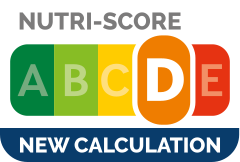 Lower nutritional quality
Nutri-Score data warning
Nutrient levels
Fat in moderate quantity (7.3%)
Saturated fat in moderate quantity (4.6%)
Sugars in low quantity (1.4%)
Salt in moderate quantity (1.3%)
Nutrition label

Nutrition facts
| Nutrition facts | As sold for 100 g / 100 ml | Compared to: Cured ham pizza |
|---|---|---|
| Energy | 766 kcal (183 kcal) | 913.251 kJ (217 kcal) |
| Fat | 7.3 g | 6.997 g (+4%) |
| Saturated fat | 4.6 g | 3.248 g (+42%) |
| Carbohydrates | 16.8 g | 26.625 g (-37%) |
| Sugars | 1.4 g | 2.553 g (-45%) |
| Dietary fiber | ? | ? |
| Proteins | 12 g | 10.792 g (+11%) |
| Salt | 1.3 g | 1.322 g (-2%) |
| Sodium | 0.52 g | 0.526 g (-1%) |
| Fruits, vegetables and legumes | ? | ? |
Nutrition facts (Detailed data)
| Nutrition facts | As sold for 100 g / 100 ml | As sold Per serving (legacy) |
|---|---|---|
| Energy | 766 kcal (183 kcal) | 2760 kcal (659 kcal) |
| Fat | 7.3 g | 26.3 g |
| Saturated fat | 4.6 g | 16.6 g |
| Carbohydrates | 16.8 g | 60.5 g |
| Sugars | 1.4 g | 5.04 g |
| Dietary fiber | ? | ? |
| Proteins | 12 g | 43.2 g |
| Salt | 1.3 g | 4.68 g |
| Sodium | 0.52 g | 1.87 g |
| Fruits, vegetables and legumes | ? | ? |
Serving size
Ingredients
Ingredients image

Ingredients list
Ingredient information
Allergens
Ingredients analysis
Palm oil content unknown
Contains non-vegan ingredients.
Unrecognized: fr:starter, fr:champignons-agaricus-bisporus
Contains non-vegetarian ingredients.
Unrecognized: fr:starter, fr:champignons-agaricus-bisporus
Food Processing
NOVA group
 Ultra-processed food and drink products
Elements that indicate the product is in NOVA group 4
How NOVA works
Additives
E250 - Sodium nitrite EFSA overexposure risk: highPreservative
Sodium nitrite (E250) is a salt used for curing and preserving meat products.
It plays a critical role in preventing the growth of Clostridium botulinum, the bacterium responsible for botulism, in cured meats like bacon, ham, and sausages. It also provides the characteristic pink color and flavor.
However, nitrites can react with amines in the stomach to form nitrosamines, which are potent carcinogens. High intake of processed meats containing nitrites is associated with an increased risk of colorectal cancer. Regulatory bodies have set strict limits on its use in food.
E262 - Sodium acetatesPreservativeSequestrant
SODIUM ACETATE, also abbreviated NaOAc,[8] is the sodium salt of acetic acid.
E300 - Ascorbic acidAntioxidantSequestrant
No additive description is available yet.
E316 - sodium erythorbate EFSA overexposure risk: noAntioxidant
SODIUM ERYTHORBATE is the sodium salt of erythorbic acid. Sodium erythorbate is produced from sugars derived from different sources, such as beets, sugar cane, and corn. It is used predominantly in meats, poultry, and soft drinks.
E322 - LecithinsAntioxidantEmulsifier
Lecithins are natural compounds commonly used in the food industry as emulsifiers and stabilizers.
Extracted from sources like soybeans and eggs, lecithins consist of phospholipids that enhance the mixing of oil and water, ensuring smooth textures in various products like chocolates, dressings, and baked goods.
They do not present any known health risks.
E322i - LecithinAntioxidantEmulsifier
Lecithins are natural compounds commonly used in the food industry as emulsifiers and stabilizers.
Extracted from sources like soybeans and eggs, lecithins consist of phospholipids that enhance the mixing of oil and water, ensuring smooth textures in various products like chocolates, dressings, and baked goods.
They do not present any known health risks.
E331 - Sodium citratesEmulsifierSequestrantStabiliser
DISODIUM CITRATE, more properly, disodium hydrogen citrate, is an acid salt of citric acid with the chemical formula Na2C6H6O7. It is used as an antioxidant in food and to improve the effects of other antioxidants. It is also used as an acidity regulator and sequestrant. Typical products include gelatin, jam, sweets, ice cream, carbonated beverages, milk powder, wine, and processed cheeses.
E407 - Carrageenan EFSA overexposure risk: highCarrierEmulsifierHumectantStabiliserThickener
Carrageenan (E407), derived from red seaweed, is widely employed in the food industry as a gelling, thickening, and stabilizing agent, notably in dairy and meat products.
It can exist in various forms, each imparting distinct textural properties to food.
However, its degraded form, often referred to as poligeenan, has raised health concerns due to its potential inflammatory effects and its classification as a possible human carcinogen (Group 2B) by the International Agency for Research on Cancer (IARC).
Nevertheless, food-grade carrageenan has been deemed safe by various regulatory bodies when consumed in amounts typically found in food.
E471 - Mono- and diglycerides of fatty acidsEmulsifierStabiliser
Mono- and diglycerides of fatty acids (E471), are food additives commonly used as emulsifiers in various processed foods.
These compounds consist of glycerol molecules linked to one or two fatty acid chains, which help stabilize and blend water and oil-based ingredients. E471 enhances the texture and shelf life of products like margarine, baked goods, and ice cream, ensuring a smooth and consistent texture.
It is generally considered safe for consumption within established regulatory limits.
E481 - Sodium stearoyl-2-lactylate EFSA overexposure risk: highEmulsifierStabiliser
Sodium stearoyl-2-lactylate (sodium stearoyl lactylate or SSL) is a versatile, FDA approved food additive used to improve the mix tolerance and volume of processed foods. It is one type of a commercially available lactylate. SSL is non-toxic, biodegradable, and typically manufactured using biorenewable feedstocks. Because SSL is a safe and highly effective food additive, it is used in a wide variety of products ranging from baked goods and desserts to pet foods.As described by the Food Chemicals Codex 7th edition, SSL is a cream-colored powder or brittle solid. SSL is currently manufactured by the esterification of stearic acid with lactic acid and partially neutralized with either food-grade soda ash (sodium carbonate) or caustic soda (concentrated sodium hydroxide). Commercial grade SSL is a mixture of sodium salts of stearoyl lactylic acids and minor proportions of other sodium salts of related acids. The HLB for SSL is 10-12. SSL is slightly hygroscopic, soluble in ethanol and in hot oil or fat, and dispersible in warm water. These properties are the reason that SSL is an excellent emulsifier for fat-in-water emulsions and can also function as a humectant.
Environment
Green-Score, origins bonus, and transportation impact are shown for Worldwide .
Green Score
Overall grade
 Moderate environmental impact
About Green-Score
Current scope
Life cycle analysis
Average impact of the category
 Pizza, cured ham • Score: 61/100
Life-cycle reference
Overall environmental impact by stage (PEF)
The overall environmental impact figure (PEF) comes from ADEME's Agribalyse database, for the category: Pizza, cured ham. Source: ADEME Agribalyse Database.
| Stage | Impact |
|---|---|
| Agriculture | 69.0 % |
| Processing | 10.0 % |
| Packaging | 5.2 % |
| Transportation | 4.9 % |
| Distribution | 2.3 % |
| Consumption | 8.5 % |
Bonuses and maluses
Declared origins
Packaging impact
Green-Score for this product
Green-Score for this product
Final score: 45/100Final score breakdown
Carbon footprint
Carbon footprint
Climate impact by stage (CO2e)
The carbon emission figure comes from ADEME's Agribalyse database, for the category: Pizza, cured ham. Source: ADEME Agribalyse Database.
| Stage | Impact |
|---|---|
| Agriculture | 71.8 % |
| Processing | 7.5 % |
| Packaging | 7.9 % |
| Transportation | 8.5 % |
| Distribution | 1.3 % |
| Consumption | 2.9 % |
Packaging
Packaging impact
Packaging components
| Shape | Material | Recycling | Impact |
|---|---|---|---|
| 1 Sleeve | Cardboard | Recycle | Low |
| 1 BAG | Plastic | Discard | High |
Declared packaging
Transportation
Declared origins
Forest footprint
Forest footprint
Deforestation risk details
Data Source
Product data comes from Open Food Facts. Food Benchmark also adds translations, category comparisons and explanatory calculations.
The database is licensed under ODbL 1.0, individual contents under DbCL 1.0, and product photos under CC BY-SA 3.0.
Product added on January 25, 2019 at 12:43:11 PM UTC by kiliweb .
Last edit on December 30, 2025 at 6:40:24 PM UTC by kiliweb .
Product page also edited by fanfan54, kiliweb, openfoodfacts-contributors, packbot, quechoisir, yuka.675b86de79104624, yuka.WUlZOFRKb0l1TmxibjhBbjd6RDI2T3h4M2JLclhIT1pEZFlWSWc9PQ, yuka.ZHBreEgvOElxT1lWaGZZK3BnK0wzWUo4NXNXRUExT0hGc2N5SVE9PQ, yuka.sY2b0xO6T85zoF3NwEKvll5LYfvOpQ7kKiHuq2i31I6oE7XQT9EtsoT5Kqg, yuka.sY2b0xO6T85zoF3NwEKvlnRFQvDEsgDnDzvUsnet78auLLz4Yd5t09DqKqs.