

Poulet au Maroilles
Health
Nutrition
Nutri-Score
 Good nutritional quality
Nutri-Score data warning
Nutrient levels
Fat in moderate quantity (10.7%)
Saturated fat in moderate quantity (4.29%)
Sugars in low quantity (0.82%)
Salt in moderate quantity (0.74%)
Nutrition label
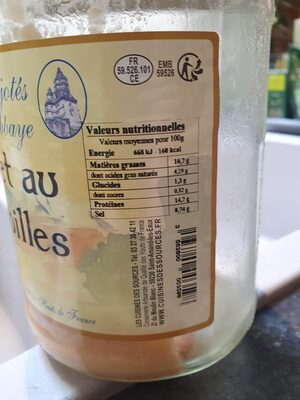
Nutrition facts
| Nutrition facts | As sold for 100 g / 100 ml | Compared to: Artisan products |
|---|---|---|
| Energy | ~ 667.9 kJ (160 kcal) | 1,225.712 kJ (293 kcal) (-46%) |
| Fat | 10.7 g | 8.957 g (+19%) |
| Saturated fat | 4.29 g | 2.889 g (+48%) |
| Carbohydrates | 1.3 g | 37.5 g (-97%) |
| Sugars | 0.82 g | 13.361 g (-94%) |
| Dietary fiber | ? | ? |
| Proteins | 14.7 g | 6.827 g (+115%) |
| Salt | 0.74 g | 0.718 g (+3%) |
| Sodium | 0.296 g | 0.288 g (+3%) |
| Fruits, vegetables and legumes | ~ 0.730552673339844 % | ? |
Nutrition facts (Detailed data)
| Nutrition facts | As sold for 100 g / 100 ml | As sold Per 100 g (packaging) | As sold Per 100 g (estimate) |
|---|---|---|---|
| Energy | ~ 667.9 kJ (160 kcal) | ? (160 kcal) | ? |
| Fat | 10.7 g | 10.7 g | ? |
| Saturated fat | 4.29 g | 4.29 g | ? |
| Carbohydrates | 1.3 g | 1.3 g | ? |
| Sugars | 0.82 g | 0.82 g | ? |
| Dietary fiber | ? | ? | ? |
| Proteins | 14.7 g | 14.7 g | ? |
| Salt | 0.74 g | 0.74 g | ? |
| Sodium | 0.296 g | 0.296 g | ? |
| Fruits, vegetables and legumes | ~ 0.730552673339844 % | ? | ~ 0.730552673339844 % |
Ingredients
Ingredients image

Ingredients list
Ingredient information
Added sugars
Allergens
Traces
Ingredients analysis
Palm oil content unknown
Contains non-vegan ingredients.
Unrecognized: fr:baies-de-genevrier
Contains non-vegetarian ingredients.
Unrecognized: fr:baies-de-genevrier
Food Processing
NOVA group
 Ultra-processed food and drink products
Elements that indicate the product is in NOVA group 4
How NOVA works
Additives
E100 - CurcuminColour
No additive description is available yet.
E14XX - Modified StarchEmulsifierStabiliserThickener
No additive description is available yet.
E410 - Locust bean gumEmulsifierStabiliserThickener
Locust bean gum (LBG, also known as carob gum, carob bean gum, carobin, E410) is a thickening agent and a gelling agent used in food technology.
E440 - PectinsEmulsifierStabiliserThickener
Pectins (E440) are natural carbohydrates, predominantly found in fruits, that act as gelling agents in the food industry, creating the desirable jelly-like texture in jams, jellies, and marmalades.
Pectins stabilize and thicken various food products, such as desserts, confectioneries, and beverages, ensuring a uniform consistency and quality.
Recognized as safe by various health authorities, pectins have been widely used without notable adverse effects when consumed in typical dietary amounts.
E451 - Triphosphates EFSA overexposure risk: highEmulsifierHumectantSequestrantStabiliserThickener
Sodium triphosphate (STP), also sodium tripolyphosphate (STPP), or tripolyphosphate (TPP),) is an inorganic compound with formula Na5P3O10. It is the sodium salt of the polyphosphate penta-anion, which is the conjugate base of triphosphoric acid. It is produced on a large scale as a component of many domestic and industrial products, especially detergents. Environmental problems associated with eutrophication are attributed to its widespread use.
E460 - CelluloseCarrierEmulsifierHumectantStabiliserThickener
CELLULOSE is an organic compound with the formula (C6H10O5)n, a polysaccharide consisting of a linear chain of several hundred to many thousands of linked D-glucose units. Cellulose is used as emulsifier, thickener and stabilizer in processed foods. Cellulose powder is, for example, used in processed cheese to prevent caking inside the package.
E471 - Mono- and diglycerides of fatty acidsEmulsifierStabiliser
Mono- and diglycerides of fatty acids (E471), are food additives commonly used as emulsifiers in various processed foods.
These compounds consist of glycerol molecules linked to one or two fatty acid chains, which help stabilize and blend water and oil-based ingredients. E471 enhances the texture and shelf life of products like margarine, baked goods, and ice cream, ensuring a smooth and consistent texture.
It is generally considered safe for consumption within established regulatory limits.
E621 - Monosodium glutamate EFSA overexposure risk: highFlavour Enhancer
Monosodium glutamate (MSG), or E621, is the sodium salt of glutamic acid, an amino acid found naturally in many foods.
It is widely used as a flavor enhancer to provide an "umami" or savory taste to a variety of processed foods, including soups, snack chips, and frozen meals.
MSG is generally recognized as safe (GRAS) by food authorities. However, some people report sensitivity to MSG, experiencing short-term symptoms like headaches and flushing, though scientific studies have not shown a consistent link.
E635 - Disodium 5'-ribonucleotide
No additive description is available yet.
Environment
Green-Score, origins bonus, and transportation impact are shown for Worldwide .
Green Score
Overall grade
 Very high environmental impact
About Green-Score
Current scope
Life cycle analysis
Average impact of the category
 Chicken, Basque style • Score: 40/100
Life-cycle reference
Overall environmental impact by stage (PEF)
The overall environmental impact figure (PEF) comes from ADEME's Agribalyse database, for the category: Chicken, Basque style. Source: ADEME Agribalyse Database.
| Stage | Impact |
|---|---|
| Agriculture | 76.1 % |
| Processing | 13.6 % |
| Packaging | 4.6 % |
| Transportation | 3.5 % |
| Distribution | 1.3 % |
| Consumption | 0.9 % |
Bonuses and maluses
Declared origins
Packaging impact
Green-Score for this product
Green-Score for this product
Final score: 25/100Final score breakdown
Carbon footprint
Carbon footprint
Climate impact by stage (CO2e)
The carbon emission figure comes from ADEME's Agribalyse database, for the category: Chicken, Basque style. Source: ADEME Agribalyse Database.
| Stage | Impact |
|---|---|
| Agriculture | 60.7 % |
| Processing | 20.5 % |
| Packaging | 10.1 % |
| Transportation | 7.4 % |
| Distribution | 0.9 % |
| Consumption | 0.4 % |
Packaging

Packaging impact
Packaging components
| Shape | Material | Recycling | Impact |
|---|---|---|---|
| LID | Glass | Unknown | Low |
| JAR | Metal | Unknown | High |
Declared packaging
Data precision
Transportation
Manufacturing locations
Declared origins
Forest footprint
Forest footprint
Ingredients linked to forest pressure
| Ingredient | Type | Percent in product | Forest footprint |
|---|---|---|---|
| Chicken Meat | Poulet Importé | 69.00 % | 1.97 |
| Chicken Meat | Poulet Importé | 0.00 % | 0.00 |
Data Source
Product data comes from Open Food Facts. Food Benchmark also adds translations, category comparisons and explanatory calculations.
The database is licensed under ODbL 1.0, individual contents under DbCL 1.0, and product photos under CC BY-SA 3.0.
Product added on January 27, 2015 at 2:32:13 PM UTC by tacite .
Last edit on March 18, 2026 at 12:52:15 AM UTC by new-nutrition-bot .
Product page also edited by date-limite-app, jacob80, kiliweb, new-nutrition-bot, oliviers, openfoodfacts-contributors, packbot, roboto-app, tacite, yuka.WEx3NUs0QlluUFFtb1AwVnh3dlIxL050eFpYd2RsS3RNTzBOSVE9PQ.