

Cône citron (S) sauce au citron et morceaux de citron x6 - 120mL
Health
Nutrition
Nutri-Score
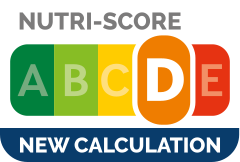 Lower nutritional quality
Nutri-Score data warning
Nutrient levels
Fat in moderate quantity (4.2%)
Saturated fat in moderate quantity (3.4%)
Sugars in high quantity (27%)
Salt in low quantity (0%)
Nutrition facts
| Nutrition facts | As sold for 100 g / 100 ml | Compared to: Sorbet cones |
|---|---|---|
| Energy | 847 kJ (205 kcal) | 864.494 kJ (205 kcal) (-2%) |
| Fat | 4.2 g | 4.983 g (-16%) |
| Saturated fat | 3.4 g | 3.861 g (-12%) |
| Carbohydrates | 39 g | 37.557 g (+4%) |
| Sugars | 27 g | 26.545 g (+2%) |
| Dietary fiber | 0.8 g | ? |
| Proteins | 1.3 g | 1.547 g (-16%) |
| Salt | 0 g | 0.072 g (-100%) |
| Sodium | 0 g | 0.029 g (-100%) |
| Fruits, vegetables and legumes | ~ 1.9 % | ? |
Nutrition facts (Detailed data)
| Nutrition facts | As sold for 100 g / 100 ml | As sold Per 100 g (packaging) | As sold Per 100 g (estimate) |
|---|---|---|---|
| Energy | 847 kJ (205 kcal) | 847 kJ (205 kcal) | ? |
| Fat | 4.2 g | 4.2 g | ? |
| Saturated fat | 3.4 g | 3.4 g | ? |
| Carbohydrates | 39 g | 39 g | ? |
| Sugars | 27 g | 27 g | ? |
| Dietary fiber | 0.8 g | 0.8 g | ? |
| Proteins | 1.3 g | 1.3 g | ? |
| Salt | 0 g | 0 g | ? |
| Sodium | 0 g | 0 g | ? |
| Fruits, vegetables and legumes | ~ 1.9 % | ? | ~ 1.9 % |
Serving size
Ingredients
Ingredients image
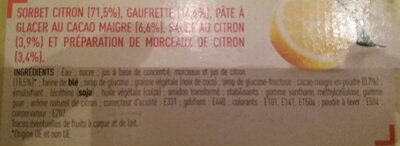
Ingredients list
Ingredient information
Added sugars
Allergens
Traces
Ingredients analysis
No ingredients containing palm oil.
Vegan status unknown
Unrecognized: fr:jus-de-citrona-base-de-concentre, fr:jusde-citron, fr:amidontransforme, fr:aromenaturel-de-citron, fr:citratesde-sodium, fr:complexes-cuivre-chlorophylles-etcuivre-chlorophyllines
Vegetarian status unknown
Unrecognized: fr:jus-de-citrona-base-de-concentre, fr:jusde-citron, fr:amidontransforme, fr:aromenaturel-de-citron, fr:citratesde-sodium, fr:complexes-cuivre-chlorophylles-etcuivre-chlorophyllines
Food Processing
NOVA group
 Ultra-processed food and drink products
Elements that indicate the product is in NOVA group 4
How NOVA works
Additives
E141 - Copper complexes of chlorophylls and chlorophyllinsColour
No additive description is available yet.
E141i - Copper complexes of chlorophyllsColour
No additive description is available yet.
E322 - LecithinsAntioxidantEmulsifier
Lecithins are natural compounds commonly used in the food industry as emulsifiers and stabilizers.
Extracted from sources like soybeans and eggs, lecithins consist of phospholipids that enhance the mixing of oil and water, ensuring smooth textures in various products like chocolates, dressings, and baked goods.
They do not present any known health risks.
E322i - LecithinAntioxidantEmulsifier
Lecithins are natural compounds commonly used in the food industry as emulsifiers and stabilizers.
Extracted from sources like soybeans and eggs, lecithins consist of phospholipids that enhance the mixing of oil and water, ensuring smooth textures in various products like chocolates, dressings, and baked goods.
They do not present any known health risks.
E412 - Guar gumEmulsifierStabiliserThickener
Guar gum (E412) is a natural food additive derived from guar beans.
This white, odorless powder is valued for its remarkable thickening and stabilizing properties, making it a common ingredient in various food products, including sauces, dressings, and ice creams.
When used in moderation, guar gum is considered safe for consumption, with no known adverse health effects.
E415 - Xanthan gumEmulsifierStabiliserThickener
Xanthan gum (E415) is a natural polysaccharide derived from fermented sugars, often used in the food industry as a thickening and stabilizing agent.
This versatile food additive enhances texture and prevents ingredient separation in a wide range of products, including salad dressings, sauces, and gluten-free baked goods.
It is considered safe for consumption even at high intake amounts.
E440 - PectinsEmulsifierStabiliserThickener
Pectins (E440) are natural carbohydrates, predominantly found in fruits, that act as gelling agents in the food industry, creating the desirable jelly-like texture in jams, jellies, and marmalades.
Pectins stabilize and thicken various food products, such as desserts, confectioneries, and beverages, ensuring a uniform consistency and quality.
Recognized as safe by various health authorities, pectins have been widely used without notable adverse effects when consumed in typical dietary amounts.
E461 - methyl celluloseEmulsifierStabiliserThickener
METHYL CELLULOSE is a chemical compound derived from cellulose. Methyl cellulose is added to food products, to generate their characteristic thick consistency, for example ice cream or croquette.
Environment
Green-Score, origins bonus, and transportation impact are shown for Worldwide .
Green Score
Overall grade
 Low environmental impact
About Green-Score
Current scope
Life cycle analysis
Average impact of the category
 Frosted lemon or orange (sorbet) • Score: 76/100
Life-cycle reference
Overall environmental impact by stage (PEF)
The overall environmental impact figure (PEF) comes from ADEME's Agribalyse database, for the category: Frosted lemon or orange (sorbet). Source: ADEME Agribalyse Database.
| Stage | Impact |
|---|---|
| Agriculture | 38.3 % |
| Processing | 12.6 % |
| Packaging | 34.3 % |
| Transportation | 5.8 % |
| Distribution | 5.6 % |
| Consumption | 3.3 % |
Bonuses and maluses
Declared origins
Packaging impact
Green-Score for this product
Green-Score for this product
Final score: 70/100Final score breakdown
Carbon footprint
Carbon footprint
Climate impact by stage (CO2e)
The carbon emission figure comes from ADEME's Agribalyse database, for the category: Frosted lemon or orange (sorbet). Source: ADEME Agribalyse Database.
| Stage | Impact |
|---|---|
| Agriculture | 47.7 % |
| Processing | 8.7 % |
| Packaging | 28.8 % |
| Transportation | 10.6 % |
| Distribution | 3.0 % |
| Consumption | 1.2 % |
Packaging
Packaging impact
Packaging materials
| Material | % | Packaging weight | Packaging weight per 100 g of product |
|---|---|---|---|
| Paper or cardboard | 100 % | 72.38 g | 10.05 g |
| Total | 100 % | 72.38 g | 10.05 g |
Packaging components
| Shape | Material | Recycling | Impact |
|---|---|---|---|
| 6 Film | Other Paper | Unknown | Low |
| 6 Seal | NON Corrugated Cardboard | Unknown | Low |
| 1 Sleeve | NON Corrugated Cardboard | Unknown | Low |
Declared packaging
Transportation
Declared origins
Forest footprint
Forest footprint
Deforestation risk details
Data Source
Product data comes from Open Food Facts. Food Benchmark also adds translations, category comparisons and explanatory calculations.
The database is licensed under ODbL 1.0, individual contents under DbCL 1.0, and product photos under CC BY-SA 3.0.
Product added on April 21, 2018 at 8:00:44 PM UTC by kiliweb .
Last edit on March 17, 2026 at 9:51:08 AM UTC by new-nutrition-bot .
Product page also edited by autorotate-bot, jeremy64, kiliweb, new-nutrition-bot, openfoodfacts-contributors, org-les-mousquetaires, packbot, roboto-app, sebleouf, yuka.JIxZH9-OA-gbNcrowKgm2mSXGPzwB_NTA1c_og, yuka.SFl3UElxQUFsdnNVbnN3ZSt3N0k1Zmd1bUx1TVUzMjRDc1pKSUE9PQ.
Source List
- les-mousquetaires