

Shrimp Flavoured Slice
Health
Nutrition
Nutri-Score
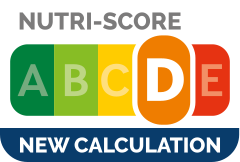 Lower nutritional quality
Nutrient levels
Fat in low quantity (0.5%)
Saturated fat in low quantity (0.2%)
Sugars in low quantity (2.9%)
Salt in high quantity (2.6%)
Nutrition facts
| Nutrition facts | As sold for 100 g / 100 ml | Compared to: Prawn crackers |
|---|---|---|
| Energy | 1469 kcal (351 kcal) | 2,091.585 kJ (504 kcal) |
| Fat | 0.5 g | 25.963 g (-98%) |
| Saturated fat | 0.2 g | 2.664 g (-92%) |
| Carbohydrates | 84.5 g | 63.522 g (+33%) |
| Sugars | 2.9 g | 7.308 g (-60%) |
| Dietary fiber | ? | ? |
| Proteins | 0.7 g | 2.119 g (-67%) |
| Salt | 2.6 g | 1.996 g (+30%) |
| Sodium | 1.04 g | 0.795 g (+31%) |
| Fruits, vegetables and legumes | ? | ? |
Nutrition facts (Detailed data)
| Nutrition facts | As sold for 100 g / 100 ml | As sold Per serving (legacy) |
|---|---|---|
| Energy | 1469 kcal (351 kcal) | ? |
| Fat | 0.5 g | ? |
| Saturated fat | 0.2 g | ? |
| Carbohydrates | 84.5 g | ? |
| Sugars | 2.9 g | ? |
| Dietary fiber | ? | ? |
| Proteins | 0.7 g | ? |
| Salt | 2.6 g | ? |
| Sodium | 1.04 g | ? |
| Fruits, vegetables and legumes | ? | ? |
Ingredients
Ingredients list
Ingredient information
Added sugars
Allergens
Ingredients analysis
Palm oil content unknown
Unrecognized: fr:produits-crustaceens, fr:brillant-bleu-fcf
Contains non-vegan ingredients.
Unrecognized: fr:produits-crustaceens, fr:brillant-bleu-fcf
Contains non-vegetarian ingredients.
Unrecognized: fr:produits-crustaceens, fr:brillant-bleu-fcf
Food Processing
NOVA group
 Ultra-processed food and drink products
Elements that indicate the product is in NOVA group 4
How NOVA works
Additives
E102 - TartrazineColour
Tartrazine (E102) is a synthetic lemon-yellow azo dye used as a food coloring.
It is found in a wide range of products such as soft drinks, desserts, candies, and snack foods to give them a vibrant yellow appearance.
While approved by many regulatory agencies, tartrazine has been linked to allergic reactions, such as hives, in a small portion of the population. Some studies have also suggested a link to increased hyperactivity in children, particularly when consumed with other additives like benzoates.
E120 - CochinealColour
Cochineal extract or carmine (E120) is a natural red colorant derived from the dried bodies of the female cochineal insect.
It is widely used to impart a pink, red, or purple hue to various food and beverage products, including yogurts, ice creams, confectionery, and fruit juices.
Although it is a natural additive, E120 is known to cause severe allergic reactions, including anaphylaxis, in some individuals. It is also not suitable for vegetarians or vegans due to its insect origin.
E133 - Brilliant blue FCF EFSA overexposure risk: moderateColour
BRILLIANT BLUE FCF (Blue 1) is an organic compound classified as a blue triarylmethane dye, reflecting its chemical structure. Known under various commercial names, it is a colorant for foods and other substances.
E621 - Monosodium glutamate EFSA overexposure risk: highFlavour Enhancer
Monosodium glutamate (MSG), or E621, is the sodium salt of glutamic acid, an amino acid found naturally in many foods.
It is widely used as a flavor enhancer to provide an "umami" or savory taste to a variety of processed foods, including soups, snack chips, and frozen meals.
MSG is generally recognized as safe (GRAS) by food authorities. However, some people report sensitivity to MSG, experiencing short-term symptoms like headaches and flushing, though scientific studies have not shown a consistent link.
Environment
Green-Score, origins bonus, and transportation impact are shown for Worldwide .
Green Score
Overall grade
 Moderate environmental impact
About Green-Score
Current scope
Life cycle analysis
Average impact of the category
 Prawn crackers • Score: 69/100
Life-cycle reference
Overall environmental impact by stage (PEF)
The overall environmental impact figure (PEF) comes from ADEME's Agribalyse database, for the category: Prawn crackers. Source: ADEME Agribalyse Database.
| Stage | Impact |
|---|---|
| Agriculture | 66.5 % |
| Processing | 14.7 % |
| Packaging | 6.7 % |
| Transportation | 10.7 % |
| Distribution | 1.4 % |
| Consumption | 0.0 % |
Bonuses and maluses
Declared origins
Packaging impact
Green-Score for this product
Green-Score for this product
Final score: 53/100Final score breakdown
Carbon footprint
Carbon footprint
Climate impact by stage (CO2e)
The carbon emission figure comes from ADEME's Agribalyse database, for the category: Prawn crackers. Source: ADEME Agribalyse Database.
| Stage | Impact |
|---|---|
| Agriculture | 74.9 % |
| Processing | 8.6 % |
| Packaging | 6.7 % |
| Transportation | 9.4 % |
| Distribution | 0.5 % |
| Consumption | 0.0 % |
Packaging
Packaging impact
Packaging components
| Shape | Material | Recycling | Impact |
|---|---|---|---|
| Unknown | Plastic | Unknown | High |
| Unknown | Cardboard | Unknown | Low |
Declared packaging
Data precision
Transportation
Declared origins
Forest footprint
Forest footprint
Deforestation risk details
Data Source
Product data comes from Open Food Facts. Food Benchmark also adds translations, category comparisons and explanatory calculations.
The database is licensed under ODbL 1.0, individual contents under DbCL 1.0, and product photos under CC BY-SA 3.0.
Product added on September 25, 2018 at 3:57:49 AM UTC by kiliweb .
Last edit on February 11, 2022 at 6:07:38 AM UTC by packbot .
Product page also edited by openfoodfacts-contributors, beniben, packbot, yuka.VExzYkNJTXZsT2NBbU1kZzFUR0w5T2hwd1p5UUFGeTRlc1E5SUE9PQ, kiliweb.