

Cherry Blossom
Health
Nutrition
Nutri-Score
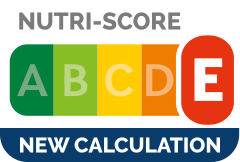 Lower nutritional quality
Nutri-Score data warning
Nutrient levels
Fat in high quantity (22.2%)
Saturated fat in high quantity (15.6%)
Sugars in high quantity (51.1%)
Salt in moderate quantity (0.306%)
Nutrition label
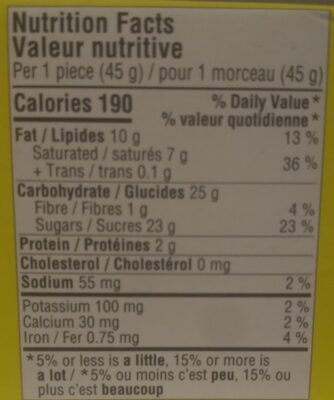
Nutrition facts
| Nutrition facts | As sold for 100 g / 100 ml | Compared to: Bonbons |
|---|---|---|
| Energy | ~ 1860 kJ (422 kcal) | 2,198.823 kJ (529 kcal) (-15%) |
| Fat | 22.2222222222222 g | 32.172 g (-31%) |
| Saturated fat | 15.5555555555556 g | 17.275 g (-10%) |
| Trans fat | 0.222222222222222 g | 0.063 g (+253%) |
| Cholesterol | 0 g | 9.17 mg (-100%) |
| Carbohydrates | 55.5555555555556 g | 52.038 g (+7%) |
| Sugars | 51.1111111111111 g | 46.629 g (+10%) |
| Dietary fiber | 2.22222222222222 g | ? |
| Proteins | 4.44444444444444 g | 6.017 g (-26%) |
| Salt | 0.305555555555556 g | 0.152 g (+101%) |
| Sodium | 0.122222222222222 g | 0.061 g (+100%) |
| Potassium | 0.222222222222222 g | 290.583 mg (-24%) |
| Calcium | 0.0666666666666667 g | 104.433 mg (-36%) |
| Iron | 0.00166666666666667 g | 1.416 mg (+18%) |
| Fruits, vegetables and legumes | ~ 0.375 % | ? |
Nutrition facts (Detailed data)
| Nutrition facts | As sold for 100 g / 100 ml | As sold Per serving (45 g) (packaging) | As sold Per 100 g (estimate) |
|---|---|---|---|
| Energy | ~ 1860 kJ (422 kcal) | ? (190 kcal) | ? |
| Fat | 22.2222222222222 g | 10 g | ? |
| Saturated fat | 15.5555555555556 g | 7 g | ? |
| Trans fat | 0.222222222222222 g | 0.1 g | ? |
| Cholesterol | 0 g | 0 g | ? |
| Carbohydrates | 55.5555555555556 g | 25 g | ? |
| Sugars | 51.1111111111111 g | 23 g | ? |
| Dietary fiber | 2.22222222222222 g | 1 g | ? |
| Proteins | 4.44444444444444 g | 2 g | ? |
| Salt | 0.305555555555556 g | 0.1375 g | ? |
| Sodium | 0.122222222222222 g | 0.055 g | ? |
| Potassium | 0.222222222222222 g | 0.1 g | ? |
| Calcium | 0.0666666666666667 g | 0.03 g | ? |
| Iron | 0.00166666666666667 g | 0.00075 g | ? |
| Fruits, vegetables and legumes | ~ 0.375 % | ? | ~ 0.375 % |
Serving size
Ingredients
Ingredients image
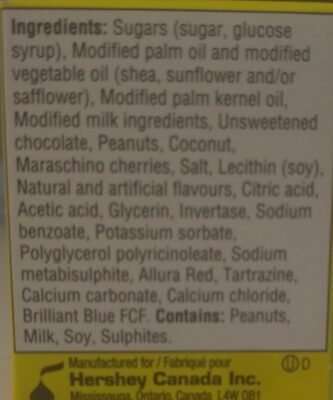
Ingredients list
Ingredient information
Added sugars
Allergens
Ingredients analysis
Contains ingredients containing palm oil.
Contains non-vegan ingredients.
Unrecognized: en:maraschino-cherries
Vegetarian status unknown
Unrecognized: en:maraschino-cherries
Food Processing
NOVA group
 Ultra-processed food and drink products
Elements that indicate the product is in NOVA group 4
How NOVA works
Additives
E102 - TartrazineColour
Tartrazine (E102) is a synthetic lemon-yellow azo dye used as a food coloring.
It is found in a wide range of products such as soft drinks, desserts, candies, and snack foods to give them a vibrant yellow appearance.
While approved by many regulatory agencies, tartrazine has been linked to allergic reactions, such as hives, in a small portion of the population. Some studies have also suggested a link to increased hyperactivity in children, particularly when consumed with other additives like benzoates.
E1103 - InvertaseStabiliser
Invertase is an enzyme that catalyzes the hydrolysis (breakdown) of sucrose (table sugar) into fructose and glucose. Alternative names for invertase include EC 3.2.1.26, saccharase, glucosucrase, beta-h-fructosidase, beta-fructosidase, invertin, sucrase, maxinvert L 1000, fructosylinvertase, alkaline invertase, acid invertase, and the systematic name: beta-fructofuranosidase. The resulting mixture of fructose and glucose is called inverted sugar syrup. Related to invertases are sucrases. Invertases and sucrases hydrolyze sucrose to give the same mixture of glucose and fructose. Invertases cleave the O-C(fructose) bond, whereas the sucrases cleave the O-C(glucose) bond.For industrial use, invertase is usually derived from yeast. It is also synthesized by bees, which use it to make honey from nectar. Optimal temperature at which the rate of reaction is at its greatest is 60 °C and an optimum pH of 4.5. Typically, sugar is inverted with sulfuric acid.
E129 - Allura red EFSA overexposure risk: noColour
Allura Red AC is a red azo dye that goes by several names, including FD&C Red 40. It is used as a food dye and has the E number E129. It is usually supplied as its red sodium salt, but can also be used as the calcium and potassium salts. These salts are soluble in water. In solution, its maximum absorbance lies at about 504 nm.
E133 - Brilliant blue FCF EFSA overexposure risk: moderateColour
BRILLIANT BLUE FCF (Blue 1) is an organic compound classified as a blue triarylmethane dye, reflecting its chemical structure. Known under various commercial names, it is a colorant for foods and other substances.
E202 - Potassium sorbate EFSA overexposure risk: highPreservative
Potassium sorbate (E202) is a synthetic food preservative commonly used to extend the shelf life of various food products.
It works by inhibiting the growth of molds, yeast, and some bacteria, preventing spoilage. When added to foods, it helps maintain their freshness and quality.
Some studies have shown that when combined with nitrites, potassium sorbate have genotoxic activity in vitro. However, potassium sorbate is generally recognized as safe (GRAS) by regulatory authorities.
E211 - Sodium benzoate EFSA overexposure risk: highPreservative
SODIUM BENZOATE is a substance which has the chemical formula NaC7H5O2
E223 - Sodium metabisulphite EFSA overexposure risk: highAntioxidantPreservative
SODIUM METABISULFITE or sodium pyrosulfite (IUPAC spelling; Br. E. sodium metabisulphite or sodium pyrosulphite) is an inorganic compound of chemical formula Na2S2O5.
E260 - Acetic acidPreservative
ACETIC ACID, systematically named ethanoic acid, is a colourless liquid organic compound with the chemical formula CH3COOH (also written as CH3CO2H or C2H4O2).
E322 - LecithinsAntioxidantEmulsifier
Lecithins are natural compounds commonly used in the food industry as emulsifiers and stabilizers.
Extracted from sources like soybeans and eggs, lecithins consist of phospholipids that enhance the mixing of oil and water, ensuring smooth textures in various products like chocolates, dressings, and baked goods.
They do not present any known health risks.
E322i - LecithinAntioxidantEmulsifier
Lecithins are natural compounds commonly used in the food industry as emulsifiers and stabilizers.
Extracted from sources like soybeans and eggs, lecithins consist of phospholipids that enhance the mixing of oil and water, ensuring smooth textures in various products like chocolates, dressings, and baked goods.
They do not present any known health risks.
E330 - Citric acidAntioxidantSequestrant
Citric acid is a natural organic acid found in citrus fruits such as lemons, oranges, and limes.
It is widely used in the food industry as a flavor enhancer, acidulant, and preservative due to its tart and refreshing taste.
Citric acid is safe for consumption when used in moderation and is considered a generally recognized as safe (GRAS) food additive by regulatory agencies worldwide.
E422 - GlycerolHumectantThickener
Glycerol (; also called glycerine or glycerin; see spelling differences) is a simple polyol compound. It is a colorless, odorless, viscous liquid that is sweet-tasting and non-toxic. The glycerol backbone is found in all lipids known as triglycerides. It is widely used in the food industry as a sweetener and humectant and in pharmaceutical formulations. Glycerol has three hydroxyl groups that are responsible for its solubility in water and its hygroscopic nature.
E476 - Polyglycerol polyricinoleateEmulsifier
Polyglycerol polyricinoleate (PGPR), E476, is an emulsifier made from glycerol and fatty acids (usually from castor bean, but also from soybean oil). In chocolate, compound chocolate and similar coatings, PGPR is mainly used with another substance like lecithin to reduce viscosity. It is used at low levels (below 0.5%), and works by decreasing the friction between the solid particles (e.g. cacao, sugar, milk) in molten chocolate, reducing the yield stress so that it flows more easily, approaching the behaviour of a Newtonian fluid. It can also be used as an emulsifier in spreads and in salad dressings, or to improve the texture of baked goods. It is made up of a short chain of glycerol molecules connected by ether bonds, with ricinoleic acid side chains connected by ester bonds. PGPR is a yellowish, viscous liquid, and is strongly lipophilic: it is soluble in fats and oils and insoluble in water and ethanol.
Environment
Green-Score, origins bonus, and transportation impact are shown for Worldwide .
Green Score
Overall grade
 Unknown environmental impact
About Green-Score
Current scope
Green-Score availability
Bonuses and maluses
Declared origins
Threatened species risk
Packaging impact
Packaging
Packaging impact
Data precision
Transportation
Declared origins
Forest footprint
Forest footprint
Deforestation risk details
Data Source
Product data comes from Open Food Facts. Food Benchmark also adds translations, category comparisons and explanatory calculations.
The database is licensed under ODbL 1.0, individual contents under DbCL 1.0, and product photos under CC BY-SA 3.0.
Product added on January 8, 2018 at 6:25:34 PM UTC by kiliweb .
Last edit on March 17, 2026 at 11:05:15 AM UTC by new-nutrition-bot .
Product page also edited by anonymous-s7co2zv64u, foodless, kiliweb, moon-rabbit, new-nutrition-bot, openfoodfacts-contributors, yuka.BptLIOOKGvU7TcGM-JIM0zziN8u-LqNSRmRSog, yuka.IKB_BtmmHN45IsD2y7wExBKRKenQE_pVKCQPoQ, yuka.WWJJc1RLTTlxUDhLeGZJdXBCLzgyOUZsM1lHa1dseXRHODBJSVE9PQ, yuka.sY2b0xO6T85zoF3NwEKvlm1hedfUhhX9PkbStECrzfKXD4DoYeN4_IqiFas.