
Two-Layer Cake With Balloons And Candy Sequins
Labels
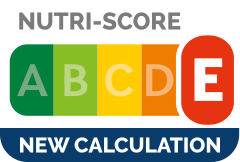 Bad nutritional quality
 Ultra-processed food and drink products
 Green-Score not computed
Health
Nutrition
Label
Bad nutritional qualityNutrient levels
Fat in moderate quantity (18.5%)
Saturated fat in high quantity (6.17%)
Sugars in high quantity (43.2%)
Salt in moderate quantity (0.68%)
Nutrition facts
| Nutrition facts | As sold for 100 g / 100 ml |
|---|---|
| Energy | 1,653 kcal (395 kcal) |
| FAT | 18.52 g |
| Saturated fat | 6.17 g |
| Trans fat | 0 g |
| Cholesterol | 0.03 mg |
| Carbohydrates | 54.32 g |
| Sugars | 43.21 g |
| Dietary fiber | 0 g |
| Proteins | 2.47 g |
| Salt | 0.68 mg |
| Sodium | 0.27 mg |
| Vitamins | |
| Vitamin A | 0 IU |
| Vitamin C | 0 mg |
| Minerals | |
| Calcium | 0.03 mg |
| Iron | 0 mg |
| Fruits, vegetables and legumes | ? |
Nutrition facts (Detailed data)
| Nutrition facts | As sold for 100 g / 100 ml | As sold Per serving (legacy) |
|---|---|---|
| Energy | 1,653 kcal (395 kcal) | 1,340 kcal (320 kcal) |
| FAT | 18.52 g | 15 g |
| Saturated fat | 6.17 g | 5 g |
| Trans fat | 0 g | 0 g |
| Cholesterol | 0.03 mg | 0.03 mg |
| Carbohydrates | 54.32 g | 44 g |
| Sugars | 43.21 g | 35 g |
| Dietary fiber | 0 g | 0 g |
| Proteins | 2.47 g | 2 g |
| Salt | 0.68 mg | 0.55 mg |
| Sodium | 0.27 mg | 0.22 mg |
| Vitamins | ||
| Vitamin A | 0 IU | 0 IU |
| Vitamin C | 0 mg | 0 mg |
| Minerals | ||
| Calcium | 0.03 mg | 0.02 mg |
| Iron | 0 mg | 0 mg |
| Fruits, vegetables and legumes | ? | ? |
Serving size
Estimated Activity Time
Approximate time needed to burn the energy in 100 g / 100 ml: 6,916 kJ. Reference adult weight: 70 kg. Energy density: High.
Ingredients
Ingredients list
Ingredient information
Allergens
Ingredients analysis
Contains ingredients containing palm oil.
Contains non-vegan ingredients.
Unrecognized: en:iron, en:invert-sugar, en:contains-2-and-less-of-arabic-gum, en:confectioner-s-glaze, en:medium-chain-triglycerides, en:propylene-glycol-mono-and-diesters-of-fatty-acids, en:red-lake-40
Vegetarian status unknown
Unrecognized: en:iron, en:invert-sugar, en:contains-2-and-less-of-arabic-gum, en:confectioner-s-glaze, en:medium-chain-triglycerides, en:propylene-glycol-mono-and-diesters-of-fatty-acids, en:red-lake-40
Food Processing
NOVA group
Ultra-processed food and drink productsElements that indicate the product is in NOVA group 4
How NOVA works
Additives
E102 - TartrazineColour
Tartrazine (E102) is a synthetic lemon-yellow azo dye used as a food coloring.
It is found in a wide range of products such as soft drinks, desserts, candies, and snack foods to give them a vibrant yellow appearance.
While approved by many regulatory agencies, tartrazine has been linked to allergic reactions, such as hives, in a small portion of the population. Some studies have also suggested a link to increased hyperactivity in children, particularly when consumed with other additives like benzoates.
E110 - Sunset yellow FCFColour
Sunset Yellow FCF (also known as Orange Yellow S, or C.I. 15985) is a petroleum-derived orange azo dye with a pH dependent maximum absorption at about 480 nm at pH 1 and 443 nm at pH 13 with a shoulder at 500 nm. When added to foods sold in the US it is known as FD&C Yellow 6; when sold in Europe, it is denoted by E Number E110.
E129 - Allura redColour
Allura Red AC is a red azo dye that goes by several names, including FD&C Red 40. It is used as a food dye and has the E number E129. It is usually supplied as its red sodium salt, but can also be used as the calcium and potassium salts. These salts are soluble in water. In solution, its maximum absorbance lies at about 504 nm.
E132 - IndigotineColour
Indigo carmine, or 5,5′-indigodisulfonic acid sodium salt, is an organic salt derived from indigo by sulfonation, which renders the compound soluble in water. It is approved for use as a food colorant in the U.S and E.U., It has the E number E132. It is also a pH indicator.
E133 - Brilliant blue FCFColour
BRILLIANT BLUE FCF (Blue 1) is an organic compound classified as a blue triarylmethane dye, reflecting its chemical structure. Known under various commercial names, it is a colorant for foods and other substances.
E200 - Sorbic acidPreservative
SORBIC ACID, or 2,4-hexadienoic acid, is a natural organic compound used as a food preservative. It has the chemical formula CH3(CH)4CO2H.
E322 - LecithinsAntioxidantEmulsifier
Lecithins are natural compounds commonly used in the food industry as emulsifiers and stabilizers.
Extracted from sources like soybeans and eggs, lecithins consist of phospholipids that enhance the mixing of oil and water, ensuring smooth textures in various products like chocolates, dressings, and baked goods.
They do not present any known health risks.
E322i - LecithinAntioxidantEmulsifier
Lecithins are natural compounds commonly used in the food industry as emulsifiers and stabilizers.
Extracted from sources like soybeans and eggs, lecithins consist of phospholipids that enhance the mixing of oil and water, ensuring smooth textures in various products like chocolates, dressings, and baked goods.
They do not present any known health risks.
E330 - Citric acidAntioxidantSequestrant
Citric acid is a natural organic acid found in citrus fruits such as lemons, oranges, and limes.
It is widely used in the food industry as a flavor enhancer, acidulant, and preservative due to its tart and refreshing taste.
Citric acid is safe for consumption when used in moderation and is considered a generally recognized as safe (GRAS) food additive by regulatory agencies worldwide.
E334 - L(+)-tartaric acidAntioxidantSequestrant
TARTARIC ACID is a white, crystalline organic acid that occurs naturally in many fruits, most notably in grapes, but also in bananas, tamarinds, and citrus
E341 - Calcium phosphatesEmulsifierHumectantSequestrantStabiliserThickener
Calcium phosphate is a family of materials and minerals containing calcium ions (Ca2+) together with inorganic phosphate anions. Some so-called calcium phosphates contain oxide and hydroxide as well. They are white solids of nutritious value.
E341i - Monocalcium phosphateEmulsifierHumectantSequestrantStabiliserThickener
No additive description is available yet.
E407 - CarrageenanCarrierEmulsifierHumectantStabiliserThickener
Carrageenan (E407), derived from red seaweed, is widely employed in the food industry as a gelling, thickening, and stabilizing agent, notably in dairy and meat products.
It can exist in various forms, each imparting distinct textural properties to food.
However, its degraded form, often referred to as poligeenan, has raised health concerns due to its potential inflammatory effects and its classification as a possible human carcinogen (Group 2B) by the International Agency for Research on Cancer (IARC).
Nevertheless, food-grade carrageenan has been deemed safe by various regulatory bodies when consumed in amounts typically found in food.
E412 - Guar gumEmulsifierStabiliserThickener
Guar gum (E412) is a natural food additive derived from guar beans.
This white, odorless powder is valued for its remarkable thickening and stabilizing properties, making it a common ingredient in various food products, including sauces, dressings, and ice creams.
When used in moderation, guar gum is considered safe for consumption, with no known adverse health effects.
E413 - TragacanthEmulsifierStabiliserThickener
Tragacanth is a natural gum obtained from the dried sap of several species of Middle Eastern legumes of the genus Astragalus, including A. adscendens, A. gummifer, A. brachycalyx, and A. tragacantha. Some of these species are known collectively under the common names "goat's thorn" and "locoweed". The gum is sometimes called Shiraz gum, shiraz, gum elect or gum dragon. The name derives from the Greek words tragos (meaning "goat") and akantha ("thorn"). Iran is the biggest producer of this gum. Gum tragacanth is a viscous, odorless, tasteless, water-soluble mixture of polysaccharides obtained from sap that is drained from the root of the plant and dried. The gum seeps from the plant in twisted ribbons or flakes that can be powdered. It absorbs water to become a gel, which can be stirred into a paste. The major fractions are known as tragacanthin, highly water soluble as a mucilaginous colloid, and the chemically related bassorin, which is far less soluble but swells in water to form a gel. The gum is used in vegetable-tanned leatherworking as an edge slicking and burnishing compound, and is occasionally used as a stiffener in textiles. The gum has been used historically as a herbal remedy for such conditions as cough and diarrhea. As a mucilage or paste, it has been used as a topical treatment for burns. It is used in pharmaceuticals and foods as an emulsifier, thickener, stabilizer, and texturant additive (E number E413). It is the traditional binder used in the making of artists' pastels, as it does not adhere to itself the same way other gums (such as gum arabic) do when dry. Gum tragacanth is also used to make a paste used in floral sugarcraft to create lifelike flowers on wires used as decorations for cakes, which air-dries brittle and can take colorings. It enables users to get a very fine, delicate finish to their work. It has traditionally been used as an adhesive in the cigar-rolling process used to secure the cap or "flag" leaf to the finished cigar body.Gum tragacanth is less common in products than other, usually cheaper, gums, such as gum arabic or guar gum. Different gums tend to be interchangeable across many uses, and production of tragacanth is far outpaced by these for reasons of economy, trade, agriculture and history, while tragacanth is mostly produced in traditional locations. However, gums are used in varied circumstances and there are many situations where tragacanth is considered superior. Common substitutions are methyl cellulose, sometimes marketed as "substitute gum tragacanth" in the food industry, and gum karaya. Gum karaya, also called "Indian tragacanth" or simply "tragacanth", might be fully or partially substituted for what appears to be genuine tragacanth. Gum tragacanth is also used in incense-making as a binder to hold all the powdered herbs together. Its water solubility is ideal for ease of working and an even spread, and it is one of the stronger gums for holding particles in suspension. Only half as much is needed, compared to gum arabic or something similar.In Saudi Arabia, a mixture of hydrated Tragacanth and ground dried Ziziphus spina-christi is used as a natural hair shampoo that is believed to promote hair growth.
E415 - Xanthan gumEmulsifierStabiliserThickener
Xanthan gum (E415) is a natural polysaccharide derived from fermented sugars, often used in the food industry as a thickening and stabilizing agent.
This versatile food additive enhances texture and prevents ingredient separation in a wide range of products, including salad dressings, sauces, and gluten-free baked goods.
It is considered safe for consumption even at high intake amounts.
E420 - SorbitolHumectantSequestrantStabiliserSweetenerThickener
Sorbitol (), less commonly known as glucitol (), is a sugar alcohol with a sweet taste which the human body metabolizes slowly. It can be obtained by reduction of glucose, which changes the aldehyde group to a hydroxyl group. Most sorbitol is made from corn syrup, but it is also found in nature, for example in apples, pears, peaches, and prunes. It is converted to fructose by sorbitol-6-phosphate 2-dehydrogenase. Sorbitol is an isomer of mannitol, another sugar alcohol; the two differ only in the orientation of the hydroxyl group on carbon 2. While similar, the two sugar alcohols have very different sources in nature, melting points, and uses.
E422 - GlycerolHumectantThickener
Glycerol (; also called glycerine or glycerin; see spelling differences) is a simple polyol compound. It is a colorless, odorless, viscous liquid that is sweet-tasting and non-toxic. The glycerol backbone is found in all lipids known as triglycerides. It is widely used in the food industry as a sweetener and humectant and in pharmaceutical formulations. Glycerol has three hydroxyl groups that are responsible for its solubility in water and its hygroscopic nature.
E433 - Polyoxyethylene sorbitan monooleateEmulsifierStabiliser
Polysorbate 80 is a nonionic surfactant and emulsifier often used in foods and cosmetics. This synthetic compound is a viscous, water-soluble yellow liquid.
E435 - Polyoxyethylene sorbitan monostearateEmulsifierStabiliser
No additive description is available yet.
E450 - DiphosphatesEmulsifierHumectantSequestrantStabiliserThickener
Diphosphates (E450) are food additives often utilized to modify the texture of products, acting as leavening agents in baking and preventing the coagulation of canned food.
These salts can stabilize whipped cream and are also found in powdered products to maintain their flow properties. They are commonly present in baked goods, processed meats, and soft drinks.
Derived from phosphoric acid, they're part of our daily phosphate intake, which often surpasses recommended levels due to the prevalence of phosphates in processed foods and drinks.
Excessive phosphate consumption is linked to health issues, such as impaired kidney function and weakened bone health. Though diphosphates are generally regarded as safe when consumed within established acceptable daily intakes, it's imperative to monitor overall phosphate consumption to maintain optimal health.
E450i - Disodium diphosphateEmulsifierHumectantSequestrantStabiliserThickener
No additive description is available yet.
E466 - Sodium carboxy methyl celluloseEmulsifierHumectantStabiliserThickener
Carboxymethyl cellulose (CMC) or cellulose gum or tylose powder is a cellulose derivative with carboxymethyl groups (-CH2-COOH) bound to some of the hydroxyl groups of the glucopyranose monomers that make up the cellulose backbone. It is often used as its sodium salt, sodium carboxymethyl cellulose.
E471 - Mono- and diglycerides of fatty acidsEmulsifierStabiliser
Mono- and diglycerides of fatty acids (E471), are food additives commonly used as emulsifiers in various processed foods.
These compounds consist of glycerol molecules linked to one or two fatty acid chains, which help stabilize and blend water and oil-based ingredients. E471 enhances the texture and shelf life of products like margarine, baked goods, and ice cream, ensuring a smooth and consistent texture.
It is generally considered safe for consumption within established regulatory limits.
E481 - Sodium stearoyl-2-lactylateEmulsifierStabiliser
Sodium stearoyl-2-lactylate (sodium stearoyl lactylate or SSL) is a versatile, FDA approved food additive used to improve the mix tolerance and volume of processed foods. It is one type of a commercially available lactylate. SSL is non-toxic, biodegradable, and typically manufactured using biorenewable feedstocks. Because SSL is a safe and highly effective food additive, it is used in a wide variety of products ranging from baked goods and desserts to pet foods.As described by the Food Chemicals Codex 7th edition, SSL is a cream-colored powder or brittle solid. SSL is currently manufactured by the esterification of stearic acid with lactic acid and partially neutralized with either food-grade soda ash (sodium carbonate) or caustic soda (concentrated sodium hydroxide). Commercial grade SSL is a mixture of sodium salts of stearoyl lactylic acids and minor proportions of other sodium salts of related acids. The HLB for SSL is 10-12. SSL is slightly hygroscopic, soluble in ethanol and in hot oil or fat, and dispersible in warm water. These properties are the reason that SSL is an excellent emulsifier for fat-in-water emulsions and can also function as a humectant.
E500 - Sodium carbonatesStabiliserThickener
Sodium carbonates (E500) are compounds commonly used in food preparation as leavening agents, helping baked goods rise by releasing carbon dioxide when they interact with acids.
Often found in baking soda, they regulate the pH of food, preventing it from becoming too acidic or too alkaline. In the culinary world, sodium carbonates can also enhance the texture and structure of foods, such as noodles, by modifying the gluten network.
Generally recognized as safe, sodium carbonates are non-toxic when consumed in typical amounts found in food.
E500ii - Sodium hydrogen carbonateStabiliserThickener
Sodium hydrogen carbonate, also known as E500ii, is a food additive commonly used as a leavening agent.
When added to recipes, it releases carbon dioxide gas upon exposure to heat or acids, causing dough to rise and resulting in a light, fluffy texture in baked goods.
It is generally recognized as safe (GRAS) by regulatory authorities when used in appropriate quantities and poses no significant health risks when consumed in typical food applications.
E541 - Sodium aluminium phosphateEmulsifierStabiliserThickener
Sodium aluminium phosphate (SAlP) describes the inorganic compounds consisting of sodium salts of aluminium phosphates. The most common SAlP has the formulas NaH14Al3(PO4)8·4H2O and Na3H15Al2(PO4)8. These materials are prepared by combining alumina, phosphoric acid, and sodium hydroxide.In addition to the usual hydrate, an anhydrous SAlP is also known, Na3H15Al2(PO4)8 (CAS#10279-59-1), referred to as 8:2:3, reflecting the ratio of phosphate to aluminium to sodium. Additionally an SAlP of ill-defined stoichiometry is used (NaxAly(PO4)z (CAS# 7785-88-8).The acidic sodium aluminium phosphates are used as acids for baking powders for the chemical leavening of baked goods. Upon heating, SAlP combines with the baking soda to give carbon dioxide. Most of its action occurs at baking temperatures, rather than when the dough or batter is mixed at room temperature. SAlPs are advantageous because they impart a neutral flavor. As a food additive, it has the E number E541. Basic sodium aluminium phosphates are also known, e.g., Na15Al3(PO4)8. These species are useful in cheese making.
E570 - Fatty acids
In chemistry, particularly in biochemistry, a fatty acid is a carboxylic acid with a long aliphatic chain, which is either saturated or unsaturated. Most naturally occurring fatty acids have an unbranched chain of an even number of carbon atoms, from 4 to 28. Fatty acids are usually not found per se in organisms, but instead as three main classes of esters: triglycerides, phospholipids, and cholesterol esters. In any of these forms, fatty acids are both important dietary sources of fuel for animals and they are important structural components for cells.
Environment
Green-Score, origins bonus, and transportation impact are shown for Worldwide .
Green Score
Overall grade
Unknown environmental impactAbout Green-Score
Current scope
Green-Score availability
Bonuses and maluses
Declared origins
Threatened species risk
Packaging impact
Packaging
Packaging impact
Data precision
Transportation
Declared origins
Forest footprint
Forest footprint
Ingredients linked to forest pressure
| Ingredient | Type | Percent in product | Forest footprint |
|---|---|---|---|
| EGG | Oeufs Importés | 6.87 % | 0.01 |
| EGG White | Oeufs Importés | 0.43 % | 0.00 |
Data Source
Data presented on this page is sourced from the Open Food Facts database. This platform does not alter the original dataset; its purpose is solely to enhance data visualization and user accessibility.
Product added on March 9, 2017 at 11:26:13 AM UTC by usda-ndb-import .
Last edit on April 22, 2020 at 5:15:30 PM UTC by org-database-usda .
Product page also edited by org-database-usda, usda-ndb-import.
Source List
- usda-ndb
- database-usda