

Samyang Hot Chicken Flavor Ramen Stew Type (soup) (bowl)
Labels
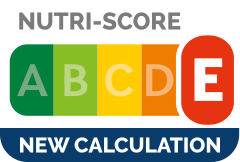 Bad nutritional quality
 Ultra-processed food and drink products
 Green-Score not computed
Health
Nutrition
Label
Bad nutritional qualityNutrient levels
Fat in moderate quantity (15.8%)
Saturated fat in high quantity (6.67%)
Sugars in moderate quantity (5%)
Salt in high quantity (4.02%)
Nutrition facts
| Nutrition facts | As sold for 100 g / 100 ml |
|---|---|
| Energy | ~ 1,647.5 kJ (383 kcal) |
| FAT | 15.83 g |
| Saturated fat | 6.67 g |
| Trans fat | 0 g |
| Cholesterol | 0 g |
| Carbohydrates | 54.17 g |
| Sugars | 5 g |
| Added sugars | 4.17 g |
| Dietary fiber | 1.67 g |
| Proteins | 7.5 g |
| Salt | 4.02 g |
| Sodium | 1.61 g |
| Minerals | |
| Potassium | 0.17 g |
| Fruits, vegetables and legumes | ~ 0 % |
Nutrition facts (Detailed data)
| Nutrition facts | As sold for 100 g / 100 ml | As sold Per serving (120 g) (packaging) | As sold Per 100 g (estimate) |
|---|---|---|---|
| Energy | ~ 1,647.5 kJ (383 kcal) | ? (460 kcal) | ? |
| FAT | 15.83 g | 19 g | ? |
| Saturated fat | 6.67 g | 8 g | ? |
| Trans fat | 0 g | 0 g | ? |
| Cholesterol | 0 g | 0 g | ? |
| Carbohydrates | 54.17 g | 65 g | ? |
| Sugars | 5 g | 6 g | ? |
| Added sugars | 4.17 g | 5 g | ~ 0 g |
| Dietary fiber | 1.67 g | 2 g | ? |
| Proteins | 7.5 g | 9 g | ? |
| Salt | 4.02 g | 4.83 g | ? |
| Sodium | 1.61 g | 1.93 g | ? |
| Minerals | |||
| Potassium | 0.17 g | 0.2 g | ? |
| Fruits, vegetables and legumes | ~ 0 % | ? | ~ 0 % |
Serving size
Estimated Activity Time
Approximate time needed to burn the energy in 100 g / 100 ml: 1,648 kJ. Reference adult weight: 70 kg. Energy density: Moderate.
Ingredients
Ingredients image

Ingredients list
Ingredient information
Allergens
Ingredients analysis
Contains ingredients containing palm oil.
Contains non-vegan ingredients.
Unrecognized: fr:saveur, fr:saveur-de-poulet-artificielle, fr:pour-les-allergens, fr:veuillez-voir-les-ingredients-en-gras, fr:fabrique-dans-une-installation-qui-traite-egalement-des-poissons, fr:contient-des-ingredients-de-ble, fr:fabrique-dans-des-installations-qui-traitent-egalement-des-produits-de-poisson
Contains non-vegetarian ingredients.
Unrecognized: fr:saveur, fr:saveur-de-poulet-artificielle, fr:pour-les-allergens, fr:veuillez-voir-les-ingredients-en-gras, fr:fabrique-dans-une-installation-qui-traite-egalement-des-poissons, fr:contient-des-ingredients-de-ble, fr:fabrique-dans-des-installations-qui-traitent-egalement-des-produits-de-poisson
Food Processing
NOVA group
Ultra-processed food and drink productsElements that indicate the product is in NOVA group 4
How NOVA works
Additives
E101 - RiboflavinColour
Riboflavin, also known as vitamin B2, is a vitamin found in food and used as a dietary supplement. Food sources include eggs, green vegetables, milk and other dairy product, meat, mushrooms, and almonds. Some countries require its addition to grains. As a supplement it is used to prevent and treat riboflavin deficiency and prevent migraines. It may be given by mouth or injection.It is nearly always well tolerated. Normal doses are safe during pregnancy. Riboflavin is in the vitamin B group. It is required by the body for cellular respiration.Riboflavin was discovered in 1920, isolated in 1933, and first made in 1935. It is on the World Health Organization's List of Essential Medicines, the most effective and safe medicines needed in a health system. Riboflavin is available as a generic medication and over the counter. In the United States a month of supplements costs less than 25 USD.
E101i - RiboflavinColour
No additive description is available yet.
E160c - Paprika extractColour
No additive description is available yet.
E322 - LecithinsAntioxidantEmulsifier
Lecithins are natural compounds commonly used in the food industry as emulsifiers and stabilizers.
Extracted from sources like soybeans and eggs, lecithins consist of phospholipids that enhance the mixing of oil and water, ensuring smooth textures in various products like chocolates, dressings, and baked goods.
They do not present any known health risks.
E322i - LecithinAntioxidantEmulsifier
Lecithins are natural compounds commonly used in the food industry as emulsifiers and stabilizers.
Extracted from sources like soybeans and eggs, lecithins consist of phospholipids that enhance the mixing of oil and water, ensuring smooth textures in various products like chocolates, dressings, and baked goods.
They do not present any known health risks.
E330 - Citric acidAntioxidantSequestrant
Citric acid is a natural organic acid found in citrus fruits such as lemons, oranges, and limes.
It is widely used in the food industry as a flavor enhancer, acidulant, and preservative due to its tart and refreshing taste.
Citric acid is safe for consumption when used in moderation and is considered a generally recognized as safe (GRAS) food additive by regulatory agencies worldwide.
E339 - Sodium phosphatesEmulsifierHumectantPreservativeSequestrantStabiliserThickener
TRISODIUM PHOSPHATE is the inorganic compound with the chemical formula Na3PO4.
E412 - Guar gumEmulsifierStabiliserThickener
Guar gum (E412) is a natural food additive derived from guar beans.
This white, odorless powder is valued for its remarkable thickening and stabilizing properties, making it a common ingredient in various food products, including sauces, dressings, and ice creams.
When used in moderation, guar gum is considered safe for consumption, with no known adverse health effects.
E415 - Xanthan gumEmulsifierStabiliserThickener
Xanthan gum (E415) is a natural polysaccharide derived from fermented sugars, often used in the food industry as a thickening and stabilizing agent.
This versatile food additive enhances texture and prevents ingredient separation in a wide range of products, including salad dressings, sauces, and gluten-free baked goods.
It is considered safe for consumption even at high intake amounts.
E500 - Sodium carbonatesStabiliserThickener
Sodium carbonates (E500) are compounds commonly used in food preparation as leavening agents, helping baked goods rise by releasing carbon dioxide when they interact with acids.
Often found in baking soda, they regulate the pH of food, preventing it from becoming too acidic or too alkaline. In the culinary world, sodium carbonates can also enhance the texture and structure of foods, such as noodles, by modifying the gluten network.
Generally recognized as safe, sodium carbonates are non-toxic when consumed in typical amounts found in food.
E500i - Sodium carbonateStabiliserThickener
No additive description is available yet.
E501 - Potassium carbonatesStabiliser
Potassium carbonate (K2CO3) is a white salt, which is soluble in water (insoluble in ethanol) and forms a strongly alkaline solution. It can be made as the product of potassium hydroxide's absorbent reaction with carbon dioxide. It is deliquescent, often appearing a damp or wet solid. Potassium carbonate is used in the production of soap and glass.
E501i - Potassium carbonateStabiliser
No additive description is available yet.
E621 - Monosodium glutamateFlavour Enhancer
Monosodium glutamate (MSG), or E621, is the sodium salt of glutamic acid, an amino acid found naturally in many foods.
It is widely used as a flavor enhancer to provide an "umami" or savory taste to a variety of processed foods, including soups, snack chips, and frozen meals.
MSG is generally recognized as safe (GRAS) by food authorities. However, some people report sensitivity to MSG, experiencing short-term symptoms like headaches and flushing, though scientific studies have not shown a consistent link.
E635 - Disodium 5'-ribonucleotide
No additive description is available yet.
Environment
Green-Score, origins bonus, and transportation impact are shown for Worldwide .
Green Score
Overall grade
Unknown environmental impactAbout Green-Score
Current scope
Green-Score availability
Bonuses and maluses
Declared origins
Threatened species risk
Packaging impact
Packaging
Packaging impact
Data precision
Transportation
Declared origins
Forest footprint
Forest footprint
Ingredients linked to forest pressure
| Ingredient | Type | Percent in product | Forest footprint |
|---|---|---|---|
| EGG | Oeufs Importés | 0.00 % | 0.00 |
Data Source
Data presented on this page is sourced from the Open Food Facts database. This platform does not alter the original dataset; its purpose is solely to enhance data visualization and user accessibility.
Product added on June 5, 2018 at 7:02:10 PM UTC by kiliweb .
Last edit on March 17, 2026 at 8:23:47 PM UTC by new-nutrition-bot .
Product page also edited by fetterrentner, foodless, kiliweb, macrofactor, new-nutrition-bot, odinh, openfoodfacts-contributors, yuka.EJNyFvDSD-gfIMbd-4Em5AiAL_fbKPt8AV0LoQ, yuka.VEk0WUs2OGVwdmt1eE1BazFDTCs4UEZuM3JxallVaW1PY1VRSVE9PQ.