

Turrón mazapán fruta
Health
Nutrition
Nutri-Score
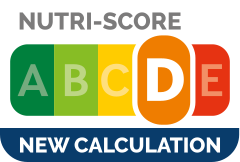 Lower nutritional quality
Nutrient levels
Fat in moderate quantity (16%)
Saturated fat in low quantity (1.3%)
Sugars in high quantity (47%)
Salt in low quantity (0.05%)
Nutrition label

Nutrition facts
| Nutrition facts | As sold for 100 g / 100 ml | Compared to: Fruit turrón |
|---|---|---|
| Energy | 1631 kJ (389 kcal) | 1,790.149 kJ (432 kcal) (-9%) |
| Fat | 16 g | 19.278 g (-17%) |
| Saturated fat | 1.3 g | 1.702 g (-24%) |
| Carbohydrates | 52 g | 53.869 g (-3%) |
| Sugars | 47 g | 50.144 g (-6%) |
| Dietary fiber | 3.9 g | ? |
| Proteins | 7.3 g | 7.962 g (-8%) |
| Salt | 0.05 g | 0.06 g (-17%) |
| Sodium | 0.02 g | 0.024 g (-17%) |
| Fruits, vegetables and legumes | ? | ? |
Nutrition facts (Detailed data)
| Nutrition facts | As sold for 100 g / 100 ml | As sold Per serving (legacy) |
|---|---|---|
| Energy | 1631 kJ (389 kcal) | ? |
| Fat | 16 g | ? |
| Saturated fat | 1.3 g | ? |
| Carbohydrates | 52 g | ? |
| Sugars | 47 g | ? |
| Dietary fiber | 3.9 g | ? |
| Proteins | 7.3 g | ? |
| Salt | 0.05 g | ? |
| Sodium | 0.02 g | ? |
| Fruits, vegetables and legumes | ? | ? |
Ingredients
Ingredients image

Ingredients list
Ingredient information
Added sugars
Allergens
Traces
Ingredients analysis
Palm oil content unknown
Unrecognized: es:clorofilina-cuprosodica
Vegan status unknown
Unrecognized: en:marzipan, fr:fruits-confits, es:clorofilina-cuprosodica
Vegetarian status unknown
Unrecognized: en:marzipan, fr:fruits-confits, es:clorofilina-cuprosodica
Food Processing
NOVA group
 Ultra-processed food and drink products
Elements that indicate the product is in NOVA group 4
How NOVA works
Additives
E140 - Chlorophylls and ChlorophyllinsColour
CHLOROPHYLL is any of several related green pigments found in cyanobacteria and the chloroplasts of algae and plants. Chefs use chlorophyll to color a variety of foods and beverages green, such as pasta and spirits.
E140ii - ChlorophyllinsColour
No additive description is available yet.
E160d - LycopeneColour
Lycopene (from the neo-Latin Lycopersicum, the tomato species) is a bright red carotene and carotenoid pigment and phytochemical found in tomatoes and other red fruits and vegetables, such as red carrots, watermelons, gac, and papayas, but it is not in strawberries or cherries. Although lycopene is chemically a carotene, it has no vitamin A activity. Foods that are not red may also contain lycopene, such as asparagus and parsley.In plants, algae, and other photosynthetic organisms, lycopene is an intermediate in the biosynthesis of many carotenoids, including beta-carotene, which is responsible for yellow, orange, or red pigmentation, photosynthesis, and photoprotection. Like all carotenoids, lycopene is a tetraterpene. It is insoluble in water. Eleven conjugated double bonds give lycopene its deep red color. Owing to the strong color, lycopene is useful as a food coloring (registered as E160d) and is approved for use in the USA, Australia and New Zealand (registered as 160d) and the European Union.
E200 - Sorbic acid EFSA overexposure risk: highPreservative
SORBIC ACID, or 2,4-hexadienoic acid, is a natural organic compound used as a food preservative. It has the chemical formula CH3(CH)4CO2H.
E330 - Citric acidAntioxidantSequestrant
Citric acid is a natural organic acid found in citrus fruits such as lemons, oranges, and limes.
It is widely used in the food industry as a flavor enhancer, acidulant, and preservative due to its tart and refreshing taste.
Citric acid is safe for consumption when used in moderation and is considered a generally recognized as safe (GRAS) food additive by regulatory agencies worldwide.
Environment
Green-Score, origins bonus, and transportation impact are shown for Worldwide .
Green Score
Overall grade
 High environmental impact
About Green-Score
Current scope
Life cycle analysis
Average impact of the category
 Nougat • Score: 58/100
Life-cycle reference
Overall environmental impact by stage (PEF)
The overall environmental impact figure (PEF) comes from ADEME's Agribalyse database, for the category: Nougat. Source: ADEME Agribalyse Database.
| Stage | Impact |
|---|---|
| Agriculture | 80.9 % |
| Processing | 8.4 % |
| Packaging | 5.1 % |
| Transportation | 4.6 % |
| Distribution | 1.0 % |
| Consumption | 0.0 % |
Bonuses and maluses
Declared origins
Packaging impact
Green-Score for this product
Green-Score for this product
Final score: 38/100Final score breakdown
Carbon footprint
Carbon footprint
Climate impact by stage (CO2e)
The carbon emission figure comes from ADEME's Agribalyse database, for the category: Nougat. Source: ADEME Agribalyse Database.
| Stage | Impact |
|---|---|
| Agriculture | 61.5 % |
| Processing | 13.0 % |
| Packaging | 13.6 % |
| Transportation | 11.0 % |
| Distribution | 0.9 % |
| Consumption | 0.0 % |
Packaging
Packaging impact
Data precision
Transportation
Declared origins
Data Source
Product data comes from Open Food Facts. Food Benchmark also adds translations, category comparisons and explanatory calculations.
The database is licensed under ODbL 1.0, individual contents under DbCL 1.0, and product photos under CC BY-SA 3.0.
Product added on November 16, 2019 at 1:14:51 PM UTC by kiliweb .
Last edit on May 1, 2021 at 1:35:23 PM UTC by teolemon .
Product page also edited by moon-rabbit, teolemon, org-carrefour-espana, thaialagata, kiliweb, yuka.WmJCY01ZMHE5OTRsc2ZGbjRCN2YyNDR1L3FDdURWbXNHL1U5SUE9PQ.
Source List
- carrefour-espana