

Pannetone
Health
Nutrition
Nutri-Score
 Lower nutritional quality
Nutri-Score data warning
Nutrient levels
Fat in high quantity (22.1%)
Saturated fat in high quantity (13.1%)
Sugars in high quantity (22.4%)
Salt in moderate quantity (0.3%)
Nutrition label
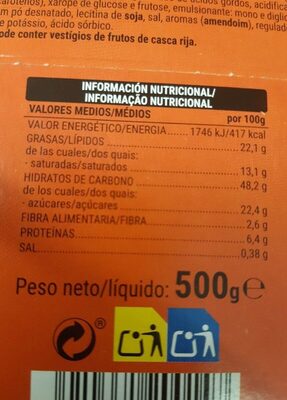
Nutrition facts
| Nutrition facts | As sold for 100 g / 100 ml | Compared to: Panettone |
|---|---|---|
| Energy | ~ 1766.7 kJ (417 kcal) | 1,579.212 kJ (378 kcal) (+12%) |
| Fat | 22.1 g | 15.765 g (+40%) |
| Saturated fat | 13.1 g | 9.201 g (+42%) |
| Carbohydrates | 48.2 g | 51.196 g (-6%) |
| Sugars | 22.4 g | 25.71 g (-13%) |
| Dietary fiber | 2.6 g | ? |
| Proteins | 6.4 g | 6.826 g (-6%) |
| Salt | 0.3 g | 0.433 g (-31%) |
| Sodium | 0.12 g | 0.173 g (-31%) |
| Fruits, vegetables and legumes | ~ 0.3125 % | ? |
Nutrition facts (Detailed data)
| Nutrition facts | As sold for 100 g / 100 ml | As sold Per 100 g (packaging) | As sold Per 100 g (estimate) |
|---|---|---|---|
| Energy | ~ 1766.7 kJ (417 kcal) | ? (417 kcal) | ~ 1644.184375 kJ (391 kcal) |
| Fat | 22.1 g | 22.1 g | ~ 15.184265625 g |
| Saturated fat | 13.1 g | 13.1 g | ~ 8.8800375 g |
| Carbohydrates | 48.2 g | 48.2 g | ~ 51.697809375 g |
| Sugars | 22.4 g | 22.4 g | ~ 15.8024265625 g |
| Dietary fiber | 2.6 g | 2.6 g | ~ 6.445 g |
| Proteins | 6.4 g | 6.4 g | ~ 9.214503125 g |
| Salt | 0.3 g | 0.3 g | ~ 0.08222871875 g |
| Sodium | 0.12 g | 0.12 g | ~ 0.021326290625 g |
| Fruits, vegetables and legumes | ~ 0.3125 % | ? | ~ 0.3125 % |
Ingredients
Ingredients image

Ingredients list
Ingredient information
Added sugars
Allergens
Traces
Ingredients analysis
Contains ingredients containing palm oil.
Contains non-vegan ingredients.
Vegetarian status unknown
Food Processing
NOVA group
 Ultra-processed food and drink products
Elements that indicate the product is in NOVA group 4
How NOVA works
Additives
E200 - Sorbic acid EFSA overexposure risk: highPreservative
SORBIC ACID, or 2,4-hexadienoic acid, is a natural organic compound used as a food preservative. It has the chemical formula CH3(CH)4CO2H.
E202 - Potassium sorbate EFSA overexposure risk: highPreservative
Potassium sorbate (E202) is a synthetic food preservative commonly used to extend the shelf life of various food products.
It works by inhibiting the growth of molds, yeast, and some bacteria, preventing spoilage. When added to foods, it helps maintain their freshness and quality.
Some studies have shown that when combined with nitrites, potassium sorbate have genotoxic activity in vitro. However, potassium sorbate is generally recognized as safe (GRAS) by regulatory authorities.
E282 - calcium propionatePreservative
CALCIUM PROPIONATE has the formula Ca(C2H5COO)2. Calcium propionate is used as a preservative in a wide variety of products, including but not limited to:bread, other baked goods, processed meat, whey, and other dairy products.
E322 - LecithinsAntioxidantEmulsifier
Lecithins are natural compounds commonly used in the food industry as emulsifiers and stabilizers.
Extracted from sources like soybeans and eggs, lecithins consist of phospholipids that enhance the mixing of oil and water, ensuring smooth textures in various products like chocolates, dressings, and baked goods.
They do not present any known health risks.
E322i - LecithinAntioxidantEmulsifier
Lecithins are natural compounds commonly used in the food industry as emulsifiers and stabilizers.
Extracted from sources like soybeans and eggs, lecithins consist of phospholipids that enhance the mixing of oil and water, ensuring smooth textures in various products like chocolates, dressings, and baked goods.
They do not present any known health risks.
E330 - Citric acidAntioxidantSequestrant
Citric acid is a natural organic acid found in citrus fruits such as lemons, oranges, and limes.
It is widely used in the food industry as a flavor enhancer, acidulant, and preservative due to its tart and refreshing taste.
Citric acid is safe for consumption when used in moderation and is considered a generally recognized as safe (GRAS) food additive by regulatory agencies worldwide.
E420 - SorbitolHumectantSequestrantStabiliserSweetenerThickener
Sorbitol (), less commonly known as glucitol (), is a sugar alcohol with a sweet taste which the human body metabolizes slowly. It can be obtained by reduction of glucose, which changes the aldehyde group to a hydroxyl group. Most sorbitol is made from corn syrup, but it is also found in nature, for example in apples, pears, peaches, and prunes. It is converted to fructose by sorbitol-6-phosphate 2-dehydrogenase. Sorbitol is an isomer of mannitol, another sugar alcohol; the two differ only in the orientation of the hydroxyl group on carbon 2. While similar, the two sugar alcohols have very different sources in nature, melting points, and uses.
E420ii - Sorbitol syrupHumectantSequestrantStabiliserSweetenerThickener
No additive description is available yet.
E421 - MannitolHumectantStabiliserSweetenerThickener
Mannitol is a type of sugar alcohol which is also used as a medication. As a sugar, it is often used as a sweetener in diabetic food, as it is poorly absorbed from the intestines. As a medication, it is used to decrease pressure in the eyes, as in glaucoma, and to lower increased intracranial pressure. Medically, it is given by injection. Effects typically begin within 15 minutes and last up to 8 hours.Common side effects from medical use include electrolyte problems and dehydration. Other serious side effects may include worsening heart failure and kidney problems. It is unclear if use is safe in pregnancy. Mannitol is in the osmotic diuretic family of medications and works by pulling fluid from the brain and eyes.The discovery of mannitol is attributed to Joseph Louis Proust in 1806. It is on the World Health Organization's List of Essential Medicines, the most effective and safe medicines needed in a health system. The wholesale cost in the developing world is about US$1.12 to 5.80 a dose. In the United States, a course of treatment costs $25 to 50. It was originally made from the flowering ash and called manna due to its supposed resemblance to the Biblical food. Mannitol is on the World Anti-Doping Agency's banned drug list due to concerns that it may mask other drugs.
E471 - Mono- and diglycerides of fatty acidsEmulsifierStabiliser
Mono- and diglycerides of fatty acids (E471), are food additives commonly used as emulsifiers in various processed foods.
These compounds consist of glycerol molecules linked to one or two fatty acid chains, which help stabilize and blend water and oil-based ingredients. E471 enhances the texture and shelf life of products like margarine, baked goods, and ice cream, ensuring a smooth and consistent texture.
It is generally considered safe for consumption within established regulatory limits.
Environment
Green-Score, origins bonus, and transportation impact are shown for Worldwide .
Green Score
Overall grade
 High environmental impact
About Green-Score
Current scope
Life cycle analysis
Average impact of the category
 Brioche • Score: 73/100
Life-cycle reference
Overall environmental impact by stage (PEF)
The overall environmental impact figure (PEF) comes from ADEME's Agribalyse database, for the category: Brioche. Source: ADEME Agribalyse Database.
| Stage | Impact |
|---|---|
| Agriculture | 80.6 % |
| Processing | 11.5 % |
| Packaging | 2.7 % |
| Transportation | 4.6 % |
| Distribution | 0.4 % |
| Consumption | 0.0 % |
Bonuses and maluses
Declared origins
Threatened species risk
Packaging impact
Green-Score for this product
Green-Score for this product
Final score: 43/100Final score breakdown
Carbon footprint
Carbon footprint
Climate impact by stage (CO2e)
The carbon emission figure comes from ADEME's Agribalyse database, for the category: Brioche. Source: ADEME Agribalyse Database.
| Stage | Impact |
|---|---|
| Agriculture | 82.0 % |
| Processing | 6.4 % |
| Packaging | 4.6 % |
| Transportation | 6.6 % |
| Distribution | 0.4 % |
| Consumption | 0.0 % |
Packaging
Packaging impact
Data precision
Transportation
Declared origins
Forest footprint
Forest footprint
Ingredients linked to forest pressure
| Ingredient | Type | Percent in product | Forest footprint |
|---|---|---|---|
| Pasteurised EGG Yolk | Oeufs Importés | 8.00 % | 0.01 |
Data Source
Product data comes from Open Food Facts. Food Benchmark also adds translations, category comparisons and explanatory calculations.
The database is licensed under ODbL 1.0, individual contents under DbCL 1.0, and product photos under CC BY-SA 3.0.
Product added on December 29, 2018 at 8:21:19 AM UTC by kiliweb .
Last edit on March 17, 2026 at 5:28:01 PM UTC by new-nutrition-bot .
Product page also edited by bertrand-amaraggi, ecoscore-impact-estimator, kiliweb, musarana, new-nutrition-bot, openfoodfacts-contributors, roboto-app, scanbot, teolemon, yuka.R1BGWU42b0R2S1piZ3NZWTFCZngxK3AzN0p5SVJ6eThOZm9mSWc9PQ, yuka.ZmE4cE1yOHI5dVl2d01VRDd3L0kzZEZIeklLSGQxNmNFckV6SVE9PQ, yuka.sY2b0xO6T85zoF3NwEKvlhxACt_98iDdMAHugkKuyMmoIrzDYolY8LbBFKs, yuka.sY2b0xO6T85zoF3NwEKvllxacofw-mn7KzvUghTTzceTJbjLSI4r-orlaqs.