

Jamon de pechuga de pavo Balance
Health
Nutrition
Nutri-Score
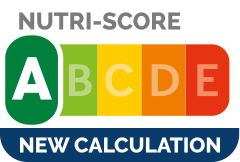 Very good nutritional quality
Nutri-Score data warning
Nutrient levels
Fat in low quantity (0.8%)
Saturated fat in low quantity (0.3%)
Sugars in low quantity (0.4%)
Salt in moderate quantity (0.995%)
Nutrition label

Nutrition facts
| Nutrition facts | As sold for 100 g / 100 ml | Compared to: Hams |
|---|---|---|
| Energy | 364 kcal (87 kcal) | 704.251 kJ (169 kcal) |
| Fat | 0.8 g | 7.872 g (-90%) |
| Saturated fat | 0.3 g | 2.916 g (-90%) |
| Trans fat | 0 g | 0 g |
| Carbohydrates | 3.1 g | 0.791 g (+292%) |
| Sugars | 0.4 g | 0.52 g (-23%) |
| Dietary fiber | 0 g | ? |
| Proteins | 16.8 g | 23.121 g (-27%) |
| Salt | 0.995 g | 2.901 g (-66%) |
| Sodium | 0.398 g | 1.161 g (-66%) |
| Fruits, vegetables and legumes | ? | ? |
Nutrition facts (Detailed data)
| Nutrition facts | As sold for 100 g / 100 ml | As sold Per serving (legacy) |
|---|---|---|
| Energy | 364 kcal (87 kcal) | 364 kcal (87 kcal) |
| Fat | 0.8 g | 0.8 g |
| Saturated fat | 0.3 g | 0.3 g |
| Trans fat | 0 g | 0 g |
| Carbohydrates | 3.1 g | 3.1 g |
| Sugars | 0.4 g | 0.4 g |
| Dietary fiber | 0 g | 0 g |
| Proteins | 16.8 g | 16.8 g |
| Salt | 0.995 g | 0.995 g |
| Sodium | 0.398 g | 0.398 g |
| Fruits, vegetables and legumes | ? | ? |
Serving size
Ingredients
Ingredients list
Ingredient information
Ingredients analysis
Palm oil content unknown
Vegan status unknown
Unrecognized: fr:carne-de-pechuga-de-pavo, fr:agua, fr:ogm, fr:aroma-natural, fr:vinagre, fr:ogm, fr:glucosa-dextrosa, fr:omg, fr:agente-gelificante-e407a, fr:acentuador-del-sabor-e508, fr:sabor-a-cocido, fr:sabor-a-jamon, fr:maltodextrina-de-maiz, fr:sabor-natural-salado, fr:sabor-artificial-salado, fr:maltodextrina-de-maiz, fr:acidos-grasos-de-coco, fr:sabor-a-salado
Vegetarian status unknown
Unrecognized: fr:carne-de-pechuga-de-pavo, fr:agua, fr:ogm, fr:aroma-natural, fr:vinagre, fr:ogm, fr:glucosa-dextrosa, fr:omg, fr:agente-gelificante-e407a, fr:acentuador-del-sabor-e508, fr:sabor-a-cocido, fr:sabor-a-jamon, fr:maltodextrina-de-maiz, fr:sabor-natural-salado, fr:sabor-artificial-salado, fr:maltodextrina-de-maiz, fr:acidos-grasos-de-coco, fr:sabor-a-salado
Food Processing
NOVA group
 Ultra-processed food and drink products
Elements that indicate the product is in NOVA group 4
How NOVA works
Additives
E250 - Sodium nitrite EFSA overexposure risk: highPreservative
Sodium nitrite (E250) is a salt used for curing and preserving meat products.
It plays a critical role in preventing the growth of Clostridium botulinum, the bacterium responsible for botulism, in cured meats like bacon, ham, and sausages. It also provides the characteristic pink color and flavor.
However, nitrites can react with amines in the stomach to form nitrosamines, which are potent carcinogens. High intake of processed meats containing nitrites is associated with an increased risk of colorectal cancer. Regulatory bodies have set strict limits on its use in food.
E262 - Sodium acetatesPreservativeSequestrant
SODIUM ACETATE, also abbreviated NaOAc,[8] is the sodium salt of acetic acid.
E262i - Sodium acetatePreservativeSequestrant
No additive description is available yet.
E270 - Lactic acid
LACTIC ACID is an organic compound with the formula CH3CH(OH)CO2H. In the form of its conjugate base called lactate (this is thus different and kept as a separate ingredient). Lactic acid is chiral, consisting of two optical isomers. One is known as L-(+)-lactic acid or (S)-lactic acid and the other, its mirror image, is D-(−)-lactic acid or (R)-lactic acid in food the L-variant is used
E316 - sodium erythorbate EFSA overexposure risk: noAntioxidant
SODIUM ERYTHORBATE is the sodium salt of erythorbic acid. Sodium erythorbate is produced from sugars derived from different sources, such as beets, sugar cane, and corn. It is used predominantly in meats, poultry, and soft drinks.
E450 - Diphosphates EFSA overexposure risk: highEmulsifierHumectantSequestrantStabiliserThickener
Diphosphates (E450) are food additives often utilized to modify the texture of products, acting as leavening agents in baking and preventing the coagulation of canned food.
These salts can stabilize whipped cream and are also found in powdered products to maintain their flow properties. They are commonly present in baked goods, processed meats, and soft drinks.
Derived from phosphoric acid, they're part of our daily phosphate intake, which often surpasses recommended levels due to the prevalence of phosphates in processed foods and drinks.
Excessive phosphate consumption is linked to health issues, such as impaired kidney function and weakened bone health. Though diphosphates are generally regarded as safe when consumed within established acceptable daily intakes, it's imperative to monitor overall phosphate consumption to maintain optimal health.
E450i - Disodium diphosphateEmulsifierHumectantSequestrantStabiliserThickener
No additive description is available yet.
E450iii - Tetrasodium diphosphateEmulsifierHumectantSequestrantStabiliserThickener
No additive description is available yet.
E450v - Tetrapotassium diphosphateEmulsifierHumectantSequestrantStabiliserThickener
No additive description is available yet.
E451 - Triphosphates EFSA overexposure risk: highEmulsifierHumectantSequestrantStabiliserThickener
Sodium triphosphate (STP), also sodium tripolyphosphate (STPP), or tripolyphosphate (TPP),) is an inorganic compound with formula Na5P3O10. It is the sodium salt of the polyphosphate penta-anion, which is the conjugate base of triphosphoric acid. It is produced on a large scale as a component of many domestic and industrial products, especially detergents. Environmental problems associated with eutrophication are attributed to its widespread use.
E451i - Pentasodium triphosphateEmulsifierHumectantSequestrantStabiliserThickener
No additive description is available yet.
E451ii - Pentapotassium triphosphateEmulsifierHumectantSequestrantStabiliserThickener
No additive description is available yet.
E471 - Mono- and diglycerides of fatty acidsEmulsifierStabiliser
Mono- and diglycerides of fatty acids (E471), are food additives commonly used as emulsifiers in various processed foods.
These compounds consist of glycerol molecules linked to one or two fatty acid chains, which help stabilize and blend water and oil-based ingredients. E471 enhances the texture and shelf life of products like margarine, baked goods, and ice cream, ensuring a smooth and consistent texture.
It is generally considered safe for consumption within established regulatory limits.
E508 - Potassium chloride EFSA overexposure risk: moderateStabiliserThickenerPreservative
Potassium chloride (KCl) is a metal halide salt composed of potassium and chlorine. It is odorless and has a white or colorless vitreous crystal appearance. The solid dissolves readily in water and its solutions have a salt-like taste. KCl is used as a fertilizer, in medicine, in scientific applications, and in food processing. In a few states of the United States it is used to cause cardiac arrest as the third drug in the "three drug cocktail" for executions by lethal injection. It occurs naturally as the mineral sylvite, and in combination with sodium chloride as sylvinite.The version for injection is on the World Health Organization's List of Essential Medicines, the most important medications needed in a basic health system.
E620 - Glutamic acid
Glutamic acid (symbol Glu or E) is an α-amino acid that is used by almost all living beings in the biosynthesis of proteins. It is non-essential in humans, meaning the body can synthesize it. It is also an excitatory neurotransmitter, in fact the most abundant one, in the vertebrate nervous system. It serves as the precursor for the synthesis of the inhibitory gamma-aminobutyric acid (GABA) in GABA-ergic neurons. It has a formula C5H9O4N. Its molecular structure could be idealized as HOOC-CH(NH2)-(CH2)2-COOH, with two carboxyl groups -COOH and one amino group -NH2. However, in the solid state and mildly acid water solutions, the molecule assumes an electrically neutral zwitterion structure −OOC-CH(NH+3)-(CH2)2-COOH. It is encoded by the codons GAA or GAG. The acid can lose one proton from its second carboxyl group to form the conjugate base, the singly-negative anion glutamate −OOC-CH(NH+3)-(CH2)2-COO−. This form of the compound is prevalent in neutral solutions. The glutamate neurotransmitter plays the principal role in neural activation. This anion is also responsible for the savory flavor (umami) of certain foods, and used in glutamate flavorings such as MSG. In highly alkaline solutions the doubly negative anion −OOC-CH(NH2)-(CH2)2-COO− prevails. The radical corresponding to glutamate is called glutamyl.
E627 - Disodium guanylate
Disodium guanylate, also known as sodium 5'-guanylate and disodium 5'-guanylate, is a natural sodium salt of the flavor enhancing nucleotide guanosine monophosphate (GMP). Disodium guanylate is a food additive with the E number E627. It is commonly used in conjunction with glutamic acid. As it is a fairly expensive additive, it is not used independently of glutamic acid; if disodium guanylate is present in a list of ingredients but MSG does not appear to be, it is likely that glutamic acid is provided as part of another ingredient such as a processed soy protein complex. It is often added to foods in conjunction with disodium inosinate; the combination is known as disodium 5'-ribonucleotides. Disodium guanylate is produced from dried seaweed and is often added to instant noodles, potato chips and other snacks, savory rice, tinned vegetables, cured meats, and packaged soup.
E631 - Disodium inosinate
Disodium inosinate (E631) is the disodium salt of inosinic acid with the chemical formula C10H11N4Na2O8P. It is used as a food additive and often found in instant noodles, potato chips, and a variety of other snacks. Although it can be obtained from bacterial fermentation of sugars, it is often commercially prepared from animal sources.
E635 - Disodium 5'-ribonucleotide
No additive description is available yet.
Environment
Green-Score, origins bonus, and transportation impact are shown for Worldwide .
Green Score
Overall grade
 Unknown environmental impact
About Green-Score
Current scope
Green-Score availability
Bonuses and maluses
Declared origins
Packaging impact
Packaging
Packaging impact
Data precision
Transportation
Declared origins
Data Source
Product data comes from Open Food Facts. Food Benchmark also adds translations, category comparisons and explanatory calculations.
The database is licensed under ODbL 1.0, individual contents under DbCL 1.0, and product photos under CC BY-SA 3.0.
Product added on January 7, 2020 at 2:42:45 PM UTC by kiliweb .
Last edit on February 12, 2026 at 2:33:50 PM UTC by macrofactor .
Product page also edited by fima, foodless, ivanna-grosso, kiliweb, macrofactor, roboto-app, teolemon, yuka.R2FBZU5MNHgvL01wZ004bS94VHUvUEpsekxhcldqanNJTWxPSVE9PQ.