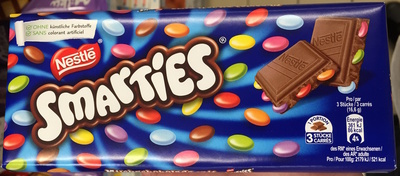
ProductsNestléChocolat Smarties
Chocolat Smarties
Barcode 7613035078581
Nestlé

Chocolat Smarties

100 g
BARCODE:7613035078581
COMMON NAME:Chocolat au lait avec 30% de bonbons de chocolat au lait dragéifiés
CATEGORIES:Snacks, Sweet Snacks, Cocoa And Its Products, Confectioneries, Chocolate Candies, Bonbons, Chocolates, Milk Chocolates, Bonbons Drageifies
LABELS:Nestle Cocoa Plan, No Artificial Colors
PACKAGING:Metal, Paper, Recyclable Metals, Aluminium
MANUFACTURING:Suisse
COUNTRIES:France, Switzerland
STORES:Carrefour Market, Magasins U

Health

Nutrition

Nutri-Score

ELower nutritional quality

Nutri-Score data warning

Warning: the amount of fruits, vegetables and nuts is not specified on the label, it was estimated from the list of ingredients: 0

Nutrient levels

Fat in high quantity (27%)
What you need to know • A high consumption of fat, especially saturated fats, can raise cholesterol, which increases the risk of heart diseases. Recommendation: Limit the consumption of fat and saturated fat • Choose products with lower fat and saturated fat content. Source: National Health Service UK (NHS) - Fat: the facts
Saturated fat in high quantity (16%)
What you need to know • A high consumption of fat, especially saturated fats, can raise cholesterol, which increases the risk of heart diseases. Recommendation: Limit the consumption of fat and saturated fat • Choose products with lower fat and saturated fat content. Source: National Health Service UK (NHS) - Fat: the facts
Sugars in high quantity (58%)
What you need to know • A high consumption of sugar can cause weight gain and tooth decay. It also augments the risk of type 2 diabetes and cardio-vascular diseases. Recommendation: Limit the consumption of sugar and sugary drinks • Sugary drinks (such as sodas, fruit beverages, and fruit juices and nectars) should be limited as much as possible (no more than 1 glass a day). • Choose products with lower sugar content and reduce the consumption of products with added sugars. Source: National Health Service UK (NHS) - Sugar: the facts
Salt in low quantity (0%)
What you need to know • A high consumption of salt (or sodium) can cause raised blood pressure, which can increase the risk of heart disease and stroke. • Many people who have high blood pressure do not know it, as there are often no symptoms. • Most people consume too much salt (on average 9 to 12 grams per day), around twice the recommended maximum level of intake. Recommendation: Limit the consumption of salt and salted food • Reduce the quantity of salt used when cooking, and don't salt again at the table. • Limit the consumption of salty snacks and choose products with lower salt content. Source: World Health Organization (WHO) - Fact sheet - Salt reduction Source: National Health Service UK (NHS) - Salt: the facts

Nutrition facts

Nutrition factsAs sold for 100 g / 100 mlCompared to: fr:Bonbons dragéifiés
Energy2179 kJ (520 kcal)1,803.112 kJ (429 kcal) (+21%)
Fat27 g12.115 g (+123%)
Saturated fat16 g6.856 g (+133%)
Carbohydrates60 g76.758 g (-22%)
Sugars58 g59.022 g (-2%)
Dietary fiber1 g?
Proteins7 g3.235 g (+116%)
Salt0 g0.101 g (-100%)
Sodium0 g0.04 g (-100%)
Fruits, vegetables and legumes??

Nutrition facts (Detailed data)

Nutrition factsAs sold for 100 g / 100 mlAs sold Per serving (legacy)
Energy2179 kJ (520 kcal)362 kJ (86 kcal)
Fat27 g4.48 g
Saturated fat16 g2.66 g
Carbohydrates60 g9.96 g
Sugars58 g9.63 g
Dietary fiber1 g0.166 g
Proteins7 g1.16 g
Salt0 g0 g
Sodium0 g0 g
Fruits, vegetables and legumes??

Serving size

16,6 g

Ingredients

Ingredients list

Sucre, lait entier en poudre, beurre de cacao, pâte de cacao, lait écrémé en poudre, matière grasse de lait anhydre, farine de blé, petit-lait en poudre, amidon de riz, émulsifiant (lécithines de tournesol), concentrés de fruits et de plantes (carthame, radis, citron, carotte noire, hibiscus), concentré de spiruline, agents d'enrobage (cire de carnauba, cire d'abeille), sirop de sucre inverti, arôme naturel de vanille.

Ingredient information

Sugar
53.33% (estimate)
Whole Milk Powder
23.33% (estimate)
Cocoa Butter
11.67% (estimate)
Cocoa Paste
5.83% (estimate)
Skimmed Milk Powder
2.92% (estimate)
Matiere Grasse De Lait Anhydre
1.46% (estimate)
Wheat Flour
0.73% (estimate)
Whey Powder
0.36% (estimate)
Rice Starch
0.18% (estimate)
Emulsifier
0.09% (estimate)
Sunflower Lecithin
0.09% (estimate)
Fruit Concentrate
0.05% (estimate)
Safflower
0.02% (estimate)
Radish
0.01% (estimate)
Lemon
0.01% (estimate)
Black Carrot
0% (estimate)
Roselle Flower
0% (estimate)
Spirulina Concentrate
0.02% (estimate)
Glazing Agent
0.01% (estimate)
E903
0.01% (estimate)
E901
0.01% (estimate)
Invert Sugar Syrup
0.01% (estimate)
Natural Vanilla Flavouring
0.01% (estimate)

Added sugars

Contains added sugars (48%) Added sugars: sugar, invert sugar syrup Quantity of added sugars: 48%

Allergens

GlutenMilk

Traces

EggsNuts

Ingredients analysis

Palm oil free
Yes

No ingredients containing palm oil.

Vegan
No

Contains non-vegan ingredients.

Unrecognized: fr:matiere-grasse-de-lait-anhydre

Vegetarian
Unknown

Vegetarian status unknown

Unrecognized: fr:matiere-grasse-de-lait-anhydre


Food Processing

NOVA group

4Ultra-processed food and drink products

Elements that indicate the product is in NOVA group 4

Additives
E322 - Lecithins
Additives
E901 - white and yellow beeswax
Additives
E903 - Carnauba wax
Ingredients
Emulsifier
Ingredients
Flavouring
Ingredients
Glazing Agent
Ingredients
Invert Sugar
Ingredients
Whey

How NOVA works

The NOVA classification assigns food products into 4 groups based on their degree of processing: 1. Unprocessed or minimally processed foods 2. Processed culinary ingredients 3. Processed foods 4. Ultra-processed food and drink products

Additives

E322 - LecithinsAntioxidantEmulsifier

Lecithins are natural compounds commonly used in the food industry as emulsifiers and stabilizers.

Extracted from sources like soybeans and eggs, lecithins consist of phospholipids that enhance the mixing of oil and water, ensuring smooth textures in various products like chocolates, dressings, and baked goods.

They do not present any known health risks.

E322i - LecithinAntioxidantEmulsifier

Lecithins are natural compounds commonly used in the food industry as emulsifiers and stabilizers.

Extracted from sources like soybeans and eggs, lecithins consist of phospholipids that enhance the mixing of oil and water, ensuring smooth textures in various products like chocolates, dressings, and baked goods.

They do not present any known health risks.

E901 - white and yellow beeswaxCarrierEmulsifierStabiliserThickener

Beeswax (cera alba) is a natural wax produced by honey bees of the genus Apis. The wax is formed into "scales" by eight wax-producing glands in the abdominal segments of worker bees, which discard it in or at the hive. The hive workers collect and use it to form cells for honey storage and larval and pupal protection within the beehive. Chemically, beeswax consists mainly of esters of fatty acids and various long-chain alcohols. Beeswax has long-standing applications in human food and flavoring. For example, it is used as a glazing agent or as a light/heat source. It is edible, in the sense of having similar negligible toxicity to plant waxes, and is approved for food use in most countries and the European Union under the E number E901. However, the wax monoesters in beeswax are poorly hydrolysed in the guts of humans and other mammals, so they have insignificant nutritional value. Some birds, such as honeyguides, can digest beeswax. Beeswax is the main diet of wax moth larvae.

E903 - Carnauba waxCarrier

Carnauba (; Portuguese: carnaúba [kaʁnɐˈubɐ]), also called Brazil wax and palm wax, is a wax of the leaves of the palm Copernicia prunifera (Synonym: Copernicia cerifera), a plant native to and grown only in the northeastern Brazilian states of Piauí, Ceará, Maranhão, Bahia, and Rio Grande do Norte. It is known as "queen of waxes" and in its pure state, usually comes in the form of hard yellow-brown flakes. It is obtained from the leaves of the carnauba palm by collecting and drying them, beating them to loosen the wax, then refining and bleaching the wax.

Environment

Green-Score, origins bonus, and transportation impact are shown for Worldwide .

Green Score

Overall grade

DHigh environmental impact

About Green-Score

The Green-Score is an experimental score that summarizes the environmental impacts of food products.

Current scope

The Green-Score was initially developed for France and it is being extended to other European countries. The Green-Score formula is subject to change as it is regularly improved to make it more precise and better suited to each country. Select a country to include the full impact of transportation in the final score.

Life cycle analysis

Average impact of the category

DMilk chocolate bar • Score: 39/100

Life-cycle reference

Category: Milk chocolate bar PEF environmental score: 0.77 Climate change impact: 12.58 kg CO2 eq / kg product The overall environmental impact figure (PEF) comes from ADEME's Agribalyse database, for the category: Milk chocolate bar. Source: ADEME Agribalyse Database.

Overall environmental impact by stage (PEF)

The overall environmental impact figure (PEF) comes from ADEME's Agribalyse database, for the category: Milk chocolate bar. Source: ADEME Agribalyse Database.

StageImpact
Agriculture87.0 %
Processing6.7 %
Packaging1.3 %
Transportation4.4 %
Distribution0.6 %
Consumption0.0 %

Bonuses and maluses

Declared origins

Origins of ingredients are missing for this product. Ingredients need to be completed before the transportation bonus can be computed precisely.

Packaging impact

Packaging with a low impact Malus: -4 Packaging score: +64

Green-Score for this product

Green-Score for this product

DFinal score: 30/100

Final score breakdown

Life cycle analysis score: 39 Sum of bonuses and maluses: -9 Final score: 30/100

Carbon footprint

Carbon footprint

Equivalent to driving 6.5 km in a petrol car. 1258 g CO2e per 100g of product. Reference category: Milk chocolate bar. The carbon emission figure comes from ADEME's Agribalyse database, for the category: Milk chocolate bar. Source: ADEME Agribalyse Database.

Climate impact by stage (CO2e)

The carbon emission figure comes from ADEME's Agribalyse database, for the category: Milk chocolate bar. Source: ADEME Agribalyse Database.

StageImpact
Agriculture91.7 %
Processing4.5 %
Packaging0.8 %
Transportation2.8 %
Distribution0.1 %
Consumption0.0 %

Packaging

Packaging impact

Packaging with a low impact Malus: -4 Packaging score: +64

Packaging components

ShapeMaterialRecyclingImpact
UnknownHeavy AluminiumRecycleMedium
UnknownPaperUnknownLow

Declared packaging

Metal, Paper, Recyclable Metals, Aluminium

Data precision

The packaging information is not sufficiently precise to compute the most accurate packaging impact. Exact shapes and materials of all packaging components help improve the Green-Score.

Transportation

Manufacturing locations

Suisse

Declared origins

Origins of ingredients are missing for this product. Ingredients need to be completed before the transportation bonus can be computed precisely.

Forest footprint

Forest footprint

Low risk of deforestation Presence of one or more ingredients at risk of deforestation, but low risk given their quantity, origin and/or labels. Forest Footprint The Forest Footprint is a methodology developed by the association Envol Vert to estimate the risk of deforestation related to our consumption. → More information on the methodology Forest Footprint grade: B Presence of one or more ingredients at risk of deforestation, but low risk given their quantity, origin and/or labels. Total Forest Footprint: 0.026 m² per kg of food

Deforestation risk details

Cocoa Primary ingredient grade: B Primary ingredient: 0.026 m² per kg of food Cocoa production, concentrated mainly in West Africa, contributes significantly to deforestation. For example, Côte d'Ivoire, the leading cocoa-producing country, has lost 90% of its forests since the 1960s. Other risky ingredients These ingredients are not yet assessed for deforestation risk: whole milk powder skimmed milk powder butterfat whey powder Labels The presence of certain labels can greatly help reduce the risk of deforestation, through the presence of environmental criteria and/or through better remuneration of producers.

Data Source

Product data comes from Open Food Facts. Food Benchmark also adds translations, category comparisons and explanatory calculations.

The database is licensed under ODbL 1.0, individual contents under DbCL 1.0, and product photos under CC BY-SA 3.0.

Product added on May 28, 2015 at 7:57:03 PM UTC by tacite .

Last edit on February 11, 2022 at 5:21:55 AM UTC by packbot .

Product page also edited by packbot, tacite, magasins-u, desan, foodrepo.