

Soyamilch
Health
Nutrition
Nutri-Score
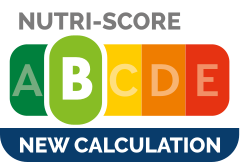 Good nutritional quality
Nutri-Score data warning
Nutrient levels
Fat in moderate quantity (1.8%)
Saturated fat in low quantity (0.3%)
Sugars in moderate quantity (2.5%)
Salt in low quantity (0.09%)
Nutrition label

Nutrition facts
| Nutrition facts | As sold for 100 g / 100 ml | Compared to: Soy-based drinks |
|---|---|---|
| Energy | ~ 164.1 kJ (39 kcal) | 189.652 kJ (45 kcal) (-13%) |
| Fat | 1.8 g | 1.824 g (-1%) |
| Saturated fat | 0.3 g | 0.324 g (-7%) |
| Carbohydrates | 2.5 g | 3.837 g (-35%) |
| Sugars | 2.5 g | 3.043 g (-18%) |
| Added sugars | ~ 1.76 g | 2.326 g (-24%) |
| Dietary fiber | 0.5 g | ? |
| Proteins | 3 g | 3.09 g (-3%) |
| Salt | 0.09 g | 0.095 g (-5%) |
| Sodium | ~ 0.036 g | 0.038 g (-5%) |
| Vitamin D | 0.00000075 g | 0.452 µg (+66%) |
| Calcium | 0.12 g | 85.851 mg (+40%) |
| Fruits, vegetables and legumes | ~ 8 % | ? |
Nutrition facts (Detailed data)
| Nutrition facts | As sold for 100 g / 100 ml | As sold Per 100 g (packaging) | As sold Per 100 ml (packaging) | As sold Per 100 g (estimate) |
|---|---|---|---|---|
| Energy | ~ 164.1 kJ (39 kcal) | ? (39 kcal) | 163 kJ (39 kcal) | ? |
| Fat | 1.8 g | 1.8 g | 1.8 g | ? |
| Saturated fat | 0.3 g | 0.3 g | 0.3 g | ? |
| Carbohydrates | 2.5 g | 2.5 g | 2.5 g | ? |
| Sugars | 2.5 g | 2.5 g | 2.5 g | ? |
| Added sugars | ~ 1.76 g | ? | ? | ~ 1.76 g |
| Dietary fiber | 0.5 g | 0.5 g | 0.5 g | ? |
| Proteins | 3 g | 3 g | 3 g | ? |
| Salt | 0.09 g | 0.09 g | 0.09 g | ? |
| Sodium | ~ 0.036 g | ? | 0.036 g | ? |
| Vitamin D | 0.00000075 g | ? | 0.00000075 g | ? |
| Calcium | 0.12 g | ? | 0.12 g | ? |
| Fruits, vegetables and legumes | ~ 8 % | ? | ? | ~ 8 % |
Serving size
Ingredients
Ingredients image

Ingredients list
Ingredient information
Added sugars
Allergens
Ingredients analysis
No ingredients containing palm oil.
No non-vegan ingredients.
No non-vegetarian ingredients.
Food Processing
NOVA group
 Ultra-processed food and drink products
Elements that indicate the product is in NOVA group 4
How NOVA works
Additives
E340 - Potassium phosphates EFSA overexposure risk: highEmulsifierHumectantSequestrantStabiliserThickener
Potassium phosphate is a generic term for the salts of potassium and phosphate ions including: Monopotassium phosphate (KH2PO4) (Molar mass approx: 136 g/mol) Dipotassium phosphate (K2HPO4) (Molar mass approx: 174 g/mol) Tripotassium phosphate (K3PO4) (Molar mass approx: 212.27 g/mol)As food additives, potassium phosphates have the E number E340.
E418 - Gellan gumStabiliserThickener
GELLAN GUM is a water-soluble anionic polysaccharide produced by the bacterium Sphingomonas elodea. It is used in plant-based milks to keep plant protein suspended in the milk.
Environment
Green-Score, origins bonus, and transportation impact are shown for Worldwide .
Green Score
Overall grade
 Very low environmental impact
About Green-Score
Current scope
Life cycle analysis
Average impact of the category
 Soy drink, plain, fortified with calcium • Score: 91/100
Life-cycle reference
Overall environmental impact by stage (PEF)
The overall environmental impact figure (PEF) comes from ADEME's Agribalyse database, for the category: Soy drink, plain, fortified with calcium. Source: ADEME Agribalyse Database.
| Stage | Impact |
|---|---|
| Agriculture | 21.6 % |
| Processing | 15.2 % |
| Packaging | 20.0 % |
| Transportation | 26.3 % |
| Distribution | 10.9 % |
| Consumption | 6.2 % |
Bonuses and maluses
Origins of ingredients
Packaging impact
Green-Score for this product
Green-Score for this product
Final score: 89/100Final score breakdown
Carbon footprint
Carbon footprint
Climate impact by stage (CO2e)
The carbon emission figure comes from ADEME's Agribalyse database, for the category: Soy drink, plain, fortified with calcium. Source: ADEME Agribalyse Database.
| Stage | Impact |
|---|---|
| Agriculture | 20.1 % |
| Processing | 21.5 % |
| Packaging | 22.2 % |
| Transportation | 31.0 % |
| Distribution | 3.6 % |
| Consumption | 1.6 % |
Packaging

Packaging impact
Packaging components
| Shape | Material | Recycling | Impact |
|---|---|---|---|
| Bottle CAP | Plastic | Unknown | High |
| 1 Brick | Tetra PAK | Unknown | Medium |
Declared packaging
Transportation
Origins of ingredients
Origins breakdown
| Origin | Percent of ingredients | Impact |
|---|---|---|
| Canada | 33 % | Medium |
| France | 33 % | Medium |
| Italy | 33 % | Medium |
Forest footprint
Forest footprint
Deforestation risk details
Additional information
- Conservation conditions
- Mindestens haltbar bis: siehe Oberseite Nach Anbruch 5 Tage im Kühlschrank haltbar (+1°C bis +7°C).
Data Source
Product data comes from Open Food Facts. Food Benchmark also adds translations, category comparisons and explanatory calculations.
The database is licensed under ODbL 1.0, individual contents under DbCL 1.0, and product photos under CC BY-SA 3.0.
Product added on January 4, 2016 at 1:15:05 PM UTC by agamitsudo .
Last edit on March 11, 2026 at 10:57:00 PM UTC by prepperapp .
Product page also edited by agamitsudo, aleene, alex-off, anticultist, aquilax, auroralifescience, avis9, celine2018, charlesnepote, chevalstar, choosebetter, chr2031, christian817, counterflow, date-limite-app, driveoff, duhowpi, ecoscore-impact-estimator, ethic-advisor.d44fddca-67bd-4cae-aef6-5d9e9c6f586d, foodless, foodrepo, foodvisor, gehrmaja, hellosct1, helmuth, heuwerk, hiajen, inf, itsjustruby, jniderkorn, julie-yuka, kiliweb, laura-chaud, laylaaa, linus, maamam, macrofactor, magasins-u, monsieurtanuki, moon-rabbit, municorn-calorie-counter-app, october-food-facts, openfood-ch-import, openfoodfacts-contributors, org-danone-ag, packbot, planteuser, pourkoiturigol, prepperapp, quechoisir, raphael0202, raymond29, roboto-app, scanbot, segundo, smias, sorins, spotter, stivolonski, tacite, tacite-mass-editor, walterppk, yuka.Ri9rSFFid25sc1V4dGZNWi9nMzExdlVybnFLMlZFeUhHOVJNSUE9PQ, yuka.VDRrTFQ0WXJodDFhZ2YxbTBTem4xUEo1enNhRVZHYWFPZVVXSWc9PQ, yuka.WFlzNkRvTVp2T2tPaE1RMHB4TCt3TmxXeFpDWFhXQ29KL1kzSVE9PQ, yuka.ZnFNY083NGUrZGNhZ004TTVCelFvZGRXeWJxeEREcXdGOVlXSWc9PQ, yukafix.
Source List