

Salade César
Labels
 Moderate nutritional quality
 Ultra-processed food and drink products
 Very high environmental impact
Health
Nutrition
Label
Moderate nutritional qualityNutrient levels
Fat in moderate quantity (8.1%)
Saturated fat in moderate quantity (1.5%)
Sugars in low quantity (1.7%)
Salt in moderate quantity (1.3%)
Nutrition facts
| Nutrition facts | As sold for 100 g / 100 ml |
|---|---|
| Energy | ~ 585.2 kJ (140 kcal) |
| FAT | 8.1 g |
| Saturated fat | 1.5 g |
| Carbohydrates | 6.8 g |
| Sugars | 1.7 g |
| Dietary fiber | 1.9 g |
| Proteins | 9.1 g |
| Salt | 1.3 g |
| Sodium | 0.52 g |
| Minerals | |
| Fruits, vegetables and legumes | ~ 29.32 % |
Nutrition facts (Detailed data)
| Nutrition facts | As sold for 100 g / 100 ml | As sold Per 100 g (packaging) | As sold Per 100 g (estimate) |
|---|---|---|---|
| Energy | ~ 585.2 kJ (140 kcal) | ? (140 kcal) | ? |
| FAT | 8.1 g | 8.1 g | ? |
| Saturated fat | 1.5 g | 1.5 g | ? |
| Carbohydrates | 6.8 g | 6.8 g | ? |
| Sugars | 1.7 g | 1.7 g | ? |
| Added sugars | ~ 0.22 g | ? | ~ 0.22 g |
| Dietary fiber | 1.9 g | 1.9 g | ? |
| Proteins | 9.1 g | 9.1 g | ? |
| Salt | 1.3 g | 1.3 g | ? |
| Sodium | 0.52 g | 0.52 g | ? |
| Minerals | |||
| Fruits, vegetables and legumes | ~ 29.32 % | ? | ~ 29.32 % |
Serving size
Estimated Activity Time
Approximate time needed to burn the energy in 100 g / 100 ml: 585 kJ. Reference adult weight: 70 kg. Energy density: Low.
Ingredients
Ingredients image
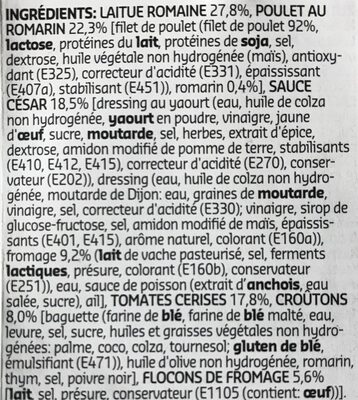
Ingredients list
Ingredient information
Allergens
Ingredients analysis
Contains ingredients containing palm oil.
Contains non-vegan ingredients.
Unrecognized: fr:proteines-du-lait-proteines-de-soja, fr:antioxy, fr:e451-romarin, fr:hufle-de-colza-non-hydrogenee, fr:jaune-d-uf, en:mustard, fr:conser, fr:huile-de-colza-non-hydro, fr:genee, fr:epaissis, fr:e41-5, fr:el-60a, fr:el-60b, fr:pau-salee, fr:tomates-cerises-1, fr:graisses-vegetales-non-hydro, fr:el-105, fr:a-40c
Contains non-vegetarian ingredients.
Unrecognized: fr:proteines-du-lait-proteines-de-soja, fr:antioxy, fr:e451-romarin, fr:hufle-de-colza-non-hydrogenee, fr:jaune-d-uf, en:mustard, fr:conser, fr:huile-de-colza-non-hydro, fr:genee, fr:epaissis, fr:e41-5, fr:el-60a, fr:el-60b, fr:pau-salee, fr:tomates-cerises-1, fr:graisses-vegetales-non-hydro, fr:el-105, fr:a-40c
Food Processing
NOVA group
Ultra-processed food and drink productsElements that indicate the product is in NOVA group 4
How NOVA works
Additives
E14XX - Modified StarchEmulsifierStabiliserThickener
No additive description is available yet.
E202 - Potassium sorbatePreservative
Potassium sorbate (E202) is a synthetic food preservative commonly used to extend the shelf life of various food products.
It works by inhibiting the growth of molds, yeast, and some bacteria, preventing spoilage. When added to foods, it helps maintain their freshness and quality.
Some studies have shown that when combined with nitrites, potassium sorbate have genotoxic activity in vitro. However, potassium sorbate is generally recognized as safe (GRAS) by regulatory authorities.
E251 - Sodium nitratePreservative
SODIUM NITRATE is the chemical compound with the formula NaNO3. Sodium nitrate is a food additive used as a preservative and colour fixative in cured meats and poultry
E270 - Lactic acid
LACTIC ACID is an organic compound with the formula CH3CH(OH)CO2H. In the form of its conjugate base called lactate (this is thus different and kept as a separate ingredient). Lactic acid is chiral, consisting of two optical isomers. One is known as L-(+)-lactic acid or (S)-lactic acid and the other, its mirror image, is D-(−)-lactic acid or (R)-lactic acid in food the L-variant is used
E325 - sodium lactateAntioxidantEmulsifierHumectantThickener
SODIUM LACTATE is the sodium salt of lactic acid, and has a mild saline taste. It is produced by fermentation of a sugar source, such as corn or beets. It acts as a preservative, acidity regulator, and bulking agent.
E330 - Citric acidAntioxidantSequestrant
Citric acid is a natural organic acid found in citrus fruits such as lemons, oranges, and limes.
It is widely used in the food industry as a flavor enhancer, acidulant, and preservative due to its tart and refreshing taste.
Citric acid is safe for consumption when used in moderation and is considered a generally recognized as safe (GRAS) food additive by regulatory agencies worldwide.
E331 - Sodium citratesEmulsifierSequestrantStabiliser
DISODIUM CITRATE, more properly, disodium hydrogen citrate, is an acid salt of citric acid with the chemical formula Na2C6H6O7. It is used as an antioxidant in food and to improve the effects of other antioxidants. It is also used as an acidity regulator and sequestrant. Typical products include gelatin, jam, sweets, ice cream, carbonated beverages, milk powder, wine, and processed cheeses.
E401 - sodium alginateCarrierEmulsifierHumectantSequestrantStabiliserThickener
No additive description is available yet.
E407a - Processed eucheuma seaweedCarrierEmulsifierHumectantStabiliserThickener
Carrageenans or carrageenins ( karr-ə-gee-nənz, from Irish carraigín, "little rock") are a family of linear sulfated polysaccharides that are extracted from red edible seaweeds. They are widely used in the food industry, for their gelling, thickening, and stabilizing properties. Their main application is in dairy and meat products, due to their strong binding to food proteins. There are three main varieties of carrageenan, which differ in their degree of sulfation. Kappa-carrageenan has one sulfate group per disaccharide, iota-carrageenan has two, and lambda-carrageenan has three. Gelatinous extracts of the Chondrus crispus (Irish moss) seaweed have been used as food additives since approximately the fifteenth century. Carrageenan is a vegetarian and vegan alternative to gelatin in some applications or may be used to replace gelatin in confectionery.
E410 - Locust bean gumEmulsifierStabiliserThickener
Locust bean gum (LBG, also known as carob gum, carob bean gum, carobin, E410) is a thickening agent and a gelling agent used in food technology.
E412 - Guar gumEmulsifierStabiliserThickener
Guar gum (E412) is a natural food additive derived from guar beans.
This white, odorless powder is valued for its remarkable thickening and stabilizing properties, making it a common ingredient in various food products, including sauces, dressings, and ice creams.
When used in moderation, guar gum is considered safe for consumption, with no known adverse health effects.
E415 - Xanthan gumEmulsifierStabiliserThickener
Xanthan gum (E415) is a natural polysaccharide derived from fermented sugars, often used in the food industry as a thickening and stabilizing agent.
This versatile food additive enhances texture and prevents ingredient separation in a wide range of products, including salad dressings, sauces, and gluten-free baked goods.
It is considered safe for consumption even at high intake amounts.
E451 - TriphosphatesEmulsifierHumectantSequestrantStabiliserThickener
Sodium triphosphate (STP), also sodium tripolyphosphate (STPP), or tripolyphosphate (TPP),) is an inorganic compound with formula Na5P3O10. It is the sodium salt of the polyphosphate penta-anion, which is the conjugate base of triphosphoric acid. It is produced on a large scale as a component of many domestic and industrial products, especially detergents. Environmental problems associated with eutrophication are attributed to its widespread use.
E471 - Mono- and diglycerides of fatty acidsEmulsifierStabiliser
Mono- and diglycerides of fatty acids (E471), are food additives commonly used as emulsifiers in various processed foods.
These compounds consist of glycerol molecules linked to one or two fatty acid chains, which help stabilize and blend water and oil-based ingredients. E471 enhances the texture and shelf life of products like margarine, baked goods, and ice cream, ensuring a smooth and consistent texture.
It is generally considered safe for consumption within established regulatory limits.
Environment
Green-Score, origins bonus, and transportation impact are shown for Worldwide .
Green Score
Overall grade
Very high environmental impactAbout Green-Score
Current scope
Life cycle analysis
Average impact of the category
 Caesar's salad (salad, chicken, croûtons, sauce) • Score: 52/100
Life-cycle reference
Overall environmental impact by stage (PEF)
The overall environmental impact figure (PEF) comes from ADEME's Agribalyse database, for the category: Caesar's salad (salad, chicken, croûtons, sauce). Source: ADEME Agribalyse Database.
| Stage | Impact |
|---|---|
| Agriculture | 53.3 % |
| Processing | 6.4 % |
| Packaging | 32.5 % |
| Transportation | 5.4 % |
| Distribution | 1.9 % |
| Consumption | 0.5 % |
Bonuses and maluses
Declared origins
Threatened species risk
Packaging impact
Green-Score for this product
Green-Score for this product
Final score: 22/100Final score breakdown
Carbon footprint
Carbon footprint
Climate impact by stage (CO2e)
The carbon emission figure comes from ADEME's Agribalyse database, for the category: Caesar's salad (salad, chicken, croûtons, sauce). Source: ADEME Agribalyse Database.
| Stage | Impact |
|---|---|
| Agriculture | 45.3 % |
| Processing | 8.5 % |
| Packaging | 35.4 % |
| Transportation | 9.4 % |
| Distribution | 1.1 % |
| Consumption | 0.2 % |
Packaging
Packaging impact
Data precision
Transportation
Declared origins
Forest footprint
Forest footprint
Ingredients linked to forest pressure
| Ingredient | Type | Percent in product | Forest footprint |
|---|---|---|---|
| Chicken Fillet | Poulet Importé | 11.15 % | 0.32 |
| Chicken Fillet | Poulet Importé | 20.52 % | 0.59 |
Data Source
Data presented on this page is sourced from the Open Food Facts database. This platform does not alter the original dataset; its purpose is solely to enhance data visualization and user accessibility.
Product added on September 1, 2017 at 11:00:01 AM UTC by kiliweb .
Last edit on March 17, 2026 at 8:20:38 PM UTC by new-nutrition-bot .
Product page also edited by autorotate-bot, foodvisor, kiliweb, new-nutrition-bot, openfoodfacts-contributors, roboto-app, tacite-mass-editor, teolemon, yuka.VDcwL1FLNWFwTmRiaXZBczFURG5vTzF3bThHMGJYeStOc1F1SVE9PQ, yuka.XIxCJNmlR_59OvrXzJIp3Tq6T86-IPN2QVIAog.