ProductsDelhaizeTartine saumon fumé et sauce gravlax
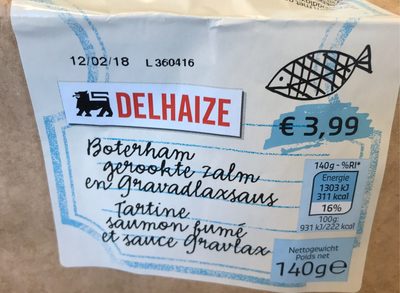
Tartine saumon fumé et sauce gravlax
Barcode 5400112483701
Delhaize

Tartine saumon fumé et sauce gravlax

140 g
BARCODE:5400112483701
CATEGORIES:Seafood, Fishes And Their Products, Fishes, Fatty Fishes, Sandwiches, Fish Sandwiches, Salmons, Smoked Fishes, Salmon Sandwiches, Smoked Salmons
LABELS:Green Dot
COUNTRIES:Belgium, France
STORES:Delhaize

Health

Nutrition

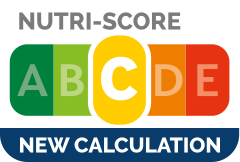
Nutri-Score

CAverage nutritional quality

Nutri-Score data warning

Warning: the amount of fruits, vegetables and nuts is not specified on the label, it was estimated from the list of ingredients: 13

Nutrient levels

Fat in moderate quantity (8.3%)
What you need to know • A high consumption of fat, especially saturated fats, can raise cholesterol, which increases the risk of heart diseases. Recommendation: Limit the consumption of fat and saturated fat • Choose products with lower fat and saturated fat content. Source: National Health Service UK (NHS) - Fat: the facts
Saturated fat in low quantity (1.2%)
What you need to know • A high consumption of fat, especially saturated fats, can raise cholesterol, which increases the risk of heart diseases. Recommendation: Limit the consumption of fat and saturated fat • Choose products with lower fat and saturated fat content. Source: National Health Service UK (NHS) - Fat: the facts
Sugars in low quantity (3.3%)
What you need to know • A high consumption of sugar can cause weight gain and tooth decay. It also augments the risk of type 2 diabetes and cardio-vascular diseases. Recommendation: Limit the consumption of sugar and sugary drinks • Sugary drinks (such as sodas, fruit beverages, and fruit juices and nectars) should be limited as much as possible (no more than 1 glass a day). • Choose products with lower sugar content and reduce the consumption of products with added sugars. Source: National Health Service UK (NHS) - Sugar: the facts
Salt in moderate quantity (1.48%)
What you need to know • A high consumption of salt (or sodium) can cause raised blood pressure, which can increase the risk of heart disease and stroke. • Many people who have high blood pressure do not know it, as there are often no symptoms. • Most people consume too much salt (on average 9 to 12 grams per day), around twice the recommended maximum level of intake. Recommendation: Limit the consumption of salt and salted food • Reduce the quantity of salt used when cooking, and don't salt again at the table. • Limit the consumption of salty snacks and choose products with lower salt content. Source: World Health Organization (WHO) - Fact sheet - Salt reduction Source: National Health Service UK (NHS) - Salt: the facts

Nutrition facts

Nutrition factsAs sold for 100 g / 100 mlCompared to: Salmon sandwiches
Energy~ 930.5 kJ (311 kcal)981.65 kJ (236 kcal) (-5%)
Fat8.3 g9.722 g (-15%)
Saturated fat1.2 g2.306 g (-48%)
Carbohydrates24 g26.239 g (-9%)
Sugars3.3 g3.359 g (-2%)
Dietary fiber2.7 g?
Proteins11.4 g9.522 g (+20%)
Salt1.48 g1.353 g (+9%)
Sodium0.592 g0.541 g (+9%)
Fruits, vegetables and legumes~ 7.07 %?

Nutrition facts (Detailed data)

Nutrition factsAs sold for 100 g / 100 mlAs sold Per 100 g (packaging)As sold Per 100 g (estimate)
Energy~ 930.5 kJ (311 kcal)? (311 kcal)?
Fat8.3 g8.3 g?
Saturated fat1.2 g1.2 g?
Carbohydrates24 g24 g?
Sugars3.3 g3.3 g?
Dietary fiber2.7 g2.7 g?
Proteins11.4 g11.4 g?
Salt1.48 g1.48 g?
Sodium0.592 g0.592 g?
Fruits, vegetables and legumes~ 7.07 %?~ 7.07 %

Ingredients

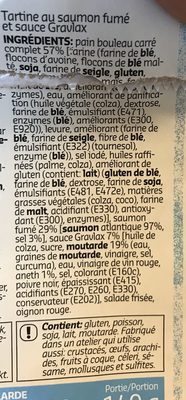
Ingredients image

Tartine saumon fumé et sauce gravlax ingredients image

Ingredients list

pain bouleau carré complet 57% [farine (farine de blé, flocons d'avoine, flocons de blé malté, soja, farine de seigle, gluten, - zymes), eau, améliorant de panification (huile végétale (colza), dextrose, farine de blé, émulsifiant (E471 enzymes (blé), améliorants (E300, Ir E920)), levure, améliorant (farine de blé, farine de seigle fibre de blé, émulsifiant (E322), tournesol), enzyme (blé)), sel iodé, huiles raffinées (palme, colza), améliorant de gluten (contient: lait) (gluten de blé, farine de blé, dextrose, farine de soja, émulsifiants (E481 , E472e), matières grasses végétales (colza, coco), farine de malt, acidifiant (E330), antioxydant (E300), enzymes)], saumon fumé 29% [saumon atlantique 97%, sel 3%], sauce Gravlax 7% [huile de colza, sucre, moutarde 19% (eau, graines de moutarde, vinaigre, sel, curcuma), eau, vinaigre de vin rouge, aneth 1%, sel, colorant (E160c), poivre noir, épaississant (E415), acidifiants (E270, E260, E330), conservateur (E202)], salade frisée, oignon rouge.

Ingredient information

Pain Bouleau Carre Complet
57.0%
Flour
29.8% (estimate)
Wheat Flour
15.08% (estimate)
Oat Flakes
7.36% (estimate)
Malted Wheat Flakes
3.68% (estimate)
Soya Flour
1.84% (estimate)
Rye Flour
0.92% (estimate)
Gluten
0.46% (estimate)
Zymes
0.46% (estimate)
Water
13.6% (estimate)
Bread Improver
6.8% (estimate)
Vegetable Oil
3.4% (estimate)
Colza Oil
3.4% (estimate)
Dextrose
1.7% (estimate)
Wheat Flour
0.85% (estimate)
Emulsifier
0.43% (estimate)
E471 Enzymes
0.21% (estimate)
Wheat
0.21% (estimate)
Enhancer
0.21% (estimate)
E300
0.11% (estimate)
Ir E920
0.11% (estimate)
Yeast
0.21% (estimate)
Enhancer
0.11% (estimate)
Wheat Flour
0.05% (estimate)
Farine De Seigle Fibre De Ble
0.03% (estimate)
Emulsifier
0.01% (estimate)
E322
0.01% (estimate)
Sunflower
0.01% (estimate)
Enzyme
0.05% (estimate)
Wheat
0.05% (estimate)
Iodised Salt
0.03% (estimate)
Oil
0.01% (estimate)
Palm Oil
0.01% (estimate)
Colza Oil
0.01% (estimate)
Enhancer
0.01% (estimate)
Gluten
0% (estimate)
Wheat Gluten
0% (estimate)
Wheat Flour
0% (estimate)
Dextrose
0% (estimate)
Soya Flour
0% (estimate)
Emulsifier
0% (estimate)
E481
0% (estimate)
E472e
0% (estimate)
Vegetable Fat
0% (estimate)
Colza Oil
0% (estimate)
Coconut Oil
0% (estimate)
Malt Flour
0% (estimate)
Acid
0% (estimate)
E330
0% (estimate)
Antioxidant
0% (estimate)
Vitamin C
0% (estimate)
Enzyme
0% (estimate)
Smoked Salmon
29.0%
Atlantic Salmon
28.13%
Salt
0.87%
Sauce Gravlax
7.0%
Colza Oil
2.73% (estimate)
Sugar
2.03% (estimate)
Mustard
1.33%
Water
0.8% (estimate)
Mustard Seed
0.27% (estimate)
Vinegar
0.13% (estimate)
Salt
0.07% (estimate)
Turmeric
0.07% (estimate)
Water
0.49% (estimate)
Red Wine Vinegar
0.24% (estimate)
Dill
0.07%
Salt
0.04% (estimate)
Colour
0.03% (estimate)
E160c
0.03% (estimate)
Black Pepper
0.02% (estimate)
Thickener
0.01% (estimate)
E415
0.01% (estimate)
Acid
0% (estimate)
E270
0% (estimate)
E260
0% (estimate)
E330
0% (estimate)
Preservative
0% (estimate)
E202
0% (estimate)
Curly Endive
5.25% (estimate)
Red Onion
1.75% (estimate)

Added sugars

Contains added sugars (3%) Added sugars: dextrose, sugar Quantity of added sugars: 3%

Allergens

FishGlutenMilkMustardSoybeans

Ingredients analysis

Palm oil free
No

Contains ingredients containing palm oil.

Vegan
No

Contains non-vegan ingredients.

Unrecognized: fr:zymes, fr:ir-e920, fr:farine-de-seigle-fibre-de-ble

Vegetarian
No

Contains non-vegetarian ingredients.

Unrecognized: fr:zymes, fr:ir-e920, fr:farine-de-seigle-fibre-de-ble


Food Processing

NOVA group

4Ultra-processed food and drink products

Elements that indicate the product is in NOVA group 4

Additives
E160c - Paprika extract
Additives
E322 - Lecithins
Additives
E415 - Xanthan gum
Additives
E471 - Mono- and diglycerides of fatty acids
Additives
E472e - Mono- and diacetyltartaric acid esters of mono- and diglycerides of fatty acids
Additives
E481 - Sodium stearoyl-2-lactylate
Ingredients
Colour
Ingredients
Dextrose
Ingredients
Emulsifier
Ingredients
Glucose
Ingredients
Gluten
Ingredients
Thickener

How NOVA works

The NOVA classification assigns food products into 4 groups based on their degree of processing: 1. Unprocessed or minimally processed foods 2. Processed culinary ingredients 3. Processed foods 4. Ultra-processed food and drink products

Additives

E160c - Paprika extractColour

No additive description is available yet.

E202 - Potassium sorbate EFSA overexposure risk: highPreservative

Potassium sorbate (E202) is a synthetic food preservative commonly used to extend the shelf life of various food products.

It works by inhibiting the growth of molds, yeast, and some bacteria, preventing spoilage. When added to foods, it helps maintain their freshness and quality.

Some studies have shown that when combined with nitrites, potassium sorbate have genotoxic activity in vitro. However, potassium sorbate is generally recognized as safe (GRAS) by regulatory authorities.

E260 - Acetic acidPreservative

ACETIC ACID, systematically named ethanoic acid, is a colourless liquid organic compound with the chemical formula CH3COOH (also written as CH3CO2H or C2H4O2).

E270 - Lactic acid

LACTIC ACID is an organic compound with the formula CH3CH(OH)CO2H. In the form of its conjugate base called lactate (this is thus different and kept as a separate ingredient). Lactic acid is chiral, consisting of two optical isomers. One is known as L-(+)-lactic acid or (S)-lactic acid and the other, its mirror image, is D-(−)-lactic acid or (R)-lactic acid in food the L-variant is used

E300 - Ascorbic acidAntioxidantSequestrant

No additive description is available yet.

E322 - LecithinsAntioxidantEmulsifier

Lecithins are natural compounds commonly used in the food industry as emulsifiers and stabilizers.

Extracted from sources like soybeans and eggs, lecithins consist of phospholipids that enhance the mixing of oil and water, ensuring smooth textures in various products like chocolates, dressings, and baked goods.

They do not present any known health risks.

E330 - Citric acidAntioxidantSequestrant

Citric acid is a natural organic acid found in citrus fruits such as lemons, oranges, and limes.

It is widely used in the food industry as a flavor enhancer, acidulant, and preservative due to its tart and refreshing taste.

Citric acid is safe for consumption when used in moderation and is considered a generally recognized as safe (GRAS) food additive by regulatory agencies worldwide.

E415 - Xanthan gumEmulsifierStabiliserThickener

Xanthan gum (E415) is a natural polysaccharide derived from fermented sugars, often used in the food industry as a thickening and stabilizing agent.

This versatile food additive enhances texture and prevents ingredient separation in a wide range of products, including salad dressings, sauces, and gluten-free baked goods.

It is considered safe for consumption even at high intake amounts.

E471 - Mono- and diglycerides of fatty acidsEmulsifierStabiliser

Mono- and diglycerides of fatty acids (E471), are food additives commonly used as emulsifiers in various processed foods.

These compounds consist of glycerol molecules linked to one or two fatty acid chains, which help stabilize and blend water and oil-based ingredients. E471 enhances the texture and shelf life of products like margarine, baked goods, and ice cream, ensuring a smooth and consistent texture.

It is generally considered safe for consumption within established regulatory limits.

E472e - Mono- and diacetyltartaric acid esters of mono- and diglycerides of fatty acidsEmulsifierSequestrantStabiliser

No additive description is available yet.

E481 - Sodium stearoyl-2-lactylate EFSA overexposure risk: highEmulsifierStabiliser

Sodium stearoyl-2-lactylate (sodium stearoyl lactylate or SSL) is a versatile, FDA approved food additive used to improve the mix tolerance and volume of processed foods. It is one type of a commercially available lactylate. SSL is non-toxic, biodegradable, and typically manufactured using biorenewable feedstocks. Because SSL is a safe and highly effective food additive, it is used in a wide variety of products ranging from baked goods and desserts to pet foods.As described by the Food Chemicals Codex 7th edition, SSL is a cream-colored powder or brittle solid. SSL is currently manufactured by the esterification of stearic acid with lactic acid and partially neutralized with either food-grade soda ash (sodium carbonate) or caustic soda (concentrated sodium hydroxide). Commercial grade SSL is a mixture of sodium salts of stearoyl lactylic acids and minor proportions of other sodium salts of related acids. The HLB for SSL is 10-12. SSL is slightly hygroscopic, soluble in ethanol and in hot oil or fat, and dispersible in warm water. These properties are the reason that SSL is an excellent emulsifier for fat-in-water emulsions and can also function as a humectant.

Environment

Green-Score, origins bonus, and transportation impact are shown for Worldwide .

Green Score

Overall grade

FVery high environmental impact

About Green-Score

The Green-Score is an experimental score that summarizes the environmental impacts of food products.

Current scope

The Green-Score was initially developed for France and it is being extended to other European countries. The Green-Score formula is subject to change as it is regularly improved to make it more precise and better suited to each country. Select a country to include the full impact of transportation in the final score.

Life cycle analysis

Average impact of the category

DSalmon, smoked (packaging fixed) • Score: 31/100

Life-cycle reference

Category: Salmon, smoked (packaging fixed) PEF environmental score: 1.02 Climate change impact: 7.85 kg CO2 eq / kg product The overall environmental impact figure (PEF) comes from ADEME's Agribalyse database, for the category: Salmon, smoked (packaging fixed). Source: ADEME Agribalyse Database.

Overall environmental impact by stage (PEF)

The overall environmental impact figure (PEF) comes from ADEME's Agribalyse database, for the category: Salmon, smoked (packaging fixed). Source: ADEME Agribalyse Database.

StageImpact
Agriculture75.5 %
Processing6.6 %
Packaging7.9 %
Transportation9.1 %
Distribution0.6 %
Consumption0.3 %

Bonuses and maluses

Declared origins

Origins of ingredients are missing for this product. Ingredients need to be completed before the transportation bonus can be computed precisely.

Threatened species risk

Contains ingredients that may threaten species or ecosystems, such as palm oil.

Packaging impact

Packaging with a high impact Malus: -15 The information about the packaging of this product is not filled in.

Green-Score for this product

Green-Score for this product

FFinal score: 1/100

Final score breakdown

Life cycle analysis score: 31 Sum of bonuses and maluses: -30 Final score: 1/100

Carbon footprint

Carbon footprint

Equivalent to driving 4.1 km in a petrol car. 785 g CO2e per 100g of product. Reference category: Salmon, smoked (packaging fixed). The carbon emission figure comes from ADEME's Agribalyse database, for the category: Salmon, smoked (packaging fixed). Source: ADEME Agribalyse Database.

Climate impact by stage (CO2e)

The carbon emission figure comes from ADEME's Agribalyse database, for the category: Salmon, smoked (packaging fixed). Source: ADEME Agribalyse Database.

StageImpact
Agriculture70.1 %
Processing3.8 %
Packaging11.5 %
Transportation14.3 %
Distribution0.3 %
Consumption0.1 %

Packaging

Packaging impact

Packaging with a high impact Malus: -15 The information about the packaging of this product is not filled in.

Data precision

The packaging information is not sufficiently precise to compute the most accurate packaging impact. Exact shapes and materials of all packaging components help improve the Green-Score.

Transportation

Declared origins

Origins of ingredients are missing for this product. Ingredients need to be completed before the transportation bonus can be computed precisely.

Forest footprint

Forest footprint

Low risk of deforestation Presence of one or more ingredients at risk of deforestation, but low risk given their quantity, origin and/or labels. Forest Footprint The Forest Footprint is a methodology developed by the association Envol Vert to estimate the risk of deforestation related to our consumption. → More information on the methodology Forest Footprint grade: B Presence of one or more ingredients at risk of deforestation, but low risk given their quantity, origin and/or labels. Total Forest Footprint: 0.000 m² per kg of food

Deforestation risk details

Palm oil Primary ingredient grade: B Primary ingredient: 0.000 m² per kg of food Palm oil production, concentrated mainly in Indonesia and Malaysia, contributes significantly to deforestation. Borneo has lost more than half of its forests since the 1970s. Other risky ingredients These ingredients are not yet assessed for deforestation risk: soya flour soya flour Labels The presence of certain labels can greatly help reduce the risk of deforestation, through the presence of environmental criteria and/or through better remuneration of producers.

Data Source

Product data comes from Open Food Facts. Food Benchmark also adds translations, category comparisons and explanatory calculations.

The database is licensed under ODbL 1.0, individual contents under DbCL 1.0, and product photos under CC BY-SA 3.0.

Product added on February 12, 2018 at 2:08:28 PM UTC by kiliweb .

Last edit on March 17, 2026 at 8:42:24 AM UTC by new-nutrition-bot .

Product page also edited by aleene, annelotte, cupcakes, kiliweb, new-nutrition-bot, openfoodfacts-contributors, roboto-app, tacite-mass-editor, teolemon, yuka.WFljRENxSWNtUFk3aE1KaXh3SEl4ZlpSMjd1RmJWS1NMTTQ4SVE9PQ.