

Carrefour Eclairs 4 PCS
Labels
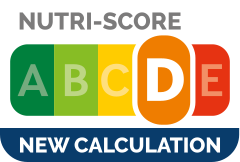 Poor nutritional quality
 Ultra-processed food and drink products
 Moderate environmental impact
Health
Nutrition
Label
Poor nutritional qualityNutrient levels
Fat in moderate quantity (8.3%)
Saturated fat in moderate quantity (3.6%)
Sugars in high quantity (24%)
Salt in moderate quantity (0.4%)
Nutrition facts
| Nutrition facts | As sold for 100 g / 100 ml |
|---|---|
| Energy | 934 kJ (222 kcal) |
| FAT | 8.3 g |
| Saturated fat | 3.6 g |
| Carbohydrates | 33 g |
| Sugars | 24 g |
| Dietary fiber | 0.6 g |
| Proteins | 3.2 g |
| Salt | 0.4 g |
| Sodium | 0.16 g |
| Minerals | |
| Fruits, vegetables and legumes | ~ 0 % |
Nutrition facts (Detailed data)
| Nutrition facts | As sold for 100 g / 100 ml | As sold Per 100 g (packaging) | As sold Per 100 g (estimate) |
|---|---|---|---|
| Energy | 934 kJ (222 kcal) | 934 kJ (222 kcal) | ? |
| FAT | 8.3 g | 8.3 g | ? |
| Saturated fat | 3.6 g | 3.6 g | ? |
| Carbohydrates | 33 g | 33 g | ? |
| Sugars | 24 g | 24 g | ? |
| Added sugars | ~ 12.37 g | ? | ~ 12.37 g |
| Dietary fiber | 0.6 g | 0.6 g | ? |
| Proteins | 3.2 g | 3.2 g | ? |
| Salt | 0.4 g | 0.4 g | ? |
| Sodium | 0.16 g | 0.16 g | ? |
| Minerals | |||
| Fruits, vegetables and legumes | ~ 0 % | ? | ~ 0 % |
Estimated Activity Time
Approximate time needed to burn the energy in 100 g / 100 ml: 934 kJ. Reference adult weight: 70 kg. Energy density: Low.
Ingredients
Ingredients list
Ingredient information
Allergens
Traces
Ingredients analysis
Contains ingredients containing palm oil.
Contains non-vegan ingredients.
Vegetarian status unknown
Food Processing
NOVA group
Ultra-processed food and drink productsElements that indicate the product is in NOVA group 4
How NOVA works
Additives
E1414 - Acetylated distarch phosphateEmulsifierStabiliserThickener
No additive description is available yet.
E14XX - Modified StarchEmulsifierStabiliserThickener
No additive description is available yet.
E160a - caroteneColour
β-Carotene is an organic, strongly colored red-orange pigment abundant in plants and fruits. It is a member of the carotenes, which are terpenoids (isoprenoids), synthesized biochemically from eight isoprene units and thus having 40 carbons. Among the carotenes, β-carotene is distinguished by having beta-rings at both ends of the molecule. β-Carotene is biosynthesized from geranylgeranyl pyrophosphate.β-Carotene is the most common form of carotene in plants. When used as a food coloring, it has the E number E160a. The structure was deduced by Karrer et al. in 1930. In nature, β-carotene is a precursor (inactive form) to vitamin A via the action of beta-carotene 15,15'-monooxygenase.Isolation of β-carotene from fruits abundant in carotenoids is commonly done using column chromatography. It can also be extracted from the beta-carotene rich algae, Dunaliella salina. The separation of β-carotene from the mixture of other carotenoids is based on the polarity of a compound. β-Carotene is a non-polar compound, so it is separated with a non-polar solvent such as hexane. Being highly conjugated, it is deeply colored, and as a hydrocarbon lacking functional groups, it is very lipophilic.
E202 - Potassium sorbatePreservative
Potassium sorbate (E202) is a synthetic food preservative commonly used to extend the shelf life of various food products.
It works by inhibiting the growth of molds, yeast, and some bacteria, preventing spoilage. When added to foods, it helps maintain their freshness and quality.
Some studies have shown that when combined with nitrites, potassium sorbate have genotoxic activity in vitro. However, potassium sorbate is generally recognized as safe (GRAS) by regulatory authorities.
E322 - LecithinsAntioxidantEmulsifier
Lecithins are natural compounds commonly used in the food industry as emulsifiers and stabilizers.
Extracted from sources like soybeans and eggs, lecithins consist of phospholipids that enhance the mixing of oil and water, ensuring smooth textures in various products like chocolates, dressings, and baked goods.
They do not present any known health risks.
E339 - Sodium phosphatesEmulsifierHumectantPreservativeSequestrantStabiliserThickener
TRISODIUM PHOSPHATE is the inorganic compound with the chemical formula Na3PO4.
E401 - sodium alginateCarrierEmulsifierHumectantSequestrantStabiliserThickener
No additive description is available yet.
E420 - SorbitolHumectantSequestrantStabiliserSweetenerThickener
Sorbitol (), less commonly known as glucitol (), is a sugar alcohol with a sweet taste which the human body metabolizes slowly. It can be obtained by reduction of glucose, which changes the aldehyde group to a hydroxyl group. Most sorbitol is made from corn syrup, but it is also found in nature, for example in apples, pears, peaches, and prunes. It is converted to fructose by sorbitol-6-phosphate 2-dehydrogenase. Sorbitol is an isomer of mannitol, another sugar alcohol; the two differ only in the orientation of the hydroxyl group on carbon 2. While similar, the two sugar alcohols have very different sources in nature, melting points, and uses.
E450 - DiphosphatesEmulsifierHumectantSequestrantStabiliserThickener
Diphosphates (E450) are food additives often utilized to modify the texture of products, acting as leavening agents in baking and preventing the coagulation of canned food.
These salts can stabilize whipped cream and are also found in powdered products to maintain their flow properties. They are commonly present in baked goods, processed meats, and soft drinks.
Derived from phosphoric acid, they're part of our daily phosphate intake, which often surpasses recommended levels due to the prevalence of phosphates in processed foods and drinks.
Excessive phosphate consumption is linked to health issues, such as impaired kidney function and weakened bone health. Though diphosphates are generally regarded as safe when consumed within established acceptable daily intakes, it's imperative to monitor overall phosphate consumption to maintain optimal health.
E500 - Sodium carbonatesStabiliserThickener
Sodium carbonates (E500) are compounds commonly used in food preparation as leavening agents, helping baked goods rise by releasing carbon dioxide when they interact with acids.
Often found in baking soda, they regulate the pH of food, preventing it from becoming too acidic or too alkaline. In the culinary world, sodium carbonates can also enhance the texture and structure of foods, such as noodles, by modifying the gluten network.
Generally recognized as safe, sodium carbonates are non-toxic when consumed in typical amounts found in food.
E516 - Calcium sulphateSequestrantStabiliser
Calcium sulfate (or calcium sulphate) is the inorganic compound with the formula CaSO4 and related hydrates. In the form of γ-anhydrite (the anhydrous form), it is used as a desiccant. One particular hydrate is better known as plaster of Paris, and another occurs naturally as the mineral gypsum. It has many uses in industry. All forms are white solids that are poorly soluble in water. Calcium sulfate causes permanent hardness in water.
Environment
Green-Score, origins bonus, and transportation impact are shown for Worldwide .
Green Score
Overall grade
Moderate environmental impactAbout Green-Score
Current scope
Life cycle analysis
Average impact of the category
 Eclair • Score: 68/100
Life-cycle reference
Overall environmental impact by stage (PEF)
The overall environmental impact figure (PEF) comes from ADEME's Agribalyse database, for the category: Eclair. Source: ADEME Agribalyse Database.
| Stage | Impact |
|---|---|
| Agriculture | 59.3 % |
| Processing | 9.9 % |
| Packaging | 25.3 % |
| Transportation | 4.0 % |
| Distribution | 1.5 % |
| Consumption | 0.0 % |
Bonuses and maluses
Production system
Declared origins
Threatened species risk
Packaging impact
Green-Score for this product
Green-Score for this product
Final score: 53/100Final score breakdown
Carbon footprint
Carbon footprint
Climate impact by stage (CO2e)
The carbon emission figure comes from ADEME's Agribalyse database, for the category: Eclair. Source: ADEME Agribalyse Database.
| Stage | Impact |
|---|---|
| Agriculture | 75.8 % |
| Processing | 4.8 % |
| Packaging | 14.3 % |
| Transportation | 4.6 % |
| Distribution | 0.7 % |
| Consumption | 0.0 % |
Packaging
Packaging impact
Data precision
Transportation
Declared origins
Forest footprint
Forest footprint
Ingredients linked to forest pressure
| Ingredient | Type | Percent in product | Forest footprint |
|---|---|---|---|
| EGG | Oeufs Importés | 2.99 % | 0.00 |
Data Source
Data presented on this page is sourced from the Open Food Facts database. This platform does not alter the original dataset; its purpose is solely to enhance data visualization and user accessibility.
Product added on December 29, 2019 at 12:58:30 PM UTC by kiliweb .
Last edit on March 17, 2026 at 7:54:31 PM UTC by new-nutrition-bot .
Product page also edited by kiliweb, new-nutrition-bot, org-carrefour-belgique, teolemon, yuka.E5RaZMSlIcsuLPX3wYts-TiBObfYWadANFILoQ, yuka.YUxzc0YvUmFvOGNPb2YwNDVUYncyL1JRdzdhdlhIMjlDOWNiSVE9PQ.
Source List
- carrefour-belgique