

Nescafe Cappuccino
Health
Nutrition
Nutrition label

Nutrition facts
| Nutrition facts | As sold for 100 g / 100 ml | Compared to: Instant powder for cappuccino with chocolate |
|---|---|---|
| Energy | ? | 1,025.021 kJ (238 kcal) |
| Fat | 1.1 g | 4.853 g (-77%) |
| Saturated fat | 1 g | 4.136 g (-76%) |
| Carbohydrates | 5.8 g | 39.701 g (-85%) |
| Sugars | 3 g | 27.822 g (-89%) |
| Dietary fiber | 0 g | ? |
| Proteins | 1 g | 5.077 g (-80%) |
| Salt | 0.05 mg | 0.501 g (-100%) |
| Sodium | 0.02 mg | 0.201 g (-100%) |
| Alcohol | 0 % vol | ? |
| Fruits, vegetables and legumes | ? | ? |
Nutrition facts (Detailed data)
| Nutrition facts | As sold for 100 g / 100 ml | As sold Per serving (legacy) |
|---|---|---|
| Energy | ? | ? |
| Fat | 1.1 g | ? |
| Saturated fat | 1 g | ? |
| Carbohydrates | 5.8 g | ? |
| Sugars | 3 g | ? |
| Dietary fiber | 0 g | ? |
| Proteins | 1 g | ? |
| Salt | 0.05 mg | ? |
| Sodium | 0.02 mg | ? |
| Alcohol | 0 % vol | 0 % vol |
| Fruits, vegetables and legumes | ? | ? |
Ingredients
Ingredients image
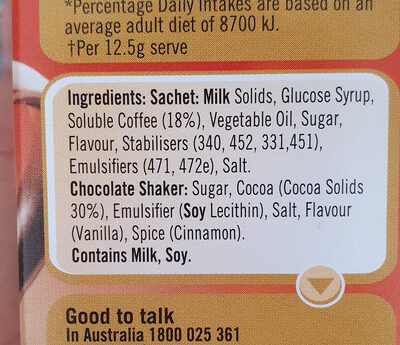
Ingredients list
Ingredient information
Added sugars
Allergens
Ingredients analysis
Palm oil content unknown
Contains non-vegan ingredients.
Unrecognized: en:340, en:452, en:331-451, en:471, en:472e, en:good-to-talk-in-australia-1800-025-361
Vegetarian status unknown
Unrecognized: en:340, en:452, en:331-451, en:471, en:472e, en:good-to-talk-in-australia-1800-025-361
Food Processing
NOVA group
 Ultra-processed food and drink products
Elements that indicate the product is in NOVA group 4
How NOVA works
Additives
E322 - LecithinsAntioxidantEmulsifier
Lecithins are natural compounds commonly used in the food industry as emulsifiers and stabilizers.
Extracted from sources like soybeans and eggs, lecithins consist of phospholipids that enhance the mixing of oil and water, ensuring smooth textures in various products like chocolates, dressings, and baked goods.
They do not present any known health risks.
E322i - LecithinAntioxidantEmulsifier
Lecithins are natural compounds commonly used in the food industry as emulsifiers and stabilizers.
Extracted from sources like soybeans and eggs, lecithins consist of phospholipids that enhance the mixing of oil and water, ensuring smooth textures in various products like chocolates, dressings, and baked goods.
They do not present any known health risks.
E331 - Sodium citratesEmulsifierSequestrantStabiliser
DISODIUM CITRATE, more properly, disodium hydrogen citrate, is an acid salt of citric acid with the chemical formula Na2C6H6O7. It is used as an antioxidant in food and to improve the effects of other antioxidants. It is also used as an acidity regulator and sequestrant. Typical products include gelatin, jam, sweets, ice cream, carbonated beverages, milk powder, wine, and processed cheeses.
E340 - Potassium phosphates EFSA overexposure risk: highEmulsifierHumectantSequestrantStabiliserThickener
Potassium phosphate is a generic term for the salts of potassium and phosphate ions including: Monopotassium phosphate (KH2PO4) (Molar mass approx: 136 g/mol) Dipotassium phosphate (K2HPO4) (Molar mass approx: 174 g/mol) Tripotassium phosphate (K3PO4) (Molar mass approx: 212.27 g/mol)As food additives, potassium phosphates have the E number E340.
E451 - Triphosphates EFSA overexposure risk: highEmulsifierHumectantSequestrantStabiliserThickener
Sodium triphosphate (STP), also sodium tripolyphosphate (STPP), or tripolyphosphate (TPP),) is an inorganic compound with formula Na5P3O10. It is the sodium salt of the polyphosphate penta-anion, which is the conjugate base of triphosphoric acid. It is produced on a large scale as a component of many domestic and industrial products, especially detergents. Environmental problems associated with eutrophication are attributed to its widespread use.
E452 - Polyphosphates EFSA overexposure risk: highEmulsifierHumectantSequestrantStabiliserThickener
No additive description is available yet.
E471 - Mono- and diglycerides of fatty acidsEmulsifierStabiliser
Mono- and diglycerides of fatty acids (E471), are food additives commonly used as emulsifiers in various processed foods.
These compounds consist of glycerol molecules linked to one or two fatty acid chains, which help stabilize and blend water and oil-based ingredients. E471 enhances the texture and shelf life of products like margarine, baked goods, and ice cream, ensuring a smooth and consistent texture.
It is generally considered safe for consumption within established regulatory limits.
E472e - Mono- and diacetyltartaric acid esters of mono- and diglycerides of fatty acidsEmulsifierSequestrantStabiliser
No additive description is available yet.
Environment
Green-Score, origins bonus, and transportation impact are shown for Worldwide .
Green Score
Overall grade
 Very high environmental impact
About Green-Score
Current scope
Life cycle analysis
Average impact of the category
 Coffee with milk or Cappuccino with chocolate, powder, instant, non rehydrated • Score: 30/100
Life-cycle reference
Overall environmental impact by stage (PEF)
The overall environmental impact figure (PEF) comes from ADEME's Agribalyse database, for the category: Coffee with milk or Cappuccino with chocolate, powder, instant, non rehydrated. Source: ADEME Agribalyse Database.
| Stage | Impact |
|---|---|
| Agriculture | 86.9 % |
| Processing | 10.0 % |
| Packaging | 1.0 % |
| Transportation | 1.7 % |
| Distribution | 0.4 % |
| Consumption | 0.0 % |
Bonuses and maluses
Declared origins
Packaging impact
Green-Score for this product
Green-Score for this product
Final score: 10/100Final score breakdown
Carbon footprint
Carbon footprint
Climate impact by stage (CO2e)
The carbon emission figure comes from ADEME's Agribalyse database, for the category: Coffee with milk or Cappuccino with chocolate, powder, instant, non rehydrated. Source: ADEME Agribalyse Database.
| Stage | Impact |
|---|---|
| Agriculture | 83.9 % |
| Processing | 12.6 % |
| Packaging | 1.2 % |
| Transportation | 2.2 % |
| Distribution | 0.2 % |
| Consumption | 0.0 % |
Packaging
Packaging impact
Data precision
Transportation
Declared origins
Data Source
Product data comes from Open Food Facts. Food Benchmark also adds translations, category comparisons and explanatory calculations.
The database is licensed under ODbL 1.0, individual contents under DbCL 1.0, and product photos under CC BY-SA 3.0.
Product added on October 20, 2019 at 4:26:19 AM UTC by openfoodfacts-contributors .
Last edit on November 23, 2025 at 9:34:36 AM UTC by sharhayward .
Product page also edited by archanox, foodless, inf, lcmortensen, openfoodfacts-contributors, roboto-app, sharhayward.