

Escalopes cordon bleu comté x 2
Health
Nutrition
Nutri-Score
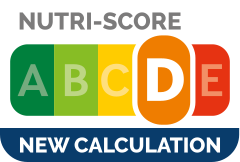 Lower nutritional quality
Nutri-Score data warning
Nutrient levels
Fat in moderate quantity (9.1%)
Saturated fat in moderate quantity (2.5%)
Sugars in low quantity (1.9%)
Salt in high quantity (1.8%)
Nutrition label

Nutrition facts
| Nutrition facts | As sold for 100 g / 100 ml | Compared to: Reconstituted chicken cordons bleus |
|---|---|---|
| Energy | 830 kJ (209 kcal) | 908.349 kJ (217 kcal) (-9%) |
| Fat | 9.1 g | 11.19 g (-19%) |
| Saturated fat | 2.5 g | 2.799 g (-11%) |
| Carbohydrates | 14 g | 14.557 g (-4%) |
| Sugars | 1.9 g | 1.551 g (+23%) |
| Dietary fiber | 1.8 g | ? |
| Proteins | 15 g | 13.671 g (+10%) |
| Salt | 1.8 g | 1.149 g (+57%) |
| Sodium | 0.72 g | 0.462 g (+56%) |
| Fruits, vegetables and legumes | ~ 1.001953125 % | ? |
Nutrition facts (Detailed data)
| Nutrition facts | As sold for 100 g / 100 ml | As sold Per 100 g (packaging) | As sold Per 100 g (estimate) |
|---|---|---|---|
| Energy | 830 kJ (209 kcal) | 830 kJ (209 kcal) | ~ 709.359765625 kJ (168 kcal) |
| Fat | 9.1 g | 9.1 g | ~ 4.857322265625 g |
| Saturated fat | 2.5 g | 2.5 g | ~ 2.5408876953125 g |
| Carbohydrates | 14 g | 14 g | ~ 14.00978046875 g |
| Sugars | 1.9 g | 1.9 g | ~ 0.833625 g |
| Dietary fiber | 1.8 g | 1.8 g | ~ 1.34023828125 g |
| Proteins | 15 g | 15 g | ~ 20.32025390625 g |
| Salt | 1.8 g | 1.8 g | ~ 0.4328840703125 g |
| Sodium | 0.72 g | 0.72 g | ~ 0.169697803125 g |
| Fruits, vegetables and legumes | ~ 1.001953125 % | ? | ~ 1.001953125 % |
Serving size
Ingredients
Ingredients image

Ingredients list
Ingredient information
Added sugars
Allergens
Traces
Ingredients analysis
No ingredients containing palm oil.
Contains non-vegan ingredients.
Contains non-vegetarian ingredients.
Food Processing
NOVA group
 Ultra-processed food and drink products
Elements that indicate the product is in NOVA group 4
How NOVA works
Additives
E14XX - Modified StarchEmulsifierStabiliserThickener
No additive description is available yet.
E202 - Potassium sorbate EFSA overexposure risk: highPreservative
Potassium sorbate (E202) is a synthetic food preservative commonly used to extend the shelf life of various food products.
It works by inhibiting the growth of molds, yeast, and some bacteria, preventing spoilage. When added to foods, it helps maintain their freshness and quality.
Some studies have shown that when combined with nitrites, potassium sorbate have genotoxic activity in vitro. However, potassium sorbate is generally recognized as safe (GRAS) by regulatory authorities.
E250 - Sodium nitrite EFSA overexposure risk: highPreservative
Sodium nitrite (E250) is a salt used for curing and preserving meat products.
It plays a critical role in preventing the growth of Clostridium botulinum, the bacterium responsible for botulism, in cured meats like bacon, ham, and sausages. It also provides the characteristic pink color and flavor.
However, nitrites can react with amines in the stomach to form nitrosamines, which are potent carcinogens. High intake of processed meats containing nitrites is associated with an increased risk of colorectal cancer. Regulatory bodies have set strict limits on its use in food.
E331 - Sodium citratesEmulsifierSequestrantStabiliser
DISODIUM CITRATE, more properly, disodium hydrogen citrate, is an acid salt of citric acid with the chemical formula Na2C6H6O7. It is used as an antioxidant in food and to improve the effects of other antioxidants. It is also used as an acidity regulator and sequestrant. Typical products include gelatin, jam, sweets, ice cream, carbonated beverages, milk powder, wine, and processed cheeses.
E407 - Carrageenan EFSA overexposure risk: highCarrierEmulsifierHumectantStabiliserThickener
Carrageenan (E407), derived from red seaweed, is widely employed in the food industry as a gelling, thickening, and stabilizing agent, notably in dairy and meat products.
It can exist in various forms, each imparting distinct textural properties to food.
However, its degraded form, often referred to as poligeenan, has raised health concerns due to its potential inflammatory effects and its classification as a possible human carcinogen (Group 2B) by the International Agency for Research on Cancer (IARC).
Nevertheless, food-grade carrageenan has been deemed safe by various regulatory bodies when consumed in amounts typically found in food.
E451 - Triphosphates EFSA overexposure risk: highEmulsifierHumectantSequestrantStabiliserThickener
Sodium triphosphate (STP), also sodium tripolyphosphate (STPP), or tripolyphosphate (TPP),) is an inorganic compound with formula Na5P3O10. It is the sodium salt of the polyphosphate penta-anion, which is the conjugate base of triphosphoric acid. It is produced on a large scale as a component of many domestic and industrial products, especially detergents. Environmental problems associated with eutrophication are attributed to its widespread use.
E452 - Polyphosphates EFSA overexposure risk: highEmulsifierHumectantSequestrantStabiliserThickener
No additive description is available yet.
E524 - Sodium hydroxide
Sodium hydroxide, also known as lye and caustic soda, is an inorganic compound with the formula NaOH. It is a white solid ionic compound consisting of sodium cations Na+ and hydroxide anions OH−. Sodium hydroxide is a highly caustic base and alkali that decomposes proteins at ordinary ambient temperatures and may cause severe chemical burns. It is highly soluble in water, and readily absorbs moisture and carbon dioxide from the air. It forms a series of hydrates NaOH·nH2O. The monohydrate NaOH·H2O crystallizes from water solutions between 12.3 and 61.8 °C. The commercially available "sodium hydroxide" is often this monohydrate, and published data may refer to it instead of the anhydrous compound. As one of the simplest hydroxides, it is frequently utilized alongside neutral water and acidic hydrochloric acid to demonstrate the pH scale to chemistry students.Sodium hydroxide is used in many industries: in the manufacture of pulp and paper, textiles, drinking water, soaps and detergents, and as a drain cleaner. Worldwide production in 2004 was approximately 60 million tonnes, while demand was 51 million tonnes.
Environment
Green-Score, origins bonus, and transportation impact are shown for Worldwide .
Green Score
Overall grade
 Very high environmental impact
About Green-Score
Current scope
Life cycle analysis
Average impact of the category
 Escalope cordon bleu (topped with a ham slice and Gruyere sauce) • Score: 35/100
Life-cycle reference
Overall environmental impact by stage (PEF)
The overall environmental impact figure (PEF) comes from ADEME's Agribalyse database, for the category: Escalope cordon bleu (topped with a ham slice and Gruyere sauce). Source: ADEME Agribalyse Database.
| Stage | Impact |
|---|---|
| Agriculture | 74.3 % |
| Processing | 12.5 % |
| Packaging | 5.0 % |
| Transportation | 3.0 % |
| Distribution | 1.1 % |
| Consumption | 4.1 % |
Bonuses and maluses
Origins of ingredients
Packaging impact
Green-Score for this product
Green-Score for this product
Final score: 15/100Final score breakdown
Carbon footprint
Carbon footprint
Climate impact by stage (CO2e)
The carbon emission figure comes from ADEME's Agribalyse database, for the category: Escalope cordon bleu (topped with a ham slice and Gruyere sauce). Source: ADEME Agribalyse Database.
| Stage | Impact |
|---|---|
| Agriculture | 63.2 % |
| Processing | 18.6 % |
| Packaging | 9.4 % |
| Transportation | 6.4 % |
| Distribution | 0.8 % |
| Consumption | 1.7 % |
Packaging

Packaging impact
Packaging components
| Shape | Material | Recycling | Impact |
|---|---|---|---|
| BOX | Plastic | Unknown | High |
| BAG | Cardboard | Unknown | Low |
| Sleeve | Unknown | Unknown | High |
Declared packaging
Data precision
Transportation
Origins of ingredients
Origins breakdown
| Origin | Percent of ingredients | Impact |
|---|---|---|
| European Union | 51 % | High |
| Unknown | 49 % | High |
Forest footprint
Forest footprint
Ingredients linked to forest pressure
| Ingredient | Type | Percent in product | Forest footprint |
|---|---|---|---|
| Chicken Fillet | Poulet Importé | 41.00 % | 1.17 |
Additional information
- Preparation
- Sortir le cordon bleu de poulet du sachet et le réchauffer : AU FOUR TRADITIONNEL : préchauffer le four à 210°C (thermostat 7). Placer les produits sur une plaque ou dans un plat adapté et faire cuire 14 minutes en retournant a mi-cuisson. À LA POELE : laisser cuire dans une poêle à feu doux 6 minutes de chaque côté sans ajout de matière grasse. Afin de conserver toutes les qualités du produit, nous déconseillons le réchauffage au four à micro-ondes.
Data Source
Product data comes from Open Food Facts. Food Benchmark also adds translations, category comparisons and explanatory calculations.
The database is licensed under ODbL 1.0, individual contents under DbCL 1.0, and product photos under CC BY-SA 3.0.
Product added on January 9, 2017 at 10:31:27 AM UTC by openfoodfacts-contributors .
Last edit on March 14, 2026 at 10:32:41 PM UTC by new-nutrition-bot .
Product page also edited by asmoth, beniben, date-limite-app, fpdsurveys, kiliweb, lolo25, new-nutrition-bot, nieki, openfoodfacts-contributors, org-scamark, packbot, quechoisir, roboto-app, scamark, segundo, tacite-mass-editor.
Source List
- Scamark
- scamark