

Salsa Curry
Health
Nutrition
Nutri-Score
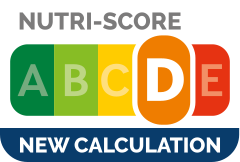 Lower nutritional quality
Nutri-Score data warning
Nutrient levels
Fat in high quantity (37%)
Saturated fat in moderate quantity (3%)
Sugars in low quantity (4.7%)
Salt in high quantity (1.9%)
Nutrition label

Nutrition facts
| Nutrition facts | As sold for 100 g / 100 ml |
|---|---|
| Energy | 1536 kJ (372 kcal) |
| Fat | 37 g |
| Saturated fat | 3 g |
| Carbohydrates | 9.4 g |
| Sugars | 4.7 g |
| Dietary fiber | 0.8 g |
| Proteins | 0.9 g |
| Salt | 1.9 g |
| Sodium | 0.76 g |
| Fruits, vegetables and legumes | ~ 0 % |
Nutrition facts (Detailed data)
| Nutrition facts | As sold for 100 g / 100 ml | As sold Per 100 g (packaging) | As sold Per 100 g (estimate) |
|---|---|---|---|
| Energy | 1536 kJ (372 kcal) | 1536 kJ (372 kcal) | ~ 1153.99776710526 kJ (278 kcal) |
| Fat | 37 g | 37 g | ~ 24.3652700657895 g |
| Saturated fat | 3 g | 3 g | ~ 2.01868219736842 g |
| Carbohydrates | 9.4 g | 9.4 g | ~ 17.3649961513158 g |
| Sugars | 4.7 g | 4.7 g | ~ 7.53564496710526 g |
| Dietary fiber | 0.8 g | 0.8 g | ~ -0.317440789473684 g |
| Proteins | 0.9 g | 0.9 g | ~ 0.524613421052632 g |
| Salt | 1.9 g | 1.9 g | ~ 0.960196071052629 g |
| Sodium | 0.76 g | 0.76 g | ~ 0.383752624210525 g |
| Fruits, vegetables and legumes | ~ 0 % | ? | ~ 0 % |
Ingredients
Ingredients list
Ingredient information
Added sugars
Allergens
Ingredients analysis
Palm oil content unknown
Contains non-vegan ingredients.
Unrecognized: es:aroma-natural-de-curry
Vegetarian status unknown
Unrecognized: es:aroma-natural-de-curry
Food Processing
NOVA group
 Ultra-processed food and drink products
Elements that indicate the product is in NOVA group 4
How NOVA works
Additives
E160a - caroteneColour
β-Carotene is an organic, strongly colored red-orange pigment abundant in plants and fruits. It is a member of the carotenes, which are terpenoids (isoprenoids), synthesized biochemically from eight isoprene units and thus having 40 carbons. Among the carotenes, β-carotene is distinguished by having beta-rings at both ends of the molecule. β-Carotene is biosynthesized from geranylgeranyl pyrophosphate.β-Carotene is the most common form of carotene in plants. When used as a food coloring, it has the E number E160a. The structure was deduced by Karrer et al. in 1930. In nature, β-carotene is a precursor (inactive form) to vitamin A via the action of beta-carotene 15,15'-monooxygenase.Isolation of β-carotene from fruits abundant in carotenoids is commonly done using column chromatography. It can also be extracted from the beta-carotene rich algae, Dunaliella salina. The separation of β-carotene from the mixture of other carotenoids is based on the polarity of a compound. β-Carotene is a non-polar compound, so it is separated with a non-polar solvent such as hexane. Being highly conjugated, it is deeply colored, and as a hydrocarbon lacking functional groups, it is very lipophilic.
E160ai - Beta-caroteneColour
No additive description is available yet.
E161b - LuteinColour
LUTEIN is a xanthophyll and one of 600 known naturally occurring carotenoids. Lutein is extracted from the petals of African marigold (Tagetes erecta). It is approved for use in the EU and Australia and New Zealand. In the United States lutein may not be used as a food coloring for foods intended for human consumption, but can be added to animal feed.
E202 - Potassium sorbate EFSA overexposure risk: highPreservative
Potassium sorbate (E202) is a synthetic food preservative commonly used to extend the shelf life of various food products.
It works by inhibiting the growth of molds, yeast, and some bacteria, preventing spoilage. When added to foods, it helps maintain their freshness and quality.
Some studies have shown that when combined with nitrites, potassium sorbate have genotoxic activity in vitro. However, potassium sorbate is generally recognized as safe (GRAS) by regulatory authorities.
E330 - Citric acidAntioxidantSequestrant
Citric acid is a natural organic acid found in citrus fruits such as lemons, oranges, and limes.
It is widely used in the food industry as a flavor enhancer, acidulant, and preservative due to its tart and refreshing taste.
Citric acid is safe for consumption when used in moderation and is considered a generally recognized as safe (GRAS) food additive by regulatory agencies worldwide.
E412 - Guar gumEmulsifierStabiliserThickener
Guar gum (E412) is a natural food additive derived from guar beans.
This white, odorless powder is valued for its remarkable thickening and stabilizing properties, making it a common ingredient in various food products, including sauces, dressings, and ice creams.
When used in moderation, guar gum is considered safe for consumption, with no known adverse health effects.
E575 - Glucono-delta-lactoneSequestrant
Glucono delta-lactone (GDL), also known as gluconolactone, is a food additive with the E number E575 used as a sequestrant, an acidifier, or a curing, pickling, or leavening agent. It is a lactone of D-gluconic acid. Pure GDL is a white odorless crystalline powder. GDL has been marketed for use in feta cheese. GDL is neutral, but hydrolyses in water to gluconic acid which is acidic, adding a tangy taste to foods, though it has roughly a third of the sourness of citric acid. It is metabolized to 6-phospho-D-gluconate; one gram of GDL yields roughly the same amount of metabolic energy as one gram of sugar. Upon addition to water, GDL is partially hydrolysed to gluconic acid, with the balance between the lactone form and the acid form established as a chemical equilibrium. The rate of hydrolysis of GDL is increased by heat and high pH.The yeast Saccharomyces bulderi can be used to ferment gluconolactone to ethanol and carbon dioxide. The pH value greatly affects culture growth. Gluconolactone at 1 or 2% in a mineral media solution causes the pH to drop below 3.It is also a complete inhibitor of the enzyme amygdalin beta-glucosidase at concentrations of 1 mM.
Environment
Green-Score, origins bonus, and transportation impact are shown for Worldwide .
Green Score
Overall grade
 Unknown environmental impact
About Green-Score
Current scope
Green-Score availability
Bonuses and maluses
Declared origins
Packaging impact
Packaging
Packaging impact
Data precision
Transportation
Declared origins
Forest footprint
Forest footprint
Ingredients linked to forest pressure
| Ingredient | Type | Percent in product | Forest footprint |
|---|---|---|---|
| EGG Yolk | Oeufs Importés | 3.90 % | 0.00 |
Additional information
- Conservation conditions
- Antes de abrir, conservar a temperatura ambiente. Una vez abierto, se conserva un mes en el frigorífico. Consumir preferentemente antes del fin de / Nº de lote: ver en el tapón.
- Customer service
- Interdis - TSA 91431 - 91343 MASSY Cedex - France
Data Source
Product data comes from Open Food Facts. Food Benchmark also adds translations, category comparisons and explanatory calculations.
The database is licensed under ODbL 1.0, individual contents under DbCL 1.0, and product photos under CC BY-SA 3.0.
Product added on July 28, 2019 at 2:12:43 PM UTC by kiliweb .
Last edit on March 17, 2026 at 10:14:38 AM UTC by new-nutrition-bot .
Product page also edited by bot-tags-and-languages, ecoscore-impact-estimator, kiliweb, new-nutrition-bot, org-carrefour, org-carrefour-espana, roboto-app, teolemon, thaialagata, yogoff, yuka.VjUwNUVZQWRtZUl2dXZBWCtEL0U2bzhyeHBPcFdWaStCY1lPSVE9PQ.
Source List
- carrefour
- carrefour-espana