
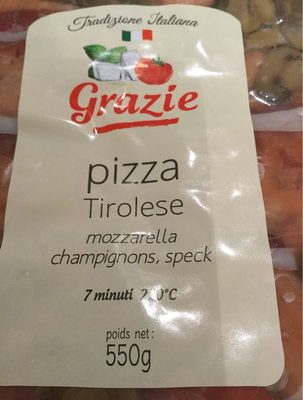
Pizza tirolese mozarella champignons speck
Labels
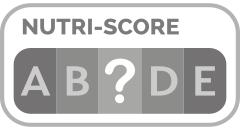 Not computed
 Ultra-processed food and drink products
 Green-Score not computed
Health
Nutrition
Nutrition label
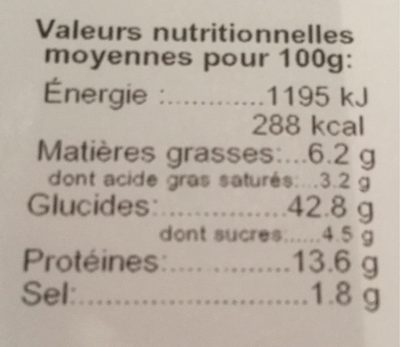
Nutrition facts
| Nutrition facts | As sold for 100 g / 100 ml |
|---|---|
| Energy | ~ 1,188.2 kJ (288 kcal) |
| FAT | 6.2 g |
| Saturated fat | 3.2 g |
| Carbohydrates | 42.8 g |
| Sugars | 4.5 g |
| Dietary fiber | ? |
| Proteins | 13.6 g |
| Salt | 1.8 g |
| Sodium | 0.72 g |
| Minerals | |
| Fruits, vegetables and legumes | ~ 9.33 % |
Nutrition facts (Detailed data)
| Nutrition facts | As sold for 100 g / 100 ml | As sold Per 100 g (packaging) | As sold Per 100 g (estimate) |
|---|---|---|---|
| Energy | ~ 1,188.2 kJ (288 kcal) | ? (288 kcal) | ? |
| FAT | 6.2 g | 6.2 g | ? |
| Saturated fat | 3.2 g | 3.2 g | ? |
| Carbohydrates | 42.8 g | 42.8 g | ? |
| Sugars | 4.5 g | 4.5 g | ? |
| Added sugars | ~ 0 g | ? | ~ 0 g |
| Dietary fiber | ? | ? | ? |
| Proteins | 13.6 g | 13.6 g | ? |
| Salt | 1.8 g | 1.8 g | ? |
| Sodium | 0.72 g | 0.72 g | ? |
| Minerals | |||
| Fruits, vegetables and legumes | ~ 9.33 % | ? | ~ 9.33 % |
Estimated Activity Time
Approximate time needed to burn the energy in 100 g / 100 ml: 1,188 kJ. Reference adult weight: 70 kg. Energy density: Moderate.
Ingredients
Ingredients image

Ingredients list
Ingredient information
Allergens
Traces
Ingredients analysis
No ingredients containing palm oil.
Contains non-vegan ingredients.
Unrecognized: fr:mozzarella-1-speck, fr:traces-de
Contains non-vegetarian ingredients.
Unrecognized: fr:mozzarella-1-speck, fr:traces-de
Food Processing
NOVA group
Ultra-processed food and drink productsElements that indicate the product is in NOVA group 4
How NOVA works
Additives
E202 - Potassium sorbatePreservative
Potassium sorbate (E202) is a synthetic food preservative commonly used to extend the shelf life of various food products.
It works by inhibiting the growth of molds, yeast, and some bacteria, preventing spoilage. When added to foods, it helps maintain their freshness and quality.
Some studies have shown that when combined with nitrites, potassium sorbate have genotoxic activity in vitro. However, potassium sorbate is generally recognized as safe (GRAS) by regulatory authorities.
E250 - Sodium nitritePreservative
Sodium nitrite (E250) is a salt used for curing and preserving meat products.
It plays a critical role in preventing the growth of Clostridium botulinum, the bacterium responsible for botulism, in cured meats like bacon, ham, and sausages. It also provides the characteristic pink color and flavor.
However, nitrites can react with amines in the stomach to form nitrosamines, which are potent carcinogens. High intake of processed meats containing nitrites is associated with an increased risk of colorectal cancer. Regulatory bodies have set strict limits on its use in food.
E251 - Sodium nitratePreservative
SODIUM NITRATE is the chemical compound with the formula NaNO3. Sodium nitrate is a food additive used as a preservative and colour fixative in cured meats and poultry
E322 - LecithinsAntioxidantEmulsifier
Lecithins are natural compounds commonly used in the food industry as emulsifiers and stabilizers.
Extracted from sources like soybeans and eggs, lecithins consist of phospholipids that enhance the mixing of oil and water, ensuring smooth textures in various products like chocolates, dressings, and baked goods.
They do not present any known health risks.
E322i - LecithinAntioxidantEmulsifier
Lecithins are natural compounds commonly used in the food industry as emulsifiers and stabilizers.
Extracted from sources like soybeans and eggs, lecithins consist of phospholipids that enhance the mixing of oil and water, ensuring smooth textures in various products like chocolates, dressings, and baked goods.
They do not present any known health risks.
E330 - Citric acidAntioxidantSequestrant
Citric acid is a natural organic acid found in citrus fruits such as lemons, oranges, and limes.
It is widely used in the food industry as a flavor enhancer, acidulant, and preservative due to its tart and refreshing taste.
Citric acid is safe for consumption when used in moderation and is considered a generally recognized as safe (GRAS) food additive by regulatory agencies worldwide.
Environment
Green-Score, origins bonus, and transportation impact are shown for Worldwide .
Green Score
Overall grade
Unknown environmental impactAbout Green-Score
Current scope
Green-Score availability
Bonuses and maluses
Origins of ingredients
Packaging impact
Packaging
Packaging impact
Data precision
Transportation
Origins of ingredients
Origins breakdown
| Origin | Percent of ingredients | Impact |
|---|---|---|
| Unknown | 98 % | High |
| European Union | 2 % | High |
Forest footprint
Forest footprint
Ingredients linked to forest pressure
| Ingredient | Type | Percent in product | Forest footprint |
|---|---|---|---|
| EGG | Oeufs Importés | 0.90 % | 0.00 |
Data Source
Data presented on this page is sourced from the Open Food Facts database. This platform does not alter the original dataset; its purpose is solely to enhance data visualization and user accessibility.
Product added on October 25, 2017 at 4:35:41 PM UTC by kiliweb .
Last edit on March 17, 2026 at 8:51:03 PM UTC by new-nutrition-bot .
Product page also edited by date-limite-app, kiliweb, new-nutrition-bot, openfoodfacts-contributors, roboto-app, yuka.Ry9nOFBhTWlyTk5VeS9CbjRCM1U5NEovbUxDN1ZqT3hLTkllSVE9PQ.