

Delice de dinde
Health
Nutrition
Nutri-Score
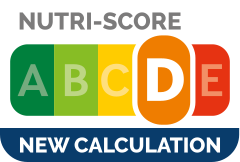 Lower nutritional quality
Nutri-Score data warning
Nutrient levels
Fat in moderate quantity (4.1%)
Saturated fat in low quantity (1.4%)
Sugars in low quantity (2.7%)
Salt in high quantity (3.35%)
Nutrition facts
| Nutrition facts | As sold for 100 g / 100 ml | Compared to: Poultry hams |
|---|---|---|
| Energy | ~ 444.1 kJ (106 kcal) | 442.723 kJ (105 kcal) (~0%) |
| Fat | 4.1 g | 2.047 g (+100%) |
| Saturated fat | 1.4 g | 0.639 g (+119%) |
| Carbohydrates | 4.2 g | 1.656 g (+154%) |
| Sugars | 2.7 g | 0.814 g (+232%) |
| Dietary fiber | ? | ? |
| Proteins | 13 g | 19.478 g (-33%) |
| Salt | 3.35 g | 1.868 g (+79%) |
| Sodium | 1.34 g | 0.745 g (+80%) |
| Fruits, vegetables and legumes | ~ 0 % | ? |
Nutrition facts (Detailed data)
| Nutrition facts | As sold for 100 g / 100 ml | As sold Per 100 g (packaging) | As sold Per 100 g (estimate) |
|---|---|---|---|
| Energy | ~ 444.1 kJ (106 kcal) | ? (106 kcal) | ? |
| Fat | 4.1 g | 4.1 g | ? |
| Saturated fat | 1.4 g | 1.4 g | ? |
| Carbohydrates | 4.2 g | 4.2 g | ? |
| Sugars | 2.7 g | 2.7 g | ? |
| Dietary fiber | ? | ? | ? |
| Proteins | 13 g | 13 g | ? |
| Salt | 3.35 g | 3.35 g | ? |
| Sodium | 1.34 g | 1.34 g | ? |
| Fruits, vegetables and legumes | ~ 0 % | ? | ~ 0 % |
Ingredients
Ingredients image

Ingredients list
Ingredient information
Allergens
Traces
Ingredients analysis
No ingredients containing palm oil.
Unrecognized: fr:farine-d-iue-dextrose-de-mais, fr:sel-stabilisants, en:e450iiil, fr:aronp, fr:ail-antioxydant, fr:001, fr:conse-rva-feu-r, fr:soja-a-consonif-r-innediatenpnt
Contains non-vegan ingredients.
Unrecognized: fr:farine-d-iue-dextrose-de-mais, en:e450iiil, fr:aronp, fr:ail-antioxydant, fr:001, fr:conse-rva-feu-r, fr:soja-a-consonif-r-innediatenpnt
Contains non-vegetarian ingredients.
Unrecognized: fr:farine-d-iue-dextrose-de-mais, en:e450iiil, fr:aronp, fr:ail-antioxydant, fr:001, fr:conse-rva-feu-r, fr:soja-a-consonif-r-innediatenpnt
Food Processing
NOVA group
 Ultra-processed food and drink products
Elements that indicate the product is in NOVA group 4
How NOVA works
Additives
E407a - Processed eucheuma seaweed EFSA overexposure risk: highCarrierEmulsifierHumectantStabiliserThickener
Carrageenans or carrageenins ( karr-ə-gee-nənz, from Irish carraigín, "little rock") are a family of linear sulfated polysaccharides that are extracted from red edible seaweeds. They are widely used in the food industry, for their gelling, thickening, and stabilizing properties. Their main application is in dairy and meat products, due to their strong binding to food proteins. There are three main varieties of carrageenan, which differ in their degree of sulfation. Kappa-carrageenan has one sulfate group per disaccharide, iota-carrageenan has two, and lambda-carrageenan has three. Gelatinous extracts of the Chondrus crispus (Irish moss) seaweed have been used as food additives since approximately the fifteenth century. Carrageenan is a vegetarian and vegan alternative to gelatin in some applications or may be used to replace gelatin in confectionery.
E508 - Potassium chloride EFSA overexposure risk: moderateStabiliserThickenerPreservative
Potassium chloride (KCl) is a metal halide salt composed of potassium and chlorine. It is odorless and has a white or colorless vitreous crystal appearance. The solid dissolves readily in water and its solutions have a salt-like taste. KCl is used as a fertilizer, in medicine, in scientific applications, and in food processing. In a few states of the United States it is used to cause cardiac arrest as the third drug in the "three drug cocktail" for executions by lethal injection. It occurs naturally as the mineral sylvite, and in combination with sodium chloride as sylvinite.The version for injection is on the World Health Organization's List of Essential Medicines, the most important medications needed in a basic health system.
Environment
Green-Score, origins bonus, and transportation impact are shown for Worldwide .
Green Score
Overall grade
 Unknown environmental impact
About Green-Score
Current scope
Green-Score availability
Bonuses and maluses
Origins of ingredients
Packaging impact
Packaging
Packaging impact
Data precision
Transportation
Origins of ingredients
Origins breakdown
| Origin | Percent of ingredients | Impact |
|---|---|---|
| France | 54 % | Medium |
| Unknown | 46 % | Medium |
Forest footprint
Forest footprint
Ingredients linked to forest pressure
| Ingredient | Type | Percent in product | Forest footprint |
|---|---|---|---|
| EGG | Oeufs Importés | 0.04 % | 0.00 |
Data Source
Product data comes from Open Food Facts. Food Benchmark also adds translations, category comparisons and explanatory calculations.
The database is licensed under ODbL 1.0, individual contents under DbCL 1.0, and product photos under CC BY-SA 3.0.
Product added on February 17, 2018 at 12:14:22 PM UTC by kiliweb .
Last edit on March 14, 2026 at 7:34:05 PM UTC by new-nutrition-bot .
Product page also edited by desan, harragastudios, kiliweb, new-nutrition-bot, openfoodfacts-contributors, roboto-app, yuka.CK9TP9-mMJwLPsPzwK847QaiOOjnX-QDFFkdoQ, yuka.UW9RakYvd0hvL0l4cHNWaDBDeisxY04zOWFTcUFrcXZkZGNBSVE9PQ, yuka.sY2b0xO6T85zoF3NwEKvlhV6b_P9pxLuEEzkuHGVz4fWH4DEbohC0NTwLKs.