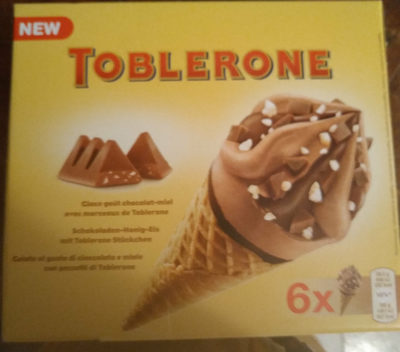
ProductsTOBLERONECônes glace au cacao miel & morceaux de chocolat au lait
Cônes glace au cacao miel & morceaux de chocolat au lait
Barcode 3274661106945
TOBLERONE

Cônes glace au cacao miel & morceaux de chocolat au lait

6
BARCODE:3274661106945
COMMON NAME:cornet glaçé
CATEGORIES:Desserts, Frozen Foods, Frozen Desserts, Ice Creams And Sorbets, Ice Creams, Ice Cream Cones
PACKAGING:Frozen
MANUFACTURING:France
COUNTRIES:France
STORES:Magasins U

Labels

Nutri-Score
Nutri-ScoreBad nutritional quality
NOVA Group
NOVA GroupUltra-processed food and drink products
Green-Score
Green-ScoreModerate environmental impact

Health

Nutrition

Label

EBad nutritional quality

Nutrient levels

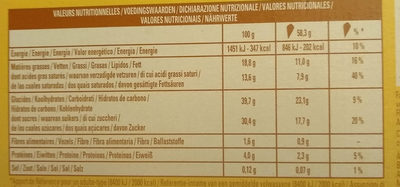
Fat in moderate quantity (18.8%)
What you need to know • A high consumption of fat, especially saturated fats, can raise cholesterol, which increases the risk of heart diseases. Recommendation: Limit the consumption of fat and saturated fat • Choose products with lower fat and saturated fat content. Source: National Health Service UK (NHS) - Fat: the facts
Saturated fat in high quantity (13.6%)
What you need to know • A high consumption of fat, especially saturated fats, can raise cholesterol, which increases the risk of heart diseases. Recommendation: Limit the consumption of fat and saturated fat • Choose products with lower fat and saturated fat content. Source: National Health Service UK (NHS) - Fat: the facts
Sugars in high quantity (30.4%)
What you need to know • A high consumption of sugar can cause weight gain and tooth decay. It also augments the risk of type 2 diabetes and cardio-vascular diseases. Recommendation: Limit the consumption of sugar and sugary drinks • Sugary drinks (such as sodas, fruit beverages, and fruit juices and nectars) should be limited as much as possible (no more than 1 glass a day). • Choose products with lower sugar content and reduce the consumption of products with added sugars. Source: National Health Service UK (NHS) - Sugar: the facts
Salt in low quantity (0.125%)
What you need to know • A high consumption of salt (or sodium) can cause raised blood pressure, which can increase the risk of heart disease and stroke. • Many people who have high blood pressure do not know it, as there are often no symptoms. • Most people consume too much salt (on average 9 to 12 grams per day), around twice the recommended maximum level of intake. Recommendation: Limit the consumption of salt and salted food • Reduce the quantity of salt used when cooking, and don't salt again at the table. • Limit the consumption of salty snacks and choose products with lower salt content. Source: World Health Organization (WHO) - Fact sheet - Salt reduction Source: National Health Service UK (NHS) - Salt: the facts

Nutrition label

Cônes glace au cacao miel & morceaux de chocolat au lait nutrition label

Nutrition facts

Nutrition factsAs sold for 100 g / 100 ml
Energy~ 1,453.7 kJ (347 kcal)
FAT18.8 g
Saturated fat13.6 g
Carbohydrates39.7 g
Sugars30.4 g
Dietary fiber1.9 g
Proteins4 g
Salt0.13 g
Sodium0.05 g
Minerals
Fruits, vegetables and legumes~ 0 %

Nutrition facts (Detailed data)

Nutrition factsAs sold for 100 g / 100 mlAs sold Per 100 g (packaging)As sold Per 100 g (estimate)
Energy~ 1,453.7 kJ (347 kcal)? (347 kcal)~ 1,229.83 kJ (295 kcal)
FAT18.8 g18.8 g~ 18.71 g
Saturated fat13.6 g13.6 g~ 12.6 g
Cholesterol~ 0 g?~ 0 g
Carbohydrates39.7 g39.7 g~ 27.17 g
Sugars30.4 g30.4 g~ 19.72 g
Added sugars~ 22.2 g?~ 22.2 g
Sucrose~ 17.91 g?~ 17.91 g
Glucose~ 0.01 g?~ 0.01 g
Fructose~ 0.01 g?~ 0.01 g
Galactose~ 0 g?~ 0 g
Lactose~ 1.7 g?~ 1.7 g
Maltose~ 0.12 g?~ 0.12 g
Starch~ 6.37 g?~ 6.37 g
Polyols~ 0 g?~ 0 g
Dietary fiber1.9 g1.9 g~ 1.46 g
Proteins4 g4 g~ 3.74 g
Salt0.13 g0.13 g~ 0.05 g
Sodium0.05 g0.05 g~ 0.02 g
Alcohol~ 0 % vol?~ 0 % vol
Vitamins
Vitamin A~ 0 g?~ 0 g
Beta-carotene~ 0 g?~ 0 g
Vitamin D~ 0 g?~ 0 g
Vitamin E~ 0 g?~ 0 g
Vitamin C~ 0 g?~ 0 g
Vitamin B1~ 0 g?~ 0 g
Vitamin B2~ 0 g?~ 0 g
Vitamin PP~ 0 g?~ 0 g
Vitamin B6~ 0 g?~ 0 g
Vitamin B9~ 0 g?~ 0 g
Vitamin B12~ 0 g?~ 0 g
Pantothenic acid~ 0 g?~ 0 g
Minerals
Potassium~ 0.14 g?~ 0.14 g
Calcium~ 0.06 g?~ 0.06 g
Phosphorus~ 0.09 g?~ 0.09 g
Iron~ 0 g?~ 0 g
Magnesium~ 0.03 g?~ 0.03 g
Zinc~ 0 g?~ 0 g
Copper~ 0 g?~ 0 g
Manganese~ 0 g?~ 0 g
Selenium~ 0 g?~ 0 g
Iodine~ 0 g?~ 0 g
Fruits, vegetables and legumes~ 0 %?~ 0 %
Phylloquinone~ 0 g?~ 0 g
Water~ 44.93 g?~ 44.93 g

Estimated Activity Time

Approximate time needed to burn the energy in 100 g / 100 ml: 1,454 kJ. Reference adult weight: 70 kg. Energy density: Moderate.

Walking
85 min (~8,476 steps)
Swimming
51 min
Bicycling
40 min
Running
30 min

Ingredients

Ingredients image

Cônes glace au cacao miel & morceaux de chocolat au lait ingredients image

Ingredients list

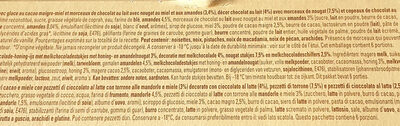
LAIT écrémé reconstitué, sucre, graisse végétale de coprah, eau, farine de BLÉ, AMANDES 4.7%, morceaux de chocolat au LAIT avec nougat au miel et aux AMANDES 3.4% (sucre, LAIT en poudre, beurre de cacao, pâte de cacao, miel 3%, BEURRE concentré, AMANDES 1.6%, émulsifiant (lécithine de SOJA), blanc d’œuf, arômes), miel 3%, poudre de cacao maigre 2.8%, sirop de glucose, beurre de cacao, sirop de glucose-fructose, lactosérum en poudre (LAIT), émulsifiants (mono et diglycérides d’acides gras, lécithine de SOJA, E476), gélifiants (farine de graines de caroube, gomme guar), BEURRE concentré, poudre de LAIT entier, pâte de cacao, huile végétale de palme, poudre de LAIT écrémé, LACTOSE, sel, blanc d’œuf, arôme naturel de vanille. Pourcentages exprimés sur la totalité de la recette.

Ingredient information

Skimmed Milk
34.3% (estimate)
Sugar
17.55% (estimate)
Coconut Oil
14.57% (estimate)
Water
12.1% (estimate)
Wheat Flour
10.62% (estimate)
Almond
4.7%
Morceaux De Chocolat Au Lait Avec Nougat Au Miel
3.4%
Almond
3.4%
Sugar
1.55% (estimate)
Milk Powder
0.66% (estimate)
Cocoa Butter
0.33% (estimate)
Cocoa Paste
0.16% (estimate)
Honey
0.1%
Butterfat
0.03% (estimate)
Almond
0.05%
Emulsifier
< 0.05% (estimate)
Soya Lecithin
< 0.05% (estimate)
Egg White
< 0.05% (estimate)
Flavouring
< 0.05% (estimate)
Honey
3.0%
Fat Reduced Cocoa Powder
2.8%
Glucose Syrup
< 2.8% (estimate)
Cocoa Butter
< 2.8% (estimate)
Glucose Fructose Syrup
< 2.8% (estimate)
Whey Powder
< 2.8% (estimate)
Emulsifier
< 2.8% (estimate)
E471
< 2.8% (estimate)
Soya Lecithin
< 1.4% (estimate)
E476
< 0.93% (estimate)
Gelling Agent
< 2.8% (estimate)
Carob Seed Flour
< 2.8% (estimate)
E412
< 1.4% (estimate)
Butterfat
< 2.8% (estimate)
Whole Milk Powder
< 2.8% (estimate)
Cocoa Paste
< 2.8% (estimate)
Palm Oil
< 2.8% (estimate)
Skimmed Milk Powder
< 2.8% (estimate)
Lactose
< 2.8% (estimate)
Salt
< 0.13% (estimate)
Egg White
< 0.13% (estimate)
Natural Vanilla Flavouring
< 0.13% (estimate)

Allergens

EggsGlutenMilkNutsSoybeans

Ingredients analysis

Palm oil free
No

Contains ingredients containing palm oil.

Vegan
No

Contains non-vegan ingredients.

Unrecognized: fr:morceaux-de-chocolat-au-lait-avec-nougat-au-miel

Vegetarian
Unknown

Vegetarian status unknown

Unrecognized: fr:morceaux-de-chocolat-au-lait-avec-nougat-au-miel


Food Processing

NOVA group

4Ultra-processed food and drink products

Elements that indicate the product is in NOVA group 4

Additives
E322 - Lecithins
Additives
E412 - Guar gum
Additives
E471 - Mono- and diglycerides of fatty acids
Additives
E476 - Polyglycerol polyricinoleate
Ingredients
Emulsifier
Ingredients
Flavouring
Ingredients
Gelling Agent
Ingredients
Glucose
Ingredients
Glucose Syrup
Ingredients
Lactose
Ingredients
Whey
Ingredients
Fructose

How NOVA works

The NOVA classification assigns food products into 4 groups based on their degree of processing: 1. Unprocessed or minimally processed foods 2. Processed culinary ingredients 3. Processed foods 4. Ultra-processed food and drink products

Additives

E322 - LecithinsAntioxidantEmulsifier

Lecithins are natural compounds commonly used in the food industry as emulsifiers and stabilizers.

Extracted from sources like soybeans and eggs, lecithins consist of phospholipids that enhance the mixing of oil and water, ensuring smooth textures in various products like chocolates, dressings, and baked goods.

They do not present any known health risks.

E322i - LecithinAntioxidantEmulsifier

Lecithins are natural compounds commonly used in the food industry as emulsifiers and stabilizers.

Extracted from sources like soybeans and eggs, lecithins consist of phospholipids that enhance the mixing of oil and water, ensuring smooth textures in various products like chocolates, dressings, and baked goods.

They do not present any known health risks.

E412 - Guar gumEmulsifierStabiliserThickener

Guar gum (E412) is a natural food additive derived from guar beans.

This white, odorless powder is valued for its remarkable thickening and stabilizing properties, making it a common ingredient in various food products, including sauces, dressings, and ice creams.

When used in moderation, guar gum is considered safe for consumption, with no known adverse health effects.

E471 - Mono- and diglycerides of fatty acidsEmulsifierStabiliser

Mono- and diglycerides of fatty acids (E471), are food additives commonly used as emulsifiers in various processed foods.

These compounds consist of glycerol molecules linked to one or two fatty acid chains, which help stabilize and blend water and oil-based ingredients. E471 enhances the texture and shelf life of products like margarine, baked goods, and ice cream, ensuring a smooth and consistent texture.

It is generally considered safe for consumption within established regulatory limits.

E476 - Polyglycerol polyricinoleateEmulsifier

Polyglycerol polyricinoleate (PGPR), E476, is an emulsifier made from glycerol and fatty acids (usually from castor bean, but also from soybean oil). In chocolate, compound chocolate and similar coatings, PGPR is mainly used with another substance like lecithin to reduce viscosity. It is used at low levels (below 0.5%), and works by decreasing the friction between the solid particles (e.g. cacao, sugar, milk) in molten chocolate, reducing the yield stress so that it flows more easily, approaching the behaviour of a Newtonian fluid. It can also be used as an emulsifier in spreads and in salad dressings, or to improve the texture of baked goods. It is made up of a short chain of glycerol molecules connected by ether bonds, with ricinoleic acid side chains connected by ester bonds. PGPR is a yellowish, viscous liquid, and is strongly lipophilic: it is soluble in fats and oils and insoluble in water and ethanol.

Environment

Green-Score, origins bonus, and transportation impact are shown for Worldwide .

Green Score

Overall grade

CModerate environmental impact

About Green-Score

The Green-Score is an experimental score that summarizes the environmental impacts of food products.

Current scope

The Green-Score was initially developed for France and it is being extended to other European countries. The Green-Score formula is subject to change as it is regularly improved to make it more precise and better suited to each country. Select a country to include the full impact of transportation in the final score.

Life cycle analysis

Average impact of the category

AIce cream, cone (normal size) • Score: 86/100

Life-cycle reference

Category: Ice cream, cone (normal size) PEF environmental score: 0.23 Climate change impact: 1.92 kg CO2 eq / kg product The overall environmental impact figure (PEF) comes from ADEME's Agribalyse database, for the category: Ice cream, cone (normal size). Source: ADEME Agribalyse Database.

Overall environmental impact by stage (PEF)

The overall environmental impact figure (PEF) comes from ADEME's Agribalyse database, for the category: Ice cream, cone (normal size). Source: ADEME Agribalyse Database.

StageImpact
Agriculture50.2 %
Processing16.5 %
Packaging13.8 %
Transportation7.9 %
Distribution7.4 %
Consumption4.3 %

Bonuses and maluses

Declared origins

Origins of ingredients are missing for this product. Ingredients need to be completed before the transportation bonus can be computed precisely.

Threatened species risk

Contains ingredients that may threaten species or ecosystems, such as palm oil.

Packaging impact

Packaging with a high impact Malus: -15 The information about the packaging of this product is not filled in.

Green-Score for this product

Green-Score for this product

CFinal score: 56/100

Final score breakdown

Life cycle analysis score: 86 Sum of bonuses and maluses: -30 Final score: 56/100

Carbon footprint

Carbon footprint

Equivalent to driving 1.0 km in a petrol car. 192 g CO2e per 100g of product. Reference category: Ice cream, cone (normal size). The carbon emission figure comes from ADEME's Agribalyse database, for the category: Ice cream, cone (normal size). Source: ADEME Agribalyse Database.

Climate impact by stage (CO2e)

The carbon emission figure comes from ADEME's Agribalyse database, for the category: Ice cream, cone (normal size). Source: ADEME Agribalyse Database.

StageImpact
Agriculture55.2 %
Processing10.1 %
Packaging17.1 %
Transportation12.7 %
Distribution3.5 %
Consumption1.3 %

Packaging

Packaging impact

Packaging with a high impact Malus: -15 The information about the packaging of this product is not filled in.

Declared packaging

Frozen

Data precision

The packaging information is not sufficiently precise to compute the most accurate packaging impact. Exact shapes and materials of all packaging components help improve the Green-Score.

Transportation

Manufacturing locations

France

Declared origins

Origins of ingredients are missing for this product. Ingredients need to be completed before the transportation bonus can be computed precisely.

Forest footprint

Forest footprint

Total forest footprint: 0.00 m2 per kg of food This estimate highlights ingredients that depend on soy-linked animal feed and deforestation risk.

Ingredients linked to forest pressure

IngredientTypePercent in productForest footprint
EGG WhiteOeufs Importés0.00 %0.00

Data Source

Data presented on this page is sourced from the Open Food Facts database. This platform does not alter the original dataset; its purpose is solely to enhance data visualization and user accessibility.

Product added on June 22, 2017 at 12:52:46 PM UTC by mdv02 .

Last edit on March 18, 2026 at 12:28:54 AM UTC by new-nutrition-bot .

Product page also edited by date-limite-app, jcbad, magasins-u, mdv02, mdv03, moon-rabbit, mrhalal, new-nutrition-bot, openfoodfacts-contributors, packbot, valouj, yuka.Vkxzc1RZTUcvL0FWcC9JMTJFM2U0TllybTZDM2MyWG5NdUFXSVE9PQ.