

Mon moelleux au chocolat facile
Health
Nutrition
Nutri-Score
 Lower nutritional quality
Nutri-Score data warning
Nutrient levels
Fat in high quantity (21%)
Saturated fat in moderate quantity (4.3%)
Sugars in high quantity (32%)
Salt in moderate quantity (0.79%)
Nutrition facts
| Nutrition facts | As sold for 100 g / 100 ml | Compared to: Molten chocolate cakes |
|---|---|---|
| Energy | 1748 kJ (417 kcal) | 1,757.927 kJ (422 kcal) (-1%) |
| Fat | 21 g | 24.748 g (-15%) |
| Saturated fat | 4.3 g | 10.805 g (-60%) |
| Carbohydrates | 52 g | 42.634 g (+22%) |
| Sugars | 32 g | 31.707 g (+1%) |
| Dietary fiber | ~ 1.8640125 g | ? |
| Proteins | 5.1 g | 6.095 g (-16%) |
| Salt | 0.79 g | 0.322 g (+145%) |
| Sodium | 0.316 g | 0.13 g (+143%) |
| Fruits, vegetables and legumes | ~ 0 % | ? |
Nutrition facts (Detailed data)
| Nutrition facts | As sold for 100 g / 100 ml | As sold Per 100 g (packaging) | As sold Per 100 g (estimate) |
|---|---|---|---|
| Energy | 1748 kJ (417 kcal) | 1748 kJ (417 kcal) | ~ 1800.49172916667 kJ (431 kcal) |
| Fat | 21 g | 21 g | ~ 25.8395672395833 g |
| Saturated fat | 4.3 g | 4.3 g | ~ 2.343174265625 g |
| Carbohydrates | 52 g | 52 g | ~ 47.4612591666667 g |
| Sugars | 32 g | 32 g | ~ 45.1436320833333 g |
| Dietary fiber | ~ 1.8640125 g | ? | ~ 1.8640125 g |
| Proteins | 5.1 g | 5.1 g | ~ 1.30173713541667 g |
| Salt | 0.79 g | 0.79 g | ~ 0.0421122755208259 g |
| Sodium | 0.316 g | 0.316 g | ~ 0.0166519425520804 g |
| Fruits, vegetables and legumes | ~ 0 % | ? | ~ 0 % |
Ingredients
Ingredients image
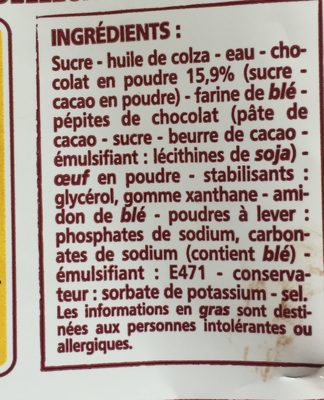
Ingredients list
Ingredient information
Added sugars
Allergens
Ingredients analysis
Palm oil content unknown
Contains non-vegan ingredients.
Vegetarian status unknown
Food Processing
NOVA group
 Ultra-processed food and drink products
Elements that indicate the product is in NOVA group 4
How NOVA works
Additives
E202 - Potassium sorbate EFSA overexposure risk: highPreservative
Potassium sorbate (E202) is a synthetic food preservative commonly used to extend the shelf life of various food products.
It works by inhibiting the growth of molds, yeast, and some bacteria, preventing spoilage. When added to foods, it helps maintain their freshness and quality.
Some studies have shown that when combined with nitrites, potassium sorbate have genotoxic activity in vitro. However, potassium sorbate is generally recognized as safe (GRAS) by regulatory authorities.
E322 - LecithinsAntioxidantEmulsifier
Lecithins are natural compounds commonly used in the food industry as emulsifiers and stabilizers.
Extracted from sources like soybeans and eggs, lecithins consist of phospholipids that enhance the mixing of oil and water, ensuring smooth textures in various products like chocolates, dressings, and baked goods.
They do not present any known health risks.
E322i - LecithinAntioxidantEmulsifier
Lecithins are natural compounds commonly used in the food industry as emulsifiers and stabilizers.
Extracted from sources like soybeans and eggs, lecithins consist of phospholipids that enhance the mixing of oil and water, ensuring smooth textures in various products like chocolates, dressings, and baked goods.
They do not present any known health risks.
E339 - Sodium phosphates EFSA overexposure risk: highEmulsifierHumectantPreservativeSequestrantStabiliserThickener
TRISODIUM PHOSPHATE is the inorganic compound with the chemical formula Na3PO4.
E415 - Xanthan gumEmulsifierStabiliserThickener
Xanthan gum (E415) is a natural polysaccharide derived from fermented sugars, often used in the food industry as a thickening and stabilizing agent.
This versatile food additive enhances texture and prevents ingredient separation in a wide range of products, including salad dressings, sauces, and gluten-free baked goods.
It is considered safe for consumption even at high intake amounts.
E422 - GlycerolHumectantThickener
Glycerol (; also called glycerine or glycerin; see spelling differences) is a simple polyol compound. It is a colorless, odorless, viscous liquid that is sweet-tasting and non-toxic. The glycerol backbone is found in all lipids known as triglycerides. It is widely used in the food industry as a sweetener and humectant and in pharmaceutical formulations. Glycerol has three hydroxyl groups that are responsible for its solubility in water and its hygroscopic nature.
E471 - Mono- and diglycerides of fatty acidsEmulsifierStabiliser
Mono- and diglycerides of fatty acids (E471), are food additives commonly used as emulsifiers in various processed foods.
These compounds consist of glycerol molecules linked to one or two fatty acid chains, which help stabilize and blend water and oil-based ingredients. E471 enhances the texture and shelf life of products like margarine, baked goods, and ice cream, ensuring a smooth and consistent texture.
It is generally considered safe for consumption within established regulatory limits.
E500 - Sodium carbonatesStabiliserThickener
Sodium carbonates (E500) are compounds commonly used in food preparation as leavening agents, helping baked goods rise by releasing carbon dioxide when they interact with acids.
Often found in baking soda, they regulate the pH of food, preventing it from becoming too acidic or too alkaline. In the culinary world, sodium carbonates can also enhance the texture and structure of foods, such as noodles, by modifying the gluten network.
Generally recognized as safe, sodium carbonates are non-toxic when consumed in typical amounts found in food.
Environment
Green-Score, origins bonus, and transportation impact are shown for Worldwide .
Green Score
Overall grade
 Very high environmental impact
About Green-Score
Current scope
Life cycle analysis
Average impact of the category
 Chocolate cake w melting centre, refrigerated • Score: 46/100
Life-cycle reference
Overall environmental impact by stage (PEF)
The overall environmental impact figure (PEF) comes from ADEME's Agribalyse database, for the category: Chocolate cake w melting centre, refrigerated. Source: ADEME Agribalyse Database.
| Stage | Impact |
|---|---|
| Agriculture | 78.9 % |
| Processing | 6.5 % |
| Packaging | 7.9 % |
| Transportation | 4.7 % |
| Distribution | 1.6 % |
| Consumption | 0.4 % |
Bonuses and maluses
Declared origins
Packaging impact
Green-Score for this product
Green-Score for this product
Final score: 26/100Final score breakdown
Carbon footprint
Carbon footprint
Climate impact by stage (CO2e)
The carbon emission figure comes from ADEME's Agribalyse database, for the category: Chocolate cake w melting centre, refrigerated. Source: ADEME Agribalyse Database.
| Stage | Impact |
|---|---|
| Agriculture | 86.4 % |
| Processing | 2.6 % |
| Packaging | 6.0 % |
| Transportation | 4.4 % |
| Distribution | 0.5 % |
| Consumption | 0.1 % |
Packaging
Packaging impact
Packaging components
| Shape | Material | Recycling | Impact |
|---|---|---|---|
| Packet | Unknown | Unknown | High |
| Packet | Unknown | Unknown | High |
Declared packaging
Data precision
Transportation
Manufacturing locations
Declared origins
Forest footprint
Forest footprint
Ingredients linked to forest pressure
| Ingredient | Type | Percent in product | Forest footprint |
|---|---|---|---|
| EGG Powder | Oeufs Importés | 0.38 % | 0.00 |
Additional information
- Other information
- Conditionné sous atmosphère protectrice.
- Preparation
- Préparation : 5 min Cuisson : 20 à 30 min à 150°C (th. 5) Ustensiles : moule rond antiadhésif de 24 cm à bord haut Mode de préparation: 1.préchauffez votre four à 150°C (th 5) pendant 10 à 15 minutes. 2.versez le contenu du sachet dans un moule rond, préalablement beurré. Pressez bien le sachet et pour le vider entiérement roulez le sachet depuis le bas jusqu'en haut. 3.mettez à cuire au four pendant 20 à 30 minutes. Au bout de 20 minutes vérifiez la cuisson de votre gâteau. Plantez la lame d'un couteau au milieu du gâteau. Si elle ressort propre,votre gâteau est cuit. Dans le cas contraire, prolongez la cuisson en renouvelant l'opération réguliérement. Sortez le gâteau du four et attendez au moins 15 minutes avant de le démouler.
- Conservation conditions
- A conserver à l'abri de l'humidité et de la chaleur.
- Disposal instructions
- Poche souple plastique
Data Source
Product data comes from Open Food Facts. Food Benchmark also adds translations, category comparisons and explanatory calculations.
The database is licensed under ODbL 1.0, individual contents under DbCL 1.0, and product photos under CC BY-SA 3.0.
Product added on November 3, 2017 at 1:50:27 PM UTC by kiliweb .
Last edit on March 17, 2026 at 10:34:43 PM UTC by new-nutrition-bot .
Product page also edited by casino, casino-off, kiliweb, new-nutrition-bot, openfoodfacts-contributors, packbot, roboto-app, rorozaza, yuka.VnY0UktaNHhnZE02bDlzNTV4UEhwOWNwNnBtVmIwT1RNOVZPSVE9PQ.
Source List
- Casino
- casino