
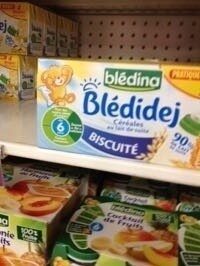
Blédidej biscuité
Health
Nutrition
Nutri-Score data warning
Nutrition facts
| Nutrition facts | As sold for 100 g / 100 ml | Compared to: Dairy dessert for baby |
|---|---|---|
| Energy | 393 kJ (93 kcal) | 381.704 kJ (91 kcal) (+3%) |
| Fat | 2.9 g | 2.872 g (+1%) |
| Saturated fat | 1.3 g | 1.754 g (-26%) |
| Alpha linolenic acid | 0.05 g | ? |
| Linoleic acid | 0.5 g | 0.195 g (+156%) |
| Carbohydrates | 14.2 g | 12.911 g (+10%) |
| Sugars | 6.2 g | 8.762 g (-29%) |
| Dietary fiber | 0.17 g | ? |
| Proteins | 2.4 g | 2.961 g (-19%) |
| Salt | 0.11 g | 0.09 g (+22%) |
| Sodium | 0.044 g | 0.036 g (+22%) |
| Vitamin A | 0.000102 µg | 32.228 µg (-100%) |
| Vitamin D | 0.000001 mg | 0.123 µg (-99%) |
| Vitamin E | 0.0014 mg | 0.2 mg (-99%) |
| Vitamin K | 0.0000091 µg | ? |
| Vitamin C | 0.0112 mg | ? |
| Vitamin B1 | 0.00019 mg | ? |
| Vitamin B2 | 0.00018 mg | ? |
| Vitamin PP | 0.0012 mg | ? |
| Vitamin B6 | 0.00013 mg | ? |
| Vitamin B9 | 0.000017 µg | ? |
| Vitamin B12 | 0.0000002 µg | ? |
| Biotin | 0.0000076 µg | ? |
| Pantothenic acid | 0.0011 mg | ? |
| Potassium | 0.102 mg | 174.148 mg (-100%) |
| Calcium | 0.068 mg | 113.772 mg (-100%) |
| Phosphorus | 0.048 mg | 80.182 mg (-100%) |
| Iron | 0.0011 mg | 0.247 mg (-100%) |
| Zinc | 0.0003 mg | 0.864 mg (-100%) |
| Iodine | 0.000011 µg | 9.158 µg (-100%) |
| Fruits, vegetables and legumes | ? | ? |
Nutrition facts (Detailed data)
| Nutrition facts | As sold for 100 g / 100 ml | As sold Per serving (legacy) |
|---|---|---|
| Energy | 393 kJ (93 kcal) | ? |
| Fat | 2.9 g | ? |
| Saturated fat | 1.3 g | ? |
| Alpha linolenic acid | 0.05 g | ? |
| Linoleic acid | 0.5 g | ? |
| Carbohydrates | 14.2 g | ? |
| Sugars | 6.2 g | ? |
| Dietary fiber | 0.17 g | ? |
| Proteins | 2.4 g | ? |
| Salt | 0.11 g | ? |
| Sodium | 0.044 g | ? |
| Vitamin A | 0.000102 µg | ? |
| Vitamin D | 0.000001 mg | ? |
| Vitamin E | 0.0014 mg | ? |
| Vitamin K | 0.0000091 µg | ? |
| Vitamin C | 0.0112 mg | ? |
| Vitamin B1 | 0.00019 mg | ? |
| Vitamin B2 | 0.00018 mg | ? |
| Vitamin PP | 0.0012 mg | ? |
| Vitamin B6 | 0.00013 mg | ? |
| Vitamin B9 | 0.000017 µg | ? |
| Vitamin B12 | 0.0000002 µg | ? |
| Biotin | 0.0000076 µg | ? |
| Pantothenic acid | 0.0011 mg | ? |
| Potassium | 0.102 mg | ? |
| Calcium | 0.068 mg | ? |
| Phosphorus | 0.048 mg | ? |
| Iron | 0.0011 mg | ? |
| Zinc | 0.0003 mg | ? |
| Iodine | 0.000011 µg | ? |
| Fruits, vegetables and legumes | ? | ? |
Ingredients
Ingredients image

Ingredients list
Ingredient information
Added sugars
Allergens
Ingredients analysis
Contains ingredients containing palm oil.
Contains non-vegan ingredients.
Unrecognized: en:ferric-diphosphate, en:zinc-sulfate, en:vitamin-e, en:thiamin, en:vitamin-b12
Vegetarian status unknown
Unrecognized: en:ferric-diphosphate, en:zinc-sulfate, en:vitamin-e, en:thiamin, en:vitamin-b12
Food Processing
NOVA group
 Ultra-processed food and drink products
Elements that indicate the product is in NOVA group 4
How NOVA works
Additives
E306 - Tocopherol-rich extract
No additive description is available yet.
E322 - LecithinsAntioxidantEmulsifier
Lecithins are natural compounds commonly used in the food industry as emulsifiers and stabilizers.
Extracted from sources like soybeans and eggs, lecithins consist of phospholipids that enhance the mixing of oil and water, ensuring smooth textures in various products like chocolates, dressings, and baked goods.
They do not present any known health risks.
E322i - LecithinAntioxidantEmulsifier
Lecithins are natural compounds commonly used in the food industry as emulsifiers and stabilizers.
Extracted from sources like soybeans and eggs, lecithins consist of phospholipids that enhance the mixing of oil and water, ensuring smooth textures in various products like chocolates, dressings, and baked goods.
They do not present any known health risks.
E500 - Sodium carbonatesStabiliserThickener
Sodium carbonates (E500) are compounds commonly used in food preparation as leavening agents, helping baked goods rise by releasing carbon dioxide when they interact with acids.
Often found in baking soda, they regulate the pH of food, preventing it from becoming too acidic or too alkaline. In the culinary world, sodium carbonates can also enhance the texture and structure of foods, such as noodles, by modifying the gluten network.
Generally recognized as safe, sodium carbonates are non-toxic when consumed in typical amounts found in food.
E500i - Sodium carbonateStabiliserThickener
No additive description is available yet.
E525 - Potassium hydroxide
Potassium hydroxide is an inorganic compound with the formula KOH, and is commonly called caustic potash. Along with sodium hydroxide (NaOH), this colorless solid is a prototypical strong base. It has many industrial and niche applications, most of which exploit its corrosive nature and its reactivity toward acids. An estimated 700,000 to 800,000 tonnes were produced in 2005. About 100 times more NaOH than KOH is produced annually. KOH is noteworthy as the precursor to most soft and liquid soaps, as well as numerous potassium-containing chemicals.
Environment
Green-Score, origins bonus, and transportation impact are shown for Worldwide .
Green Score
Overall grade
 Unknown environmental impact
About Green-Score
Current scope
Green-Score availability
Bonuses and maluses
Declared origins
Threatened species risk
Packaging impact
Packaging
Packaging impact
Data precision
Transportation
Declared origins
Forest footprint
Forest footprint
Deforestation risk details
Additional information
- Preparation
- Brique prête à l'emploi ou à consommer tiède. Ne pas faire bouillir, ni chauffer la brique directement au four à micro-ondes. Ne pas ajouter de sucre.
- Conservation conditions
- Avant ouverture, conserver à température ambiante dans un endroit propre et sec. Après ouverture, à conserver au réfrigérateur et à consommer dans les 48 heures maximum.
- Customer service
- Service consommateur Blédina, 81 rue de Sans Souci 69576 LIMONEST Cedex
Data Source
Product data comes from Open Food Facts. Food Benchmark also adds translations, category comparisons and explanatory calculations.
The database is licensed under ODbL 1.0, individual contents under DbCL 1.0, and product photos under CC BY-SA 3.0.
Product added on March 4, 2015 at 3:17:50 PM UTC by date-limite-app .
Last edit on September 19, 2022 at 1:39:52 AM UTC by quechoisir .
Product page also edited by yuka.sY2b0xO6T85zoF3NwEKvlldhYsvRjQPeHS7TtmHR_c6xIa3CUeFLybjGb6s, date-limite-app, org-bledina, quechoisir, openfoodfacts-contributors, marilyn, tacite, magasins-u, yuka.YjR3SkNiWVB2ZU1Xb2ZNKzEwckUzOEo1Nm8rVGVIbUtHK3RNSVE9PQ, kiliweb.
Source List
- bledina