

Cacao sugar free cookies
Health
Nutrition
Nutri-Score
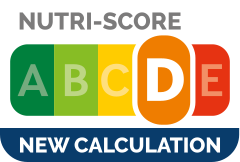 Lower nutritional quality
Nutri-Score data warning
Nutrient levels
Fat in high quantity (21.5%)
Saturated fat in high quantity (12%)
Sugars in low quantity (0.2%)
Salt in moderate quantity (0.5%)
Nutrition label

Nutrition facts
| Nutrition facts | As sold for 100 g / 100 ml | Compared to: Biscuits and crackers |
|---|---|---|
| Energy | ~ 2014.4 kJ (481 kcal) | 1,965.873 kJ (468 kcal) (+2%) |
| Fat | 21.5 g | 20.13 g (+7%) |
| Saturated fat | 12 g | 8.704 g (+38%) |
| Carbohydrates | 67 g | 63.063 g (+6%) |
| Sugars | 0.2 g | 23.401 g (-99%) |
| Dietary fiber | ? | ? |
| Proteins | 4.7 g | 7.062 g (-33%) |
| Salt | 0.5 g | 0.766 g (-35%) |
| Sodium | 0.2 g | 0.306 g (-35%) |
| Fruits, vegetables and legumes | ~ 0 % | ? |
Nutrition facts (Detailed data)
| Nutrition facts | As sold for 100 g / 100 ml | As sold Per 100 g (packaging) | As sold Per 100 g (estimate) |
|---|---|---|---|
| Energy | ~ 2014.4 kJ (481 kcal) | ? (481 kcal) | ? |
| Fat | 21.5 g | 21.5 g | ? |
| Saturated fat | 12 g | 12 g | ? |
| Carbohydrates | 67 g | 67 g | ? |
| Sugars | 0.2 g | 0.2 g | ? |
| Dietary fiber | ? | ? | ? |
| Proteins | 4.7 g | 4.7 g | ? |
| Salt | 0.5 g | 0.5 g | ? |
| Sodium | 0.2 g | 0.2 g | ? |
| Fruits, vegetables and legumes | ~ 0 % | ? | ~ 0 % |
Ingredients
Ingredients image

Ingredients list
Ingredient information
Ingredients analysis
Contains ingredients containing palm oil.
No non-vegan ingredients.
Unrecognized: en:vegetable-derived-monoglyceride
No non-vegetarian ingredients.
Unrecognized: en:vegetable-derived-monoglyceride
Food Processing
NOVA group
 Ultra-processed food and drink products
Elements that indicate the product is in NOVA group 4
How NOVA works
Additives
E1400 - DextrinCarrierEmulsifierStabiliserThickener
Dextrins are a group of low-molecular-weight carbohydrates produced by the hydrolysis of starch or glycogen. Dextrins are mixtures of polymers of D-glucose units linked by α-(1→4) or α-(1→6) glycosidic bonds. Dextrins can be produced from starch using enzymes like amylases, as during digestion in the human body and during malting and mashing, or by applying dry heat under acidic conditions (pyrolysis or roasting). The latter process is used industrially, and also occurs on the surface of bread during the baking process, contributing to flavor, color and crispness. Dextrins produced by heat are also known as pyrodextrins. The starch hydrolyses during roasting under acidic conditions, and short-chained starch parts partially rebranch with α-(1,6) bonds to the degraded starch molecule. See also Maillard Reaction. Dextrins are white, yellow, or brown powders that are partially or fully water-soluble, yielding optically active solutions of low viscosity. Most of them can be detected with iodine solution, giving a red coloration; one distinguishes erythrodextrin (dextrin that colours red) and achrodextrin (giving no colour). White and yellow dextrins from starch roasted with little or no acid are called British gum.
E330 - Citric acidAntioxidantSequestrant
Citric acid is a natural organic acid found in citrus fruits such as lemons, oranges, and limes.
It is widely used in the food industry as a flavor enhancer, acidulant, and preservative due to its tart and refreshing taste.
Citric acid is safe for consumption when used in moderation and is considered a generally recognized as safe (GRAS) food additive by regulatory agencies worldwide.
E412 - Guar gumEmulsifierStabiliserThickener
Guar gum (E412) is a natural food additive derived from guar beans.
This white, odorless powder is valued for its remarkable thickening and stabilizing properties, making it a common ingredient in various food products, including sauces, dressings, and ice creams.
When used in moderation, guar gum is considered safe for consumption, with no known adverse health effects.
E461 - methyl celluloseEmulsifierStabiliserThickener
METHYL CELLULOSE is a chemical compound derived from cellulose. Methyl cellulose is added to food products, to generate their characteristic thick consistency, for example ice cream or croquette.
E500 - Sodium carbonatesStabiliserThickener
Sodium carbonates (E500) are compounds commonly used in food preparation as leavening agents, helping baked goods rise by releasing carbon dioxide when they interact with acids.
Often found in baking soda, they regulate the pH of food, preventing it from becoming too acidic or too alkaline. In the culinary world, sodium carbonates can also enhance the texture and structure of foods, such as noodles, by modifying the gluten network.
Generally recognized as safe, sodium carbonates are non-toxic when consumed in typical amounts found in food.
E500ii - Sodium hydrogen carbonateStabiliserThickener
Sodium hydrogen carbonate, also known as E500ii, is a food additive commonly used as a leavening agent.
When added to recipes, it releases carbon dioxide gas upon exposure to heat or acids, causing dough to rise and resulting in a light, fluffy texture in baked goods.
It is generally recognized as safe (GRAS) by regulatory authorities when used in appropriate quantities and poses no significant health risks when consumed in typical food applications.
E967 - XylitolEmulsifierHumectantStabiliserSweetenerThickener
Xylitol is a sugar alcohol used as a sweetener. The name derives from Ancient Greek: ξύλον, xyl[on], "wood" + suffix -itol, used to denote sugar alcohols. Xylitol is categorized as a polyalcohol or sugar alcohol (specifically an alditol). It has the formula CH2OH(CHOH)3CH2OH. It is a colorless or white solid that is soluble in water. Use of manufactured products containing xylitol may reduce tooth decay.
Environment
Green-Score, origins bonus, and transportation impact are shown for Worldwide .
Green Score
Overall grade
 High environmental impact
About Green-Score
Current scope
Life cycle analysis
Average impact of the category
 Biscuit (cookie) • Score: 67/100
Life-cycle reference
Overall environmental impact by stage (PEF)
The overall environmental impact figure (PEF) comes from ADEME's Agribalyse database, for the category: Biscuit (cookie). Source: ADEME Agribalyse Database.
| Stage | Impact |
|---|---|
| Agriculture | 68.5 % |
| Processing | 10.1 % |
| Packaging | 15.5 % |
| Transportation | 4.5 % |
| Distribution | 1.5 % |
| Consumption | 0.0 % |
Bonuses and maluses
Declared origins
Threatened species risk
Packaging impact
Green-Score for this product
Green-Score for this product
Final score: 37/100Final score breakdown
Carbon footprint
Carbon footprint
Climate impact by stage (CO2e)
The carbon emission figure comes from ADEME's Agribalyse database, for the category: Biscuit (cookie). Source: ADEME Agribalyse Database.
| Stage | Impact |
|---|---|
| Agriculture | 63.5 % |
| Processing | 5.2 % |
| Packaging | 24.5 % |
| Transportation | 5.9 % |
| Distribution | 0.7 % |
| Consumption | 0.0 % |
Packaging
Packaging impact
Data precision
Transportation
Declared origins
Forest footprint
Forest footprint
Deforestation risk details
Data Source
Product data comes from Open Food Facts. Food Benchmark also adds translations, category comparisons and explanatory calculations.
The database is licensed under ODbL 1.0, individual contents under DbCL 1.0, and product photos under CC BY-SA 3.0.
Product added on July 8, 2019 at 1:32:34 PM UTC by kiliweb .
Last edit on March 17, 2026 at 10:59:51 PM UTC by new-nutrition-bot .
Product page also edited by benbenben, charlesnepote, date-limite-app, ecoscore-impact-estimator, inf, kiliweb, new-nutrition-bot, roboto-app, tacite-mass-editor, yuka.VjdzRUVMNDluTnBUdWZNeTdqL0kvZlYrN0ppT2V6bnBCY1VLSWc9PQ, yuka.sY2b0xO6T85zoF3NwEKvlkdFS9f3ky3ZGBzfixyX_-iQdKfvZt9N7rPXL6s.