

Bisquets integrales con chispas sabor chocolate
Health
Nutrition
Nutri-Score
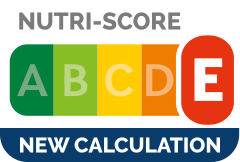 Lower nutritional quality
Nutri-Score data warning
Nutrient levels
Fat in moderate quantity (14%)
Saturated fat in moderate quantity (4.5%)
Sugars in high quantity (30%)
Salt in moderate quantity (0.7%)
Nutrition label

Nutrition facts
| Nutrition facts | As sold for 100 g / 100 ml | Compared to: Pastries |
|---|---|---|
| Energy | 1700 kJ (400 kcal) | 1,551.781 kJ (371 kcal) (+10%) |
| Fat | 14 g | 16.515 g (-15%) |
| Saturated fat | 4.5 g | 7.837 g (-43%) |
| Trans fat | 0.05 g | 0.025 g (+100%) |
| Carbohydrates | 62 g | 48.057 g (+29%) |
| Sugars | 30 g | 27.389 g (+10%) |
| Added sugars | 22 g | 21.917 g (~0%) |
| Dietary fiber | 4 g | ? |
| Proteins | 9 g | 5.321 g (+69%) |
| Salt | 0.7 g | 0.42 g (+67%) |
| Sodium | 0.28 g | 0.168 g (+67%) |
| Fruits, vegetables and legumes | ~ 0 % | ? |
Nutrition facts (Detailed data)
| Nutrition facts | As sold for 100 g / 100 ml | As sold Per 100 g (packaging) | As sold Per 100 g (estimate) |
|---|---|---|---|
| Energy | 1700 kJ (400 kcal) | 1700 kJ (400 kcal) | ? |
| Fat | 14 g | 14 g | ? |
| Saturated fat | 4.5 g | 4.5 g | ? |
| Trans fat | 0.05 g | 0.05 g | ? |
| Carbohydrates | 62 g | 62 g | ? |
| Sugars | 30 g | 30 g | ? |
| Added sugars | 22 g | 22 g | ~ 23.3434895833333 g |
| Dietary fiber | 4 g | 4 g | ? |
| Proteins | 9 g | 9 g | ? |
| Salt | 0.7 g | 0.7 g | ? |
| Sodium | 0.28 g | 0.28 g | ? |
| Fruits, vegetables and legumes | ~ 0 % | ? | ~ 0 % |
Serving size
Ingredients
Ingredients image

Ingredients list
Ingredient information
Added sugars
Allergens
Traces
Ingredients analysis
Palm oil content unknown
Contains non-vegan ingredients.
Unrecognized: es:granillo-de-trigo, es:aceite-vegetal-de-canola, es:chispa-sabor-chocolate-semiamargo, es:cocoa-alcalina, es:polvos-para-homear, es:addo-sorbico-y-color-cafe
Vegetarian status unknown
Unrecognized: es:granillo-de-trigo, es:aceite-vegetal-de-canola, es:chispa-sabor-chocolate-semiamargo, es:cocoa-alcalina, es:polvos-para-homear, es:addo-sorbico-y-color-cafe
Food Processing
NOVA group
 Ultra-processed food and drink products
Elements that indicate the product is in NOVA group 4
How NOVA works
Additives
E102 - TartrazineColour
Tartrazine (E102) is a synthetic lemon-yellow azo dye used as a food coloring.
It is found in a wide range of products such as soft drinks, desserts, candies, and snack foods to give them a vibrant yellow appearance.
While approved by many regulatory agencies, tartrazine has been linked to allergic reactions, such as hives, in a small portion of the population. Some studies have also suggested a link to increased hyperactivity in children, particularly when consumed with other additives like benzoates.
E200 - Sorbic acid EFSA overexposure risk: highPreservative
SORBIC ACID, or 2,4-hexadienoic acid, is a natural organic compound used as a food preservative. It has the chemical formula CH3(CH)4CO2H.
E280 - Propionic acidPreservative
Propionic acid (from the Greek words protos, meaning "first", and pion, meaning "fat"; also known as propanoic acid) is a naturally occurring carboxylic acid with chemical formula CH3CH2CO2H. It is a liquid with a pungent and unpleasant smell somewhat resembling body odor. The anion CH3CH2CO2− as well as the salts and esters of propionic acid are known as propionates (or propanoates).
E282 - calcium propionatePreservative
CALCIUM PROPIONATE has the formula Ca(C2H5COO)2. Calcium propionate is used as a preservative in a wide variety of products, including but not limited to:bread, other baked goods, processed meat, whey, and other dairy products.
E412 - Guar gumEmulsifierStabiliserThickener
Guar gum (E412) is a natural food additive derived from guar beans.
This white, odorless powder is valued for its remarkable thickening and stabilizing properties, making it a common ingredient in various food products, including sauces, dressings, and ice creams.
When used in moderation, guar gum is considered safe for consumption, with no known adverse health effects.
E414 - Acacia gumCarrierEmulsifierStabiliserThickener
Gum arabic, also known as acacia gum, arabic gum, gum acacia, acacia, Senegal gum and Indian gum, and by other names, is a natural gum consisting of the hardened sap of various species of the acacia tree. Originally, gum arabic was collected from Acacia nilotica which was called the "gum arabic tree"; in the present day, gum arabic is collected from acacia species, predominantly Acacia senegal and Vachellia (Acacia) seyal; the term "gum arabic" does not indicate a particular botanical source. In a few cases so‐called "gum arabic" may not even have been collected from Acacia species, but may originate from Combretum, Albizia or some other genus. Producers harvest the gum commercially from wild trees, mostly in Sudan (80%) and throughout the Sahel, from Senegal to Somalia—though it is historically cultivated in Arabia and West Asia. Gum arabic is a complex mixture of glycoproteins and polysaccharides. It is the original source of the sugars arabinose and ribose, both of which were first discovered and isolated from it, and are named after it. Gum arabic is soluble in water. It is edible, and used primarily in the food industry as a stabilizer, with EU E number E414. Gum arabic is a key ingredient in traditional lithography and is used in printing, paint production, glue, cosmetics and various industrial applications, including viscosity control in inks and in textile industries, though less expensive materials compete with it for many of these roles. While gum arabic is now produced throughout the African Sahel, it is still harvested and used in the Middle East.
E466 - Sodium carboxy methyl celluloseEmulsifierHumectantStabiliserThickener
Carboxymethyl cellulose (CMC) or cellulose gum or tylose powder is a cellulose derivative with carboxymethyl groups (-CH2-COOH) bound to some of the hydroxyl groups of the glucopyranose monomers that make up the cellulose backbone. It is often used as its sodium salt, sodium carboxymethyl cellulose.
E481 - Sodium stearoyl-2-lactylate EFSA overexposure risk: highEmulsifierStabiliser
Sodium stearoyl-2-lactylate (sodium stearoyl lactylate or SSL) is a versatile, FDA approved food additive used to improve the mix tolerance and volume of processed foods. It is one type of a commercially available lactylate. SSL is non-toxic, biodegradable, and typically manufactured using biorenewable feedstocks. Because SSL is a safe and highly effective food additive, it is used in a wide variety of products ranging from baked goods and desserts to pet foods.As described by the Food Chemicals Codex 7th edition, SSL is a cream-colored powder or brittle solid. SSL is currently manufactured by the esterification of stearic acid with lactic acid and partially neutralized with either food-grade soda ash (sodium carbonate) or caustic soda (concentrated sodium hydroxide). Commercial grade SSL is a mixture of sodium salts of stearoyl lactylic acids and minor proportions of other sodium salts of related acids. The HLB for SSL is 10-12. SSL is slightly hygroscopic, soluble in ethanol and in hot oil or fat, and dispersible in warm water. These properties are the reason that SSL is an excellent emulsifier for fat-in-water emulsions and can also function as a humectant.
Environment
Green-Score, origins bonus, and transportation impact are shown for Worldwide .
Green Score
Overall grade
 Moderate environmental impact
About Green-Score
Current scope
Life cycle analysis
Average impact of the category
 Biscuit (cookie) • Score: 67/100
Life-cycle reference
Overall environmental impact by stage (PEF)
The overall environmental impact figure (PEF) comes from ADEME's Agribalyse database, for the category: Biscuit (cookie). Source: ADEME Agribalyse Database.
| Stage | Impact |
|---|---|
| Agriculture | 68.5 % |
| Processing | 10.1 % |
| Packaging | 15.5 % |
| Transportation | 4.5 % |
| Distribution | 1.5 % |
| Consumption | 0.0 % |
Bonuses and maluses
Origins of ingredients
Packaging impact
Green-Score for this product
Green-Score for this product
Final score: 56/100Final score breakdown
Carbon footprint
Carbon footprint
Climate impact by stage (CO2e)
The carbon emission figure comes from ADEME's Agribalyse database, for the category: Biscuit (cookie). Source: ADEME Agribalyse Database.
| Stage | Impact |
|---|---|
| Agriculture | 63.5 % |
| Processing | 5.2 % |
| Packaging | 24.5 % |
| Transportation | 5.9 % |
| Distribution | 0.7 % |
| Consumption | 0.0 % |
Packaging

Packaging impact
Packaging components
| Shape | Material | Recycling | Impact |
|---|---|---|---|
| Unknown | PP 5 Polypropylene | Unknown | High |
Data precision
Transportation
Origins of ingredients
Origins breakdown
| Origin | Percent of ingredients | Impact |
|---|---|---|
| Mexico | 100 % | High |
Forest footprint
Forest footprint
Ingredients linked to forest pressure
| Ingredient | Type | Percent in product | Forest footprint |
|---|---|---|---|
| EGG | Oeufs Importés | 1.75 % | 0.00 |
Data Source
Product data comes from Open Food Facts. Food Benchmark also adds translations, category comparisons and explanatory calculations.
The database is licensed under ODbL 1.0, individual contents under DbCL 1.0, and product photos under CC BY-SA 3.0.
Product added on August 27, 2019 at 4:51:58 PM UTC by elcoco .
Last edit on March 17, 2026 at 10:05:54 PM UTC by foodless .
Product page also edited by elcoco, elcoco.1321f83f0b4c8750f4aeb471b9bb3cd3, foodless, kiliweb, roboto-app, thaialagata, uncle491, yuka.sY2b0xO6T85zoF3NwEKvlkEZSdbxhynhbjznslOU2MnSL4HqP_4j-rnoEqo.