
Garden Cream Wafers (peach Flavor) - 7oz
Health
Nutrition
Nutri-Score
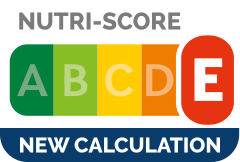 Lower nutritional quality
Nutri-Score data warning
Nutrient levels
Fat in high quantity (28%)
Saturated fat in high quantity (16%)
Sugars in high quantity (24%)
Salt in moderate quantity (0.35%)
Nutrition label
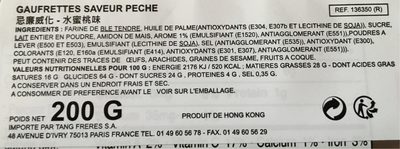
Nutrition facts
| Nutrition facts | As sold for 100 g / 100 ml | Compared to: Stuffed wafers |
|---|---|---|
| Energy | ~ 2192 kJ (520 kcal) | 2,128.895 kJ (509 kcal) (+3%) |
| Fat | 28 g | 26.567 g (+5%) |
| Saturated fat | 16 g | 16.529 g (-3%) |
| Carbohydrates | 64 g | 61.006 g (+5%) |
| Sugars | 24 g | 33.955 g (-29%) |
| Dietary fiber | ~ 3.483 g | ? |
| Proteins | 4 g | 5.575 g (-28%) |
| Salt | 0.35 g | 0.295 g (+19%) |
| Sodium | 0.14 g | 0.118 g (+19%) |
| Fruits, vegetables and legumes | ~ 0 % | ? |
Nutrition facts (Detailed data)
| Nutrition facts | As sold for 100 g / 100 ml | As sold Per 100 g (packaging) | As sold Per 100 g (estimate) |
|---|---|---|---|
| Energy | ~ 2192 kJ (520 kcal) | ? (520 kcal) | ~ 2039.28333333333 kJ (488 kcal) |
| Fat | 28 g | 28 g | ~ 27.0350625 g |
| Saturated fat | 16 g | 16 g | ~ 13.3549629166667 g |
| Carbohydrates | 64 g | 64 g | ~ 52.7515833333333 g |
| Sugars | 24 g | 24 g | ~ 15.7570833333333 g |
| Dietary fiber | ~ 3.483 g | ? | ~ 3.483 g |
| Proteins | 4 g | 4 g | ~ 6.70307083333333 g |
| Salt | 0.35 g | 0.35 g | ~ 0.140966041666664 g |
| Sodium | 0.14 g | 0.14 g | ~ 0.0449241875 g |
| Fruits, vegetables and legumes | ~ 0 % | ? | ~ 0 % |
Ingredients
Ingredients image

Ingredients list
Ingredient information
Added sugars
Allergens
Traces
Ingredients analysis
Contains ingredients containing palm oil.
Contains non-vegan ingredients.
Contains non-vegetarian ingredients.
Food Processing
NOVA group
 Ultra-processed food and drink products
Elements that indicate the product is in NOVA group 4
How NOVA works
Additives
E120 - CochinealColour
Cochineal extract or carmine (E120) is a natural red colorant derived from the dried bodies of the female cochineal insect.
It is widely used to impart a pink, red, or purple hue to various food and beverage products, including yogurts, ice creams, confectionery, and fruit juices.
Although it is a natural additive, E120 is known to cause severe allergic reactions, including anaphylaxis, in some individuals. It is also not suitable for vegetarians or vegans due to its insect origin.
E160a - caroteneColour
β-Carotene is an organic, strongly colored red-orange pigment abundant in plants and fruits. It is a member of the carotenes, which are terpenoids (isoprenoids), synthesized biochemically from eight isoprene units and thus having 40 carbons. Among the carotenes, β-carotene is distinguished by having beta-rings at both ends of the molecule. β-Carotene is biosynthesized from geranylgeranyl pyrophosphate.β-Carotene is the most common form of carotene in plants. When used as a food coloring, it has the E number E160a. The structure was deduced by Karrer et al. in 1930. In nature, β-carotene is a precursor (inactive form) to vitamin A via the action of beta-carotene 15,15'-monooxygenase.Isolation of β-carotene from fruits abundant in carotenoids is commonly done using column chromatography. It can also be extracted from the beta-carotene rich algae, Dunaliella salina. The separation of β-carotene from the mixture of other carotenoids is based on the polarity of a compound. β-Carotene is a non-polar compound, so it is separated with a non-polar solvent such as hexane. Being highly conjugated, it is deeply colored, and as a hydrocarbon lacking functional groups, it is very lipophilic.
E300 - Ascorbic acidAntioxidantSequestrant
No additive description is available yet.
E301 - Sodium ascorbateAntioxidant
SODIUM ASCORBATE is one of a number of mineral salts of ascorbic acid (vitamin C).
E304 - Fatty acid esters of ascorbic acidAntioxidant
ASCORBYL PALMITATE is an ester formed from ascorbic acid and palmitic acid creating a fat-soluble form of vitamin C.
E307 - Alpha-tocopherol
α-Tocopherol is a type of vitamin E. It has E number "E307". Vitamin E exists in eight different forms, four tocopherols and four tocotrienols. All feature a chromane ring, with a hydroxyl group that can donate a hydrogen atom to reduce free radicals and a hydrophobic side chain which allows for penetration into biological membranes. Compared to the others, α-tocopherol is preferentially absorbed and accumulated in humans.
E307b - concentrated tocopherolAntioxidant
α-Tocopherol is a type of vitamin E. It has E number "E307". Vitamin E exists in eight different forms, four tocopherols and four tocotrienols. All feature a chromane ring, with a hydroxyl group that can donate a hydrogen atom to reduce free radicals and a hydrophobic side chain which allows for penetration into biological membranes. Compared to the others, α-tocopherol is preferentially absorbed and accumulated in humans.
E322 - LecithinsAntioxidantEmulsifier
Lecithins are natural compounds commonly used in the food industry as emulsifiers and stabilizers.
Extracted from sources like soybeans and eggs, lecithins consist of phospholipids that enhance the mixing of oil and water, ensuring smooth textures in various products like chocolates, dressings, and baked goods.
They do not present any known health risks.
E322i - LecithinAntioxidantEmulsifier
Lecithins are natural compounds commonly used in the food industry as emulsifiers and stabilizers.
Extracted from sources like soybeans and eggs, lecithins consist of phospholipids that enhance the mixing of oil and water, ensuring smooth textures in various products like chocolates, dressings, and baked goods.
They do not present any known health risks.
E414 - Acacia gumCarrierEmulsifierStabiliserThickener
Gum arabic, also known as acacia gum, arabic gum, gum acacia, acacia, Senegal gum and Indian gum, and by other names, is a natural gum consisting of the hardened sap of various species of the acacia tree. Originally, gum arabic was collected from Acacia nilotica which was called the "gum arabic tree"; in the present day, gum arabic is collected from acacia species, predominantly Acacia senegal and Vachellia (Acacia) seyal; the term "gum arabic" does not indicate a particular botanical source. In a few cases so‐called "gum arabic" may not even have been collected from Acacia species, but may originate from Combretum, Albizia or some other genus. Producers harvest the gum commercially from wild trees, mostly in Sudan (80%) and throughout the Sahel, from Senegal to Somalia—though it is historically cultivated in Arabia and West Asia. Gum arabic is a complex mixture of glycoproteins and polysaccharides. It is the original source of the sugars arabinose and ribose, both of which were first discovered and isolated from it, and are named after it. Gum arabic is soluble in water. It is edible, and used primarily in the food industry as a stabilizer, with EU E number E414. Gum arabic is a key ingredient in traditional lithography and is used in printing, paint production, glue, cosmetics and various industrial applications, including viscosity control in inks and in textile industries, though less expensive materials compete with it for many of these roles. While gum arabic is now produced throughout the African Sahel, it is still harvested and used in the Middle East.
E500 - Sodium carbonatesStabiliserThickener
Sodium carbonates (E500) are compounds commonly used in food preparation as leavening agents, helping baked goods rise by releasing carbon dioxide when they interact with acids.
Often found in baking soda, they regulate the pH of food, preventing it from becoming too acidic or too alkaline. In the culinary world, sodium carbonates can also enhance the texture and structure of foods, such as noodles, by modifying the gluten network.
Generally recognized as safe, sodium carbonates are non-toxic when consumed in typical amounts found in food.
E503 - Ammonium carbonates
AMMONIUM BICARBONATE is an inorganic compound with formula (NH4)HCO3, simplified to NH5CO3. Ammonium bicarbonate is used in the food industry as a raising agent for flat baked goods, such as cookies and crackers, and in China in steamed buns and Chinese almond cookies. It was commonly used in the home before modern day baking powder was made available.
E520 - Aluminium sulphate
Aluminium sulfate is a chemical compound with the formula Al2(SO4)3. It is soluble in water and is mainly used as a coagulating agent (promoting particle collision by neutralizing charge) in the purification of drinking water and waste water treatment plants, and also in paper manufacturing. The anhydrous form occurs naturally as a rare mineral millosevichite, found e.g. in volcanic environments and on burning coal-mining waste dumps. Aluminium sulfate is rarely, if ever, encountered as the anhydrous salt. It forms a number of different hydrates, of which the hexadecahydrate Al2(SO4)3•16H2O and octadecahydrate Al2(SO4)3•18H2O are the most common. The heptadecahydrate, whose formula can be written as [Al(H2O)6]2(SO4)3•5H2O, occurs naturally as the mineral alunogen. Aluminium sulfate is sometimes called alum or papermaker's alum in certain industries. However, the name "alum" is more commonly and properly used for any double sulfate salt with the generic formula XAl(SO4)2·12H2O, where X is a monovalent cation such as potassium or ammonium.
E535 - Sodium ferrocyanide
Sodium ferrocyanide is the sodium salt of the coordination compound of formula [Fe(CN)6]4−. In its hydrous form, Na4Fe(CN)6 · 10 H2O (sodium ferrocyanide decahydrate), it is sometimes known as yellow prussiate of soda. It is a yellow crystalline solid that is soluble in water and insoluble in alcohol. The yellow color is the color of ferrocyanide anion. Despite the presence of the cyanide ligands, sodium ferrocyanide has low toxicity (acceptable daily intake 0–0.025 mg/kg body weight). The ferrocyanides are less toxic than many salts of cyanide, because they tend not to release free cyanide. However, like all ferrocyanide salt solutions, addition of an acid can result in the production of hydrogen cyanide gas, which is toxic.
E551 - Silicon dioxideCarrier
Silicon dioxide, also known as silica, silicic acid or silicic acid anydride is an oxide of silicon with the chemical formula SiO2, most commonly found in nature as quartz and in various living organisms. In many parts of the world, silica is the major constituent of sand. Silica is one of the most complex and most abundant families of materials, existing as a compound of several minerals and as synthetic product. Notable examples include fused quartz, fumed silica, silica gel, and aerogels. It is used in structural materials, microelectronics (as an electrical insulator), and as components in the food and pharmaceutical industries. Inhaling finely divided crystalline silica is toxic and can lead to severe inflammation of the lung tissue, silicosis, bronchitis, lung cancer, and systemic autoimmune diseases, such as lupus and rheumatoid arthritis. Uptake of amorphous silicon dioxide, in high doses, leads to non-permanent short-term inflammation, where all effects heal.
Environment
Green-Score, origins bonus, and transportation impact are shown for Worldwide .
Green Score
Overall grade
 Low environmental impact
About Green-Score
Current scope
Life cycle analysis
Average impact of the category
 Wafer biscuit, crunchy (thin or dry), plain or with sugar, prepacked • Score: 84/100
Life-cycle reference
Overall environmental impact by stage (PEF)
The overall environmental impact figure (PEF) comes from ADEME's Agribalyse database, for the category: Wafer biscuit, crunchy (thin or dry), plain or with sugar, prepacked. Source: ADEME Agribalyse Database.
| Stage | Impact |
|---|---|
| Agriculture | 73.8 % |
| Processing | 14.2 % |
| Packaging | 4.4 % |
| Transportation | 5.3 % |
| Distribution | 2.2 % |
| Consumption | 0.0 % |
Bonuses and maluses
Origins of ingredients
Threatened species risk
Packaging impact
Green-Score for this product
Green-Score for this product
Final score: 64/100Final score breakdown
Carbon footprint
Carbon footprint
Climate impact by stage (CO2e)
The carbon emission figure comes from ADEME's Agribalyse database, for the category: Wafer biscuit, crunchy (thin or dry), plain or with sugar, prepacked. Source: ADEME Agribalyse Database.
| Stage | Impact |
|---|---|
| Agriculture | 75.1 % |
| Processing | 8.1 % |
| Packaging | 7.6 % |
| Transportation | 7.7 % |
| Distribution | 1.2 % |
| Consumption | 0.0 % |
Packaging
Packaging impact
Packaging components
| Shape | Material | Recycling | Impact |
|---|---|---|---|
| BAG | Plastic | Unknown | High |
Declared packaging
Transportation
Origins of ingredients
Origins breakdown
| Origin | Percent of ingredients | Impact |
|---|---|---|
| Hong Kong | 100 % | High |
Forest footprint
Forest footprint
Deforestation risk details
Data Source
Product data comes from Open Food Facts. Food Benchmark also adds translations, category comparisons and explanatory calculations.
The database is licensed under ODbL 1.0, individual contents under DbCL 1.0, and product photos under CC BY-SA 3.0.
Product added on December 9, 2017 at 3:27:18 PM UTC by kiliweb .
Last edit on March 17, 2026 at 10:09:59 PM UTC by new-nutrition-bot .
Product page also edited by ecoscore-impact-estimator, kiliweb, marilyn, naruyoko, new-nutrition-bot, openfoodfacts-contributors, packbot, scholes8, sebleouf, yuka.I5JTPNutQNMiO_bU0pkShjbnSMT8GqNJG0Ijog, yuka.ZTd0UVBaazYvZWdxbDhNdzVCSDU4UHhNMVpPSmNGMk9CTGRQSUE9PQ.