

Bimbo roles
Labels
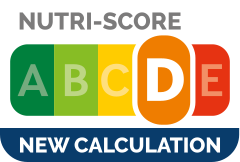 Poor nutritional quality
 Ultra-processed food and drink products
 Not computed
Health
Nutrition
Serving Size
Nutri-Score label
Poor nutritional qualityNutrient levels for 100 g
Fat in moderate quantity (7.5 g, 7.5%)
What you need to know
A high consumption of fat, especially saturated fats, can raise cholesterol, which increases the risk of heart diseases.
Recommendation: Limit the consumption of fat and saturated fat
Choose products with lower fat and saturated fat content.
Saturated fat in moderate quantity (3 g, 3%)
What you need to know
A high consumption of fat, especially saturated fats, can raise cholesterol, which increases the risk of heart diseases.
Recommendation: Limit the consumption of fat and saturated fat
Choose products with lower fat and saturated fat content.
Sugars in high quantity (29.5 g, 29.5%)
What you need to know
A high consumption of sugar can cause weight gain and tooth decay. It also augments the risk of type 2 diabetes and cardio-vascular diseases.
Recommendation: Limit the consumption of sugar and sugary drinks
Sugary drinks should be limited as much as possible. Choose products with lower sugar content.
Salt in moderate quantity (0.54 g, 0.54%)
What you need to know
A high consumption of salt (or sodium) can cause raised blood pressure, which can increase the risk of heart disease and stroke.
Recommendation: Limit the consumption of salt and salted food
Reduce the quantity of salt used when cooking. Limit the consumption of salty snacks.
Nutrition Facts
| Nutrition Facts | As sold for 100 g / 100 ml | Per serving 1 piece (61 g) |
|---|---|---|
| Energy | 320 kcal | 195 kcal |
| Fat | 7.5 g | 4.58 g |
| Saturated fat | 3 g | 1.83 g |
| Carbohydrates | 56.4 g | 34.4 g |
| Sugars | 29.5 g | 18 g |
| Dietary fiber | 2.1 g | 1.28 g |
| Proteins | 6.7 g | 4.09 g |
| Salt | 0.54 g | 0.33 g |
| Sodium | 0.21 g | 0.13 g |
Ingredients
Ingredients List
Ingredient Information
Food Processing
NOVA Group label
Ultra-processed food and drink productsElements that indicate the product is in the NOVA group 4:
- Additives: E322 - Lecithins
- Additives: E412 - Guar gum
- Additives: E466 - Sodium carboxy methyl cellulose
- Additives: E471 - Mono- and diglycerides of fatty acids
- Additives: E472e - Mono- and diacetyltartaric acid esters of mono- and diglycerides of fatty acids
- Ingredients: Dextrose
- Ingredients: Flavouring
- Ingredients: Glucose
- Ingredients: Gluten
- Ingredients: High Fructose Corn Syrup
- Ingredients: Fructose
- Ingredients: Palm Stearin
The NOVA classification assigns food products into 4 groups based on their degree of processing:
- Unprocessed or minimally processed foods
- Processed culinary ingredients
- Processed foods
- Ultra-processed food and drink products
Ingredients analysis
Palm oil free
Contains ingredients containing palm oil.
Vegan
Contains non-vegan ingredients.
Unrecognized ingredients: en:vegetable-oil-spread, en:polyglycerol-esters, en:potassium-stearate, en:monoglycerides, en:reb-a, en:a-stevia-leaf-sweetener, en:enrichment, en:reduced-iron, en:zinc-oxide
Vegetarian
Vegetarian status unknown
Unrecognized ingredients: en:vegetable-oil-spread, en:polyglycerol-esters, en:potassium-stearate, en:monoglycerides, en:reb-a, en:a-stevia-leaf-sweetener, en:enrichment, en:reduced-iron, en:zinc-oxide
Additives
E1520 - Propylene GlycolEmulsifierHumectant
No additive description is available yet.
E200 - Sorbic acidPreservative
SORBIC ACID, or 2,4-hexadienoic acid, is a natural organic compound used as a food preservative. It has the chemical formula CH3(CH)4CO2H.
E211 - Sodium benzoatePreservative
SODIUM BENZOATE is a substance which has the chemical formula NaC7H5O2
E282 - calcium propionatePreservative
CALCIUM PROPIONATE has the formula Ca(C2H5COO)2. Calcium propionate is used as a preservative in a wide variety of products, including but not limited to:bread, other baked goods, processed meat, whey, and other dairy products.
E322 - LecithinsAntioxidantEmulsifier
Lecithins are natural compounds commonly used in the food industry as emulsifiers and stabilizers.
Extracted from sources like soybeans and eggs, lecithins consist of phospholipids that enhance the mixing of oil and water, ensuring smooth textures in various products like chocolates, dressings, and baked goods.
They do not present any known health risks.
E322i - LecithinAntioxidantEmulsifier
Lecithins are natural compounds commonly used in the food industry as emulsifiers and stabilizers.
Extracted from sources like soybeans and eggs, lecithins consist of phospholipids that enhance the mixing of oil and water, ensuring smooth textures in various products like chocolates, dressings, and baked goods.
They do not present any known health risks.
E330 - Citric acidAntioxidantSequestrant
Citric acid is a natural organic acid found in citrus fruits such as lemons, oranges, and limes.
It is widely used in the food industry as a flavor enhancer, acidulant, and preservative due to its tart and refreshing taste.
Citric acid is safe for consumption when used in moderation and is considered a generally recognized as safe (GRAS) food additive by regulatory agencies worldwide.
E341 - Calcium phosphatesEmulsifierHumectantSequestrantStabiliserThickener
Calcium phosphate is a family of materials and minerals containing calcium ions (Ca2+) together with inorganic phosphate anions. Some so-called calcium phosphates contain oxide and hydroxide as well. They are white solids of nutritious value.
E341i - Monocalcium phosphateEmulsifierHumectantSequestrantStabiliserThickener
No additive description is available yet.
E412 - Guar gumEmulsifierStabiliserThickener
Guar gum (E412) is a natural food additive derived from guar beans.
This white, odorless powder is valued for its remarkable thickening and stabilizing properties, making it a common ingredient in various food products, including sauces, dressings, and ice creams.
When used in moderation, guar gum is considered safe for consumption, with no known adverse health effects.
E466 - Sodium carboxy methyl celluloseEmulsifierHumectantStabiliserThickener
Carboxymethyl cellulose (CMC) or cellulose gum or tylose powder is a cellulose derivative with carboxymethyl groups (-CH2-COOH) bound to some of the hydroxyl groups of the glucopyranose monomers that make up the cellulose backbone. It is often used as its sodium salt, sodium carboxymethyl cellulose.
E471 - Mono- and diglycerides of fatty acidsEmulsifierStabiliser
Mono- and diglycerides of fatty acids (E471), are food additives commonly used as emulsifiers in various processed foods.
These compounds consist of glycerol molecules linked to one or two fatty acid chains, which help stabilize and blend water and oil-based ingredients. E471 enhances the texture and shelf life of products like margarine, baked goods, and ice cream, ensuring a smooth and consistent texture.
It is generally considered safe for consumption within established regulatory limits.
E472e - Mono- and diacetyltartaric acid esters of mono- and diglycerides of fatty acidsEmulsifierSequestrantStabiliser
No additive description is available yet.
E510 - Ammonium chloride
AMMONIUM CHLORIDE is an inorganic compound with the formula NH4Cl and a white crystalline salt that is highly soluble in water.
Environment
Environmental score label
Not computedCarbon footprint
No carbon footprint data is available for this product.
Packaging
No packaging information provided.
Transportation and origins
Origins of ingredients
No origin information provided.
Manufacturing places
No manufacturing place information provided.
Environmental labels
No environmental labels identified.
Data Source
Product added on March 9, 2017 at 9:46:59 AM UTC by usda-ndb-import .
Last edit on June 23, 2025 at 5:08:58 AM UTC by macrofactor .
Product page also edited by danis1597, foodless, macrofactor, org-database-usda, usda-ndb-import.
Source List
- usda-ndb
- database-usda