

Nutri-grain fraise
Health
Nutrition
Nutri-Score
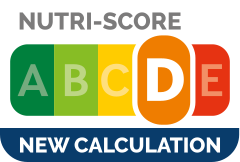 Lower nutritional quality
Nutri-Score data warning
Nutrient levels
Fat in moderate quantity (8.11%)
Saturated fat in low quantity (1.35%)
Sugars in high quantity (35.1%)
Salt in moderate quantity (0.709%)
Nutrition label

Nutrition facts
| Nutrition facts | As sold for 100 g / 100 ml | Compared to: Cereal bars |
|---|---|---|
| Energy | 1470 kcal (351 kcal) | 1,751.046 kJ (413 kcal) |
| Fat | 8.11 g | 14.423 g (-44%) |
| Saturated fat | 1.35 g | 4.69 g (-71%) |
| Carbohydrates | 70.3 g | 59.917 g (+17%) |
| Sugars | 35.1 g | 24.168 g (+45%) |
| Dietary fiber | 5.41 g | ? |
| Proteins | 5.41 g | 8.239 g (-34%) |
| Salt | 0.709 mg | 0.404 g (-100%) |
| Sodium | 0.284 mg | 0.161 g (-100%) |
| Fruits, vegetables and legumes | ? | ? |
Nutrition facts (Detailed data)
| Nutrition facts | As sold for 100 g / 100 ml | As sold Per serving (legacy) |
|---|---|---|
| Energy | 1470 kcal (351 kcal) | 544 kcal (130 kcal) |
| Fat | 8.11 g | 3 g |
| Saturated fat | 1.35 g | 0.5 g |
| Carbohydrates | 70.3 g | 26 g |
| Sugars | 35.1 g | 13 g |
| Dietary fiber | 5.41 g | 2 g |
| Proteins | 5.41 g | 2 g |
| Salt | 0.709 mg | 0.2625 mg |
| Sodium | 0.284 mg | 0.105 mg |
| Fruits, vegetables and legumes | ? | ? |
Serving size
Ingredients
Ingredients image

Ingredients list
Ingredient information
Added sugars
Allergens
Ingredients analysis
Palm oil content unknown
Contains non-vegan ingredients.
Unrecognized: en:vegetable-glycerin, en:sodium-citrate, en:vegetable-oil-shortening
Vegetarian status unknown
Unrecognized: en:vegetable-glycerin, en:sodium-citrate, en:vegetable-oil-shortening
Food Processing
NOVA group
 Ultra-processed food and drink products
Elements that indicate the product is in NOVA group 4
How NOVA works
Additives
E322 - LecithinsAntioxidantEmulsifier
Lecithins are natural compounds commonly used in the food industry as emulsifiers and stabilizers.
Extracted from sources like soybeans and eggs, lecithins consist of phospholipids that enhance the mixing of oil and water, ensuring smooth textures in various products like chocolates, dressings, and baked goods.
They do not present any known health risks.
E322i - LecithinAntioxidantEmulsifier
Lecithins are natural compounds commonly used in the food industry as emulsifiers and stabilizers.
Extracted from sources like soybeans and eggs, lecithins consist of phospholipids that enhance the mixing of oil and water, ensuring smooth textures in various products like chocolates, dressings, and baked goods.
They do not present any known health risks.
E330 - Citric acidAntioxidantSequestrant
Citric acid is a natural organic acid found in citrus fruits such as lemons, oranges, and limes.
It is widely used in the food industry as a flavor enhancer, acidulant, and preservative due to its tart and refreshing taste.
Citric acid is safe for consumption when used in moderation and is considered a generally recognized as safe (GRAS) food additive by regulatory agencies worldwide.
E331 - Sodium citratesEmulsifierSequestrantStabiliser
DISODIUM CITRATE, more properly, disodium hydrogen citrate, is an acid salt of citric acid with the chemical formula Na2C6H6O7. It is used as an antioxidant in food and to improve the effects of other antioxidants. It is also used as an acidity regulator and sequestrant. Typical products include gelatin, jam, sweets, ice cream, carbonated beverages, milk powder, wine, and processed cheeses.
E341 - Calcium phosphates EFSA overexposure risk: highEmulsifierHumectantSequestrantStabiliserThickener
Calcium phosphate is a family of materials and minerals containing calcium ions (Ca2+) together with inorganic phosphate anions. Some so-called calcium phosphates contain oxide and hydroxide as well. They are white solids of nutritious value.
E341ii - Dicalcium phosphateEmulsifierHumectantSequestrantStabiliserThickener
No additive description is available yet.
E401 - sodium alginateCarrierEmulsifierHumectantSequestrantStabiliserThickener
No additive description is available yet.
E407 - Carrageenan EFSA overexposure risk: highCarrierEmulsifierHumectantStabiliserThickener
Carrageenan (E407), derived from red seaweed, is widely employed in the food industry as a gelling, thickening, and stabilizing agent, notably in dairy and meat products.
It can exist in various forms, each imparting distinct textural properties to food.
However, its degraded form, often referred to as poligeenan, has raised health concerns due to its potential inflammatory effects and its classification as a possible human carcinogen (Group 2B) by the International Agency for Research on Cancer (IARC).
Nevertheless, food-grade carrageenan has been deemed safe by various regulatory bodies when consumed in amounts typically found in food.
E412 - Guar gumEmulsifierStabiliserThickener
Guar gum (E412) is a natural food additive derived from guar beans.
This white, odorless powder is valued for its remarkable thickening and stabilizing properties, making it a common ingredient in various food products, including sauces, dressings, and ice creams.
When used in moderation, guar gum is considered safe for consumption, with no known adverse health effects.
E421 - MannitolHumectantStabiliserSweetenerThickener
Mannitol is a type of sugar alcohol which is also used as a medication. As a sugar, it is often used as a sweetener in diabetic food, as it is poorly absorbed from the intestines. As a medication, it is used to decrease pressure in the eyes, as in glaucoma, and to lower increased intracranial pressure. Medically, it is given by injection. Effects typically begin within 15 minutes and last up to 8 hours.Common side effects from medical use include electrolyte problems and dehydration. Other serious side effects may include worsening heart failure and kidney problems. It is unclear if use is safe in pregnancy. Mannitol is in the osmotic diuretic family of medications and works by pulling fluid from the brain and eyes.The discovery of mannitol is attributed to Joseph Louis Proust in 1806. It is on the World Health Organization's List of Essential Medicines, the most effective and safe medicines needed in a health system. The wholesale cost in the developing world is about US$1.12 to 5.80 a dose. In the United States, a course of treatment costs $25 to 50. It was originally made from the flowering ash and called manna due to its supposed resemblance to the Biblical food. Mannitol is on the World Anti-Doping Agency's banned drug list due to concerns that it may mask other drugs.
E422 - GlycerolHumectantThickener
Glycerol (; also called glycerine or glycerin; see spelling differences) is a simple polyol compound. It is a colorless, odorless, viscous liquid that is sweet-tasting and non-toxic. The glycerol backbone is found in all lipids known as triglycerides. It is widely used in the food industry as a sweetener and humectant and in pharmaceutical formulations. Glycerol has three hydroxyl groups that are responsible for its solubility in water and its hygroscopic nature.
E460 - CelluloseCarrierEmulsifierHumectantStabiliserThickener
CELLULOSE is an organic compound with the formula (C6H10O5)n, a polysaccharide consisting of a linear chain of several hundred to many thousands of linked D-glucose units. Cellulose is used as emulsifier, thickener and stabilizer in processed foods. Cellulose powder is, for example, used in processed cheese to prevent caking inside the package.
E501 - Potassium carbonatesStabiliser
Potassium carbonate (K2CO3) is a white salt, which is soluble in water (insoluble in ethanol) and forms a strongly alkaline solution. It can be made as the product of potassium hydroxide's absorbent reaction with carbon dioxide. It is deliquescent, often appearing a damp or wet solid. Potassium carbonate is used in the production of soap and glass.
E501ii - Potassium hydrogen carbonateStabiliser
No additive description is available yet.
Environment
Green-Score, origins bonus, and transportation impact are shown for Worldwide .
Green Score
Overall grade
 Unknown environmental impact
About Green-Score
Current scope
Green-Score availability
Bonuses and maluses
Declared origins
Packaging impact
Packaging
Packaging impact
Data precision
Transportation
Manufacturing locations
Declared origins
Data Source
Product data comes from Open Food Facts. Food Benchmark also adds translations, category comparisons and explanatory calculations.
The database is licensed under ODbL 1.0, individual contents under DbCL 1.0, and product photos under CC BY-SA 3.0.
Product added on June 6, 2013 at 2:03:48 PM UTC by openfoodfacts-contributors .
Last edit on October 20, 2025 at 7:42:21 AM UTC by foodless .
Product page also edited by allergies-app-chakib, chancewash, foodless, kiliweb, moon-rabbit, oliveapp, openfoodfacts-contributors, roboto-app, scanada, teolemon, upcbot, yuka.U1BFOUVZWWYvOWswdDhBbnhpMkk5dDVTNExTcmVIT2RPdEVESVE9PQ.