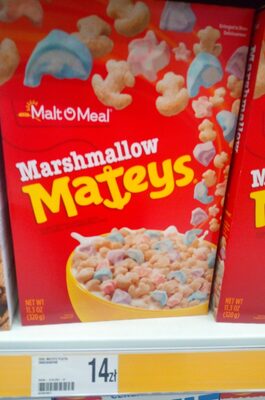
ProductsMeal Marshmallow Mateys
Meal Marshmallow Mateys
Barcode 0042400236627

Meal Marshmallow Mateys

BARCODE:0042400236627
CATEGORIES:Plant Based Foods And Beverages, Plant Based Foods, Breakfasts, Cereals And Potatoes, Cereals And Their Products, Breakfast Cereals
COUNTRIES:France, United Kingdom

Health

Nutrition

Nutri-Score

ELower nutritional quality

Nutri-Score data warning

Warning: the amount of fruits, vegetables and nuts is not specified on the label, it was estimated from the list of ingredients: 0

Nutrient levels

Fat in moderate quantity (3.5%)
What you need to know • A high consumption of fat, especially saturated fats, can raise cholesterol, which increases the risk of heart diseases. Recommendation: Limit the consumption of fat and saturated fat • Choose products with lower fat and saturated fat content. Source: National Health Service UK (NHS) - Fat: the facts
Saturated fat in low quantity (0.6%)
What you need to know • A high consumption of fat, especially saturated fats, can raise cholesterol, which increases the risk of heart diseases. Recommendation: Limit the consumption of fat and saturated fat • Choose products with lower fat and saturated fat content. Source: National Health Service UK (NHS) - Fat: the facts
Sugars in high quantity (41%)
What you need to know • A high consumption of sugar can cause weight gain and tooth decay. It also augments the risk of type 2 diabetes and cardio-vascular diseases. Recommendation: Limit the consumption of sugar and sugary drinks • Sugary drinks (such as sodas, fruit beverages, and fruit juices and nectars) should be limited as much as possible (no more than 1 glass a day). • Choose products with lower sugar content and reduce the consumption of products with added sugars. Source: National Health Service UK (NHS) - Sugar: the facts
Salt in high quantity (1.7%)
What you need to know • A high consumption of salt (or sodium) can cause raised blood pressure, which can increase the risk of heart disease and stroke. • Many people who have high blood pressure do not know it, as there are often no symptoms. • Most people consume too much salt (on average 9 to 12 grams per day), around twice the recommended maximum level of intake. Recommendation: Limit the consumption of salt and salted food • Reduce the quantity of salt used when cooking, and don't salt again at the table. • Limit the consumption of salty snacks and choose products with lower salt content. Source: World Health Organization (WHO) - Fact sheet - Salt reduction Source: National Health Service UK (NHS) - Salt: the facts

Nutrition facts

Nutrition factsAs sold for 100 g / 100 mlCompared to: Breakfast cereals
Energy~ 1572.8 kJ (385 kcal)1,669.622 kJ (394 kcal) (-6%)
Fat3.5 g8.395 g (-58%)
Saturated fat0.6 g1.936 g (-69%)
Carbohydrates78 g65.48 g (+19%)
Sugars41 g14.74 g (+178%)
Dietary fiber??
Proteins6.9 g9.855 g (-30%)
Salt1.7 g0.378 g (+350%)
Sodium0.68 g0.151 g (+350%)
Fruits, vegetables and legumes~ 0 %?

Nutrition facts (Detailed data)

Nutrition factsAs sold for 100 g / 100 mlAs sold Per 100 g (packaging)As sold Per 100 g (estimate)
Energy~ 1572.8 kJ (385 kcal)? (385 kcal)?
Fat3.5 g3.5 g?
Saturated fat0.6 g0.6 g?
Carbohydrates78 g78 g?
Sugars41 g41 g?
Dietary fiber???
Proteins6.9 g6.9 g?
Salt1.7 g1.7 g?
Sodium0.68 g0.68 g?
Fruits, vegetables and legumes~ 0 %?~ 0 %

Ingredients

Ingredients image

Meal Marshmallow Mateys ingredients image

Ingredients list

whole grain oat flour, sugar, marshmallows 18% (sugar, modified corn*starch, corn* syrup, dextrose, gelatin, artificial flavouring, colours: tartrazine (e102)**, sunset yellow(e110)**, brilliant blue (e133), allura red (e129)**), corn* syrup, wheat starch, salt, antioxidant: calcium carbonate (e170), acidity regulator: trisodium phosphate (e339iii), thiamin mononitrate (vit,b1), riboflavin (vit,b2), niacin (vit,b3), pantothenic acid (vit,b5), pyridoxine hydrochloride (vit,b6), folic acid, vitamin b12, vitamin a, vitamin c, iron (ferric orthophosphate), zinc (zinc oxide), aliergy advice: for allergens inciuding cereats containing gluten, see ingredients in bold * produced from genetically modified corn may have an adverse effect on activity and attention in children product of usa, store in a cool dry place,

Ingredient information

Oat Flour
41% (estimate)
Sugar
29.5% (estimate)
Marshmallow
18.0%
Sugar
9.9% (estimate)
Modified Corn Starch
4.05% (estimate)
Corn Syrup
2.03% (estimate)
Dextrose
1.01% (estimate)
E428
0.51% (estimate)
Artificial Flavouring
0.25% (estimate)
Colour
0.13% (estimate)
E102
0.13% (estimate)
E102
0.13% (estimate)
E110
0.06% (estimate)
E110
0.06% (estimate)
Brilliant Blue
0.03% (estimate)
E133
0.03% (estimate)
E129
0.03% (estimate)
E129
0.03% (estimate)
Corn Syrup
5.75% (estimate)
Wheat Starch
2.88% (estimate)
Salt
0.85% (estimate)
Antioxidant
0.85% (estimate)
E170i
0.85% (estimate)
E170
0.85% (estimate)
Acidity Regulator
0.59% (estimate)
E339iii
0.59% (estimate)
E339iii
0.59% (estimate)
Thiamin Mononitrate
0.29% (estimate)
Vitamins
0.15% (estimate)
Thiamin
0.15% (estimate)
E101
0.15% (estimate)
Vitamins
0.07% (estimate)
E101
0.07% (estimate)
E375
0.07% (estimate)
Vitamins
0.04% (estimate)
E375
0.04% (estimate)
Pantothenic Acid
0.04% (estimate)
Vitamins
0.02% (estimate)
Pantothenic Acid
0.02% (estimate)
Pyridoxine Hydrochloride
0.02% (estimate)
Vitamins
0.01% (estimate)
Vitamin B6
0.01% (estimate)
Folic Acid
0.01% (estimate)
Vitamins
0% (estimate)
Vitamin B12
0% (estimate)
Vitamin A
0% (estimate)
Vitamin C
0% (estimate)
Iron
0% (estimate)
Ferric Orthophosphate
0% (estimate)
Zinc
0% (estimate)
Zinc Oxide
0% (estimate)
Aliergy Advice
0% (estimate)
For Allergens Inciuding Cereats Containing Gluten
0% (estimate)
See Ingredients In Bold Produced From Genetically Modified Corn May Have An Adverse Effect On Activity And Attention In Children Product Of Usa
0% (estimate)
Store In A Cool Dry Place
0% (estimate)

Added sugars

Contains added sugars (48%) Added sugars: sugar, corn syrup, dextrose Quantity of added sugars: 48%

Allergens

GelatinGluten

Ingredients analysis

Palm oil free
Yes

No ingredients containing palm oil.

Vegan
No

Contains non-vegan ingredients.

Unrecognized: en:e170, en:for-allergens-inciuding-cereats-containing-gluten, en:see-ingredients-in-bold-produced-from-genetically-modified-corn-may-have-an-adverse-effect-on-activity-and-attention-in-children-product-of-usa, en:store-in-a-cool-dry-place

Vegetarian
No

Contains non-vegetarian ingredients.

Unrecognized: en:e170, en:for-allergens-inciuding-cereats-containing-gluten, en:see-ingredients-in-bold-produced-from-genetically-modified-corn-may-have-an-adverse-effect-on-activity-and-attention-in-children-product-of-usa, en:store-in-a-cool-dry-place


Food Processing

NOVA group

4Ultra-processed food and drink products

Elements that indicate the product is in NOVA group 4

Additives
E102 - Tartrazine
Additives
E110 - Sunset yellow FCF
Additives
E129 - Allura red
Additives
E133 - Brilliant blue FCF
Additives
E170 - Calcium carbonates
Additives
E428 - Gelatine
Ingredients
Colour
Ingredients
Dextrose
Ingredients
Flavouring
Ingredients
Glucose
Ingredients
Modified Starch

How NOVA works

The NOVA classification assigns food products into 4 groups based on their degree of processing: 1. Unprocessed or minimally processed foods 2. Processed culinary ingredients 3. Processed foods 4. Ultra-processed food and drink products

Additives

E102 - TartrazineColour

Tartrazine (E102) is a synthetic lemon-yellow azo dye used as a food coloring.

It is found in a wide range of products such as soft drinks, desserts, candies, and snack foods to give them a vibrant yellow appearance.

While approved by many regulatory agencies, tartrazine has been linked to allergic reactions, such as hives, in a small portion of the population. Some studies have also suggested a link to increased hyperactivity in children, particularly when consumed with other additives like benzoates.

E110 - Sunset yellow FCFColour

Sunset Yellow FCF (also known as Orange Yellow S, or C.I. 15985) is a petroleum-derived orange azo dye with a pH dependent maximum absorption at about 480 nm at pH 1 and 443 nm at pH 13 with a shoulder at 500 nm. When added to foods sold in the US it is known as FD&C Yellow 6; when sold in Europe, it is denoted by E Number E110.

E129 - Allura red EFSA overexposure risk: noColour

Allura Red AC is a red azo dye that goes by several names, including FD&C Red 40. It is used as a food dye and has the E number E129. It is usually supplied as its red sodium salt, but can also be used as the calcium and potassium salts. These salts are soluble in water. In solution, its maximum absorbance lies at about 504 nm.

E133 - Brilliant blue FCF EFSA overexposure risk: moderateColour

BRILLIANT BLUE FCF (Blue 1) is an organic compound classified as a blue triarylmethane dye, reflecting its chemical structure. Known under various commercial names, it is a colorant for foods and other substances.

E170 - Calcium carbonates EFSA overexposure risk: no

CALCIUM CARBONATE is a chemical compound with the formula CaCO3.

E339 - Sodium phosphates EFSA overexposure risk: highEmulsifierHumectantPreservativeSequestrantStabiliserThickener

TRISODIUM PHOSPHATE is the inorganic compound with the chemical formula Na3PO4.

E339iii - Trisodium phosphateEmulsifierHumectantPreservativeSequestrantStabiliserThickener

No additive description is available yet.

E428 - Gelatine

No additive description is available yet.

Environment

Green-Score, origins bonus, and transportation impact are shown for Worldwide .

Green Score

Overall grade

DHigh environmental impact

About Green-Score

The Green-Score is an experimental score that summarizes the environmental impacts of food products.

Current scope

The Green-Score was initially developed for France and it is being extended to other European countries. The Green-Score formula is subject to change as it is regularly improved to make it more precise and better suited to each country. Select a country to include the full impact of transportation in the final score.

Life cycle analysis

Average impact of the category

BBreakfast cereals, mix of puffed or extruded cereals, fortified with vitamins and chemical elements • Score: 61/100

Life-cycle reference

Category: Breakfast cereals, mix of puffed or extruded cereals, fortified with vitamins and chemical elements PEF environmental score: 0.42 Climate change impact: 3.40 kg CO2 eq / kg product The overall environmental impact figure (PEF) comes from ADEME's Agribalyse database, for the category: Breakfast cereals, mix of puffed or extruded cereals, fortified with vitamins and chemical elements. Source: ADEME Agribalyse Database.

Overall environmental impact by stage (PEF)

The overall environmental impact figure (PEF) comes from ADEME's Agribalyse database, for the category: Breakfast cereals, mix of puffed or extruded cereals, fortified with vitamins and chemical elements. Source: ADEME Agribalyse Database.

StageImpact
Agriculture72.1 %
Processing10.9 %
Packaging9.6 %
Transportation6.1 %
Distribution1.3 %
Consumption0.0 %

Bonuses and maluses

Declared origins

Origins of ingredients are missing for this product. Ingredients need to be completed before the transportation bonus can be computed precisely.

Packaging impact

Packaging with a high impact Malus: -15 The information about the packaging of this product is not filled in.

Green-Score for this product

Green-Score for this product

DFinal score: 41/100

Final score breakdown

Life cycle analysis score: 61 Sum of bonuses and maluses: -20 Final score: 41/100

Carbon footprint

Carbon footprint

Equivalent to driving 1.8 km in a petrol car. 340 g CO2e per 100g of product. Reference category: Breakfast cereals, mix of puffed or extruded cereals, fortified with vitamins and chemical elements. The carbon emission figure comes from ADEME's Agribalyse database, for the category: Breakfast cereals, mix of puffed or extruded cereals, fortified with vitamins and chemical elements. Source: ADEME Agribalyse Database.

Climate impact by stage (CO2e)

The carbon emission figure comes from ADEME's Agribalyse database, for the category: Breakfast cereals, mix of puffed or extruded cereals, fortified with vitamins and chemical elements. Source: ADEME Agribalyse Database.

StageImpact
Agriculture62.4 %
Processing9.7 %
Packaging18.5 %
Transportation8.4 %
Distribution0.8 %
Consumption0.0 %

Packaging

Packaging impact

Packaging with a high impact Malus: -15 The information about the packaging of this product is not filled in.

Data precision

The packaging information is not sufficiently precise to compute the most accurate packaging impact. Exact shapes and materials of all packaging components help improve the Green-Score.

Transportation

Declared origins

Origins of ingredients are missing for this product. Ingredients need to be completed before the transportation bonus can be computed precisely.

Forest footprint

Forest footprint

No deforestation risk No ingredient associated with a deforestation risk. Forest Footprint The Forest Footprint is a methodology developed by the association Envol Vert to estimate the risk of deforestation related to our consumption. → More information on the methodology Forest Footprint grade: A No ingredient associated with a deforestation risk. Total Forest Footprint: 0.000 m² per kg of food

Deforestation risk details

Labels The presence of certain labels can greatly help reduce the risk of deforestation, through the presence of environmental criteria and/or through better remuneration of producers.

Data Source

Product data comes from Open Food Facts. Food Benchmark also adds translations, category comparisons and explanatory calculations.

The database is licensed under ODbL 1.0, individual contents under DbCL 1.0, and product photos under CC BY-SA 3.0.

Product added on May 7, 2018 at 11:54:38 AM UTC by kiliweb .

Last edit on March 9, 2026 at 9:49:18 AM UTC by new-nutrition-bot .

Product page also edited by autorotate-bot, foodless, foodvisor, greenfood24, inf, kiliweb, new-nutrition-bot, openfoodfacts-contributors, scanbot, yuka.MOgZItqBGO46MvP1i9s1_WmVH_7bI_NQQ3ACog, yuka.ZDdzblRia1B1TnNTaHRvdnp3K0V3OXhYenNLMVJGNjdKczBPSVE9PQ.