

White chocolate peanut
Health
Nutrition
Nutri-Score
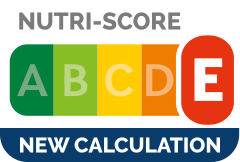 Lower nutritional quality
Nutri-Score data warning
Nutrient levels
Fat in high quantity (28.6%)
Saturated fat in high quantity (10.7%)
Sugars in high quantity (50%)
Salt in low quantity (0.135%)
Nutrition label
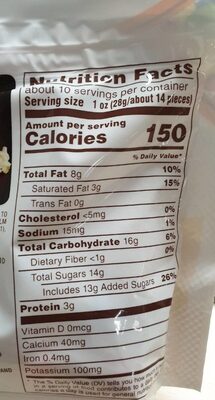
Nutrition facts
| Nutrition facts | As sold for 100 g / 100 ml | Compared to: Confectioneries |
|---|---|---|
| Energy | ~ 2239.34 kJ (536 kcal) | 1,791.758 kJ (424 kcal) (+25%) |
| Fat | 28.57 g | 15.5 g (+84%) |
| Saturated fat | 10.71 g | 7.114 g (+51%) |
| Trans fat | 0 g | 0.029 g (-100%) |
| Cholesterol | 0.018 g | 5.938 mg (+203%) |
| Carbohydrates | 57.14 g | 65.559 g (-13%) |
| Sugars | 50 g | 46.99 g (+6%) |
| Dietary fiber | 3.6 g | ? |
| Proteins | 10.71 g | 4.412 g (+143%) |
| Salt | 0.135 g | 0.16 g (-16%) |
| Sodium | 0.054 g | 0.064 g (-16%) |
| Potassium | 0.357 g | 241.855 mg (+48%) |
| Calcium | 0.143 g | 78.856 mg (+81%) |
| Iron | 0.00143 g | 1.227 mg (+17%) |
| Fruits, vegetables and legumes | ~ 0 % | ? |
Nutrition facts (Detailed data)
| Nutrition facts | As sold for 100 g / 100 ml | As sold Per 100 g (packaging) | As sold Per 100 g (estimate) |
|---|---|---|---|
| Energy | ~ 2239.34 kJ (536 kcal) | ? (536 kcal) | ~ 2182.18806818182 kJ (522 kcal) |
| Fat | 28.57 g | 28.57 g | ~ 30.4890014204545 g |
| Saturated fat | 10.71 g | 10.71 g | ~ 13.4198767329545 g |
| Trans fat | 0 g | 0 g | ? |
| Cholesterol | 0.018 g | 0.018 g | ~ 0.0118554545454545 g |
| Carbohydrates | 57.14 g | 57.14 g | ~ 51.9506363636364 g |
| Sugars | 50 g | 50 g | ~ 43.4842727272727 g |
| Dietary fiber | 3.6 g | 3.6 g | ~ 2.68386363636364 g |
| Proteins | 10.71 g | 10.71 g | ~ 8.81880426136364 g |
| Salt | 0.135 g | 0.135 g | ~ 0.120839551136364 g |
| Sodium | 0.054 g | 0.054 g | ~ 0.0484284039772727 g |
| Potassium | 0.357 g | 0.357 g | ~ 0.355274380681818 g |
| Calcium | 0.143 g | 0.143 g | ~ 0.160067500568182 g |
| Iron | 0.00143 g | 0.00143 g | ~ 0.000532030852272727 g |
| Fruits, vegetables and legumes | ~ 0 % | ? | ~ 0 % |
Serving size
Ingredients
Ingredients list
Ingredient information
Added sugars
Allergens
Ingredients analysis
Contains ingredients containing palm oil.
Contains non-vegan ingredients.
Unrecognized: en:tocopherols-to-maintain-freshness, en:less-than, en:includes-blue-1-lake
Vegetarian status unknown
Unrecognized: en:tocopherols-to-maintain-freshness, en:less-than, en:includes-blue-1-lake
Food Processing
NOVA group
 Ultra-processed food and drink products
Elements that indicate the product is in NOVA group 4
How NOVA works
Additives
E102 - TartrazineColour
Tartrazine (E102) is a synthetic lemon-yellow azo dye used as a food coloring.
It is found in a wide range of products such as soft drinks, desserts, candies, and snack foods to give them a vibrant yellow appearance.
While approved by many regulatory agencies, tartrazine has been linked to allergic reactions, such as hives, in a small portion of the population. Some studies have also suggested a link to increased hyperactivity in children, particularly when consumed with other additives like benzoates.
E110 - Sunset yellow FCFColour
Sunset Yellow FCF (also known as Orange Yellow S, or C.I. 15985) is a petroleum-derived orange azo dye with a pH dependent maximum absorption at about 480 nm at pH 1 and 443 nm at pH 13 with a shoulder at 500 nm. When added to foods sold in the US it is known as FD&C Yellow 6; when sold in Europe, it is denoted by E Number E110.
E129 - Allura red EFSA overexposure risk: noColour
Allura Red AC is a red azo dye that goes by several names, including FD&C Red 40. It is used as a food dye and has the E number E129. It is usually supplied as its red sodium salt, but can also be used as the calcium and potassium salts. These salts are soluble in water. In solution, its maximum absorbance lies at about 504 nm.
E133 - Brilliant blue FCF EFSA overexposure risk: moderateColour
BRILLIANT BLUE FCF (Blue 1) is an organic compound classified as a blue triarylmethane dye, reflecting its chemical structure. Known under various commercial names, it is a colorant for foods and other substances.
E1400 - DextrinCarrierEmulsifierStabiliserThickener
Dextrins are a group of low-molecular-weight carbohydrates produced by the hydrolysis of starch or glycogen. Dextrins are mixtures of polymers of D-glucose units linked by α-(1→4) or α-(1→6) glycosidic bonds. Dextrins can be produced from starch using enzymes like amylases, as during digestion in the human body and during malting and mashing, or by applying dry heat under acidic conditions (pyrolysis or roasting). The latter process is used industrially, and also occurs on the surface of bread during the baking process, contributing to flavor, color and crispness. Dextrins produced by heat are also known as pyrodextrins. The starch hydrolyses during roasting under acidic conditions, and short-chained starch parts partially rebranch with α-(1,6) bonds to the degraded starch molecule. See also Maillard Reaction. Dextrins are white, yellow, or brown powders that are partially or fully water-soluble, yielding optically active solutions of low viscosity. Most of them can be detected with iodine solution, giving a red coloration; one distinguishes erythrodextrin (dextrin that colours red) and achrodextrin (giving no colour). White and yellow dextrins from starch roasted with little or no acid are called British gum.
E322 - LecithinsAntioxidantEmulsifier
Lecithins are natural compounds commonly used in the food industry as emulsifiers and stabilizers.
Extracted from sources like soybeans and eggs, lecithins consist of phospholipids that enhance the mixing of oil and water, ensuring smooth textures in various products like chocolates, dressings, and baked goods.
They do not present any known health risks.
E322i - LecithinAntioxidantEmulsifier
Lecithins are natural compounds commonly used in the food industry as emulsifiers and stabilizers.
Extracted from sources like soybeans and eggs, lecithins consist of phospholipids that enhance the mixing of oil and water, ensuring smooth textures in various products like chocolates, dressings, and baked goods.
They do not present any known health risks.
E414 - Acacia gumCarrierEmulsifierStabiliserThickener
Gum arabic, also known as acacia gum, arabic gum, gum acacia, acacia, Senegal gum and Indian gum, and by other names, is a natural gum consisting of the hardened sap of various species of the acacia tree. Originally, gum arabic was collected from Acacia nilotica which was called the "gum arabic tree"; in the present day, gum arabic is collected from acacia species, predominantly Acacia senegal and Vachellia (Acacia) seyal; the term "gum arabic" does not indicate a particular botanical source. In a few cases so‐called "gum arabic" may not even have been collected from Acacia species, but may originate from Combretum, Albizia or some other genus. Producers harvest the gum commercially from wild trees, mostly in Sudan (80%) and throughout the Sahel, from Senegal to Somalia—though it is historically cultivated in Arabia and West Asia. Gum arabic is a complex mixture of glycoproteins and polysaccharides. It is the original source of the sugars arabinose and ribose, both of which were first discovered and isolated from it, and are named after it. Gum arabic is soluble in water. It is edible, and used primarily in the food industry as a stabilizer, with EU E number E414. Gum arabic is a key ingredient in traditional lithography and is used in printing, paint production, glue, cosmetics and various industrial applications, including viscosity control in inks and in textile industries, though less expensive materials compete with it for many of these roles. While gum arabic is now produced throughout the African Sahel, it is still harvested and used in the Middle East.
E903 - Carnauba waxCarrier
Carnauba (; Portuguese: carnaúba [kaʁnɐˈubɐ]), also called Brazil wax and palm wax, is a wax of the leaves of the palm Copernicia prunifera (Synonym: Copernicia cerifera), a plant native to and grown only in the northeastern Brazilian states of Piauí, Ceará, Maranhão, Bahia, and Rio Grande do Norte. It is known as "queen of waxes" and in its pure state, usually comes in the form of hard yellow-brown flakes. It is obtained from the leaves of the carnauba palm by collecting and drying them, beating them to loosen the wax, then refining and bleaching the wax.
Environment
Green-Score, origins bonus, and transportation impact are shown for Worldwide .
Green Score
Overall grade
 Unknown environmental impact
About Green-Score
Current scope
Green-Score availability
Bonuses and maluses
Declared origins
Threatened species risk
Packaging impact
Packaging
Packaging impact
Declared packaging
Data precision
Transportation
Declared origins
Forest footprint
Forest footprint
Deforestation risk details
Data Source
Product data comes from Open Food Facts. Food Benchmark also adds translations, category comparisons and explanatory calculations.
The database is licensed under ODbL 1.0, individual contents under DbCL 1.0, and product photos under CC BY-SA 3.0.
Product added on November 12, 2019 at 3:47:51 PM UTC by kiliweb .
Last edit on March 17, 2026 at 9:47:15 AM UTC by new-nutrition-bot .
Product page also edited by chevalstar, date-limite-app, kiliweb, new-nutrition-bot, org-database-usda, roboto-app, yuka.SGJzT0xha3FwZllUd2ZZSCtENk4wZnRVNHErNFgwK05jTFVNSWc9PQ.
Source List
- database-usda