

Delights cookies & cream
Labels
 Moderate nutritional quality
 Ultra-processed food and drink products
 Very low environmental impact
Health
Nutrition
Label
Moderate nutritional qualityNutrient levels
Fat in moderate quantity (3.5%)
Saturated fat in moderate quantity (2.3%)
Sugars in moderate quantity (10%)
Salt in low quantity (0.24%)
Nutrition label

Nutrition facts
| Nutrition facts | As sold for 100 ml |
|---|---|
| Energy | ~ 612.3 kJ (131 kcal) |
| FAT | 3.5 g |
| Saturated fat | 2.3 g |
| Carbohydrates | 21 g |
| Sugars | 10 g |
| Dietary fiber | ? |
| Proteins | 7.4 g |
| Salt | 0.24 g |
| Sodium | 0.1 g |
| Minerals | |
| Fruits, vegetables and legumes | ~ 0 % |
Nutrition facts (Detailed data)
| Nutrition facts | As sold for 100 ml | As sold Per 100 ml (packaging) | As sold Per 100 g (estimate) |
|---|---|---|---|
| Energy | ~ 612.3 kJ (131 kcal) | ? (131 kcal) | ? |
| FAT | 3.5 g | 3.5 g | ? |
| Saturated fat | 2.3 g | 2.3 g | ? |
| Carbohydrates | 21 g | 21 g | ? |
| Sugars | 10 g | 10 g | ? |
| Added sugars | ~ 0.14 g | ? | ~ 0.14 g |
| Dietary fiber | ? | ? | ? |
| Proteins | 7.4 g | 7.4 g | ? |
| Salt | 0.24 g | 0.24 g | ? |
| Sodium | 0.1 g | 0.1 g | ? |
| Minerals | |||
| Fruits, vegetables and legumes | ~ 0 % | ? | ~ 0 % |
Serving size
Estimated Activity Time
Approximate time needed to burn the energy in 100 g / 100 ml: 612 kJ. Reference adult weight: 70 kg. Energy density: Low.
Ingredients
Ingredients image
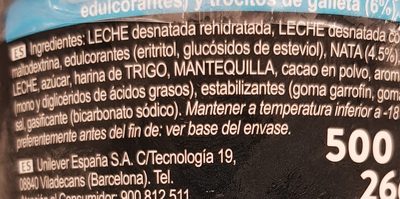
Ingredients list
Ingredient information
Allergens
Ingredients analysis
Palm oil content unknown
Contains non-vegan ingredients.
Vegetarian status unknown
Food Processing
NOVA group
Ultra-processed food and drink productsElements that indicate the product is in NOVA group 4
How NOVA works
Additives
E412 - Guar gumEmulsifierStabiliserThickener
Guar gum (E412) is a natural food additive derived from guar beans.
This white, odorless powder is valued for its remarkable thickening and stabilizing properties, making it a common ingredient in various food products, including sauces, dressings, and ice creams.
When used in moderation, guar gum is considered safe for consumption, with no known adverse health effects.
E422 - GlycerolHumectantThickener
Glycerol (; also called glycerine or glycerin; see spelling differences) is a simple polyol compound. It is a colorless, odorless, viscous liquid that is sweet-tasting and non-toxic. The glycerol backbone is found in all lipids known as triglycerides. It is widely used in the food industry as a sweetener and humectant and in pharmaceutical formulations. Glycerol has three hydroxyl groups that are responsible for its solubility in water and its hygroscopic nature.
E471 - Mono- and diglycerides of fatty acidsEmulsifierStabiliser
Mono- and diglycerides of fatty acids (E471), are food additives commonly used as emulsifiers in various processed foods.
These compounds consist of glycerol molecules linked to one or two fatty acid chains, which help stabilize and blend water and oil-based ingredients. E471 enhances the texture and shelf life of products like margarine, baked goods, and ice cream, ensuring a smooth and consistent texture.
It is generally considered safe for consumption within established regulatory limits.
E500 - Sodium carbonatesStabiliserThickener
Sodium carbonates (E500) are compounds commonly used in food preparation as leavening agents, helping baked goods rise by releasing carbon dioxide when they interact with acids.
Often found in baking soda, they regulate the pH of food, preventing it from becoming too acidic or too alkaline. In the culinary world, sodium carbonates can also enhance the texture and structure of foods, such as noodles, by modifying the gluten network.
Generally recognized as safe, sodium carbonates are non-toxic when consumed in typical amounts found in food.
E960 - Steviol glycosidesSweetener
Steviol glycosides are the chemical compounds responsible for the sweet taste of the leaves of the South American plant Stevia rebaudiana (Asteraceae) and the main ingredients (or precursors) of many sweeteners marketed under the generic name stevia and several trade names. They also occur in the related species Stevia phlebophylla (but in no other species of Stevia) and in the plant Rubus chingii (Rosaceae).Steviol glycosides from Stevia rebaudiana have been reported to be between 30 and 320 times sweeter than sucrose, although there is some disagreement in the technical literature about these numbers. They are heat-stable, pH-stable, and do not ferment. Additionally, they do not induce a glycemic response when ingested, because humans can not metabolize stevia. This makes them attractive as natural sugar substitutes for diabetics and other people on carbohydrate-controlled diets. Steviol glycosides stimulate the insulin secretion through potentiation of the β-cell, preventing high blood glucose after a meal. The acceptable daily intake (ADI) for steviol glycosides, expressed as steviol equivalents, has been established to be 4 mg/kg body weight/day, and is based on no observed effects of a 100 fold higher dose in a rat study.
E968 - ErythritolHumectantSweetener
Erythritol ((2R,3S)-butane-1,2,3,4-tetrol) is a sugar alcohol (or polyol) that has been approved for use as a food additive in the United States and throughout much of the world. It was discovered in 1848 by Scottish chemist John Stenhouse. It occurs naturally in some fruit and fermented foods. At the industrial level, it is produced from glucose by fermentation with a yeast, Moniliella pollinis. Erythritol is 60–70% as sweet as sucrose (table sugar) yet it is almost noncaloric, does not affect blood sugar, does not cause tooth decay, and is partially absorbed by the body, excreted in urine and feces. Under U.S. Food and Drug Administration (FDA) labeling requirements, it has a caloric value of 0.2 kilocalories per gram (95% less than sugar and other carbohydrates), though nutritional labeling varies from country to country. Some countries, such as Japan and the United States, label it as zero-calorie; the European Union labels it 0 kcal/g.
Environment
Green-Score, origins bonus, and transportation impact are shown for Worldwide .
Green Score
Overall grade
Very low environmental impactAbout Green-Score
Current scope
Life cycle analysis
Average impact of the category
Ice cream, cone (normal size) • Score: 86/100Life-cycle reference
Overall environmental impact by stage (PEF)
The overall environmental impact figure (PEF) comes from ADEME's Agribalyse database, for the category: Ice cream, cone (normal size). Source: ADEME Agribalyse Database.
| Stage | Impact |
|---|---|
| Agriculture | 50.2 % |
| Processing | 16.5 % |
| Packaging | 13.8 % |
| Transportation | 7.9 % |
| Distribution | 7.4 % |
| Consumption | 4.3 % |
Bonuses and maluses
Declared origins
Packaging impact
Green-Score for this product
Green-Score for this product
Final score: 80/100Final score breakdown
Carbon footprint
Carbon footprint
Climate impact by stage (CO2e)
The carbon emission figure comes from ADEME's Agribalyse database, for the category: Ice cream, cone (normal size). Source: ADEME Agribalyse Database.
| Stage | Impact |
|---|---|
| Agriculture | 55.2 % |
| Processing | 10.1 % |
| Packaging | 17.1 % |
| Transportation | 12.7 % |
| Distribution | 3.5 % |
| Consumption | 1.3 % |
Packaging
Packaging impact
Packaging materials
| Material | % | Packaging weight | Packaging weight per 100 g of product |
|---|---|---|---|
| Paper or cardboard | |||
| Total |
Declared packaging
Data precision
Transportation
Declared origins
Forest footprint
Forest footprint
Ingredients linked to forest pressure
| Ingredient | Type | Percent in product | Forest footprint |
|---|---|---|---|
| EGG | Oeufs Importés | 0.00 % | 0.00 |
Data Source
Data presented on this page is sourced from the Open Food Facts database. This platform does not alter the original dataset; its purpose is solely to enhance data visualization and user accessibility.
Product added on April 15, 2018 at 1:47:56 PM UTC by kiliweb .
Last edit on March 17, 2026 at 8:51:30 PM UTC by new-nutrition-bot .
Product page also edited by elcoco, kiliweb, musarana, new-nutrition-bot, openfoodfacts-contributors, packbot, roboto-app, royalargus, yuka.UkxoZVBac2NvTlV5c2ZCaS9oR0UyczRyNlpLaVFEK0ZJZVlOSWc9PQ.