

Party mix hot
Health
Nutrition
Nutri-Score
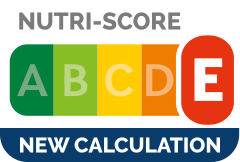 Lower nutritional quality
Nutri-Score data warning
Nutrient levels
Fat in high quantity (44.2%)
Saturated fat in high quantity (7%)
Sugars in moderate quantity (5.4%)
Salt in high quantity (2.1%)
Nutrition label

Nutrition facts
| Nutrition facts | As sold for 100 g / 100 ml | Compared to: Crackers (Appetizers) |
|---|---|---|
| Energy | 2406 kJ (574 kcal) | 1,899.96 kJ (453 kcal) (+27%) |
| Fat | 44.2 g | 17.344 g (+155%) |
| Saturated fat | 7 g | 4.321 g (+62%) |
| Carbohydrates | 20.5 g | 61.568 g (-67%) |
| Sugars | 5.4 g | 3.872 g (+39%) |
| Dietary fiber | 7.3 g | ? |
| Proteins | 19.8 g | 9.765 g (+103%) |
| Salt | 2.1 g | 1.855 g (+13%) |
| Sodium | 0.84 g | 0.741 g (+13%) |
| Fruits, vegetables and legumes | ~ 0.0649604797363281 % | ? |
Nutrition facts (Detailed data)
| Nutrition facts | As sold for 100 g / 100 ml | As sold Per 100 g (packaging) | As sold Per 100 g (estimate) |
|---|---|---|---|
| Energy | 2406 kJ (574 kcal) | 2406 kJ (574 kcal) | ? |
| Fat | 44.2 g | 44.2 g | ? |
| Saturated fat | 7 g | 7 g | ? |
| Carbohydrates | 20.5 g | 20.5 g | ? |
| Sugars | 5.4 g | 5.4 g | ? |
| Dietary fiber | 7.3 g | 7.3 g | ? |
| Proteins | 19.8 g | 19.8 g | ? |
| Salt | 2.1 g | 2.1 g | ? |
| Sodium | 0.84 g | 0.84 g | ? |
| Fruits, vegetables and legumes | ~ 0.0649604797363281 % | ? | ~ 0.0649604797363281 % |
Serving size
Ingredients
Ingredients image

Ingredients list
Ingredient information
Added sugars
Allergens
Traces
Ingredients analysis
Palm oil content unknown
Vegan status unknown
Unrecognized: fr:arome-d-origan-naturel
Vegetarian status unknown
Unrecognized: fr:arome-d-origan-naturel
Food Processing
NOVA group
 Ultra-processed food and drink products
Elements that indicate the product is in NOVA group 4
How NOVA works
Additives
E100 - CurcuminColour
No additive description is available yet.
E150 - Caramel
CARAMEL is a medium to dark-orange confectionery product made by heating a variety of sugars.
E160a - caroteneColour
β-Carotene is an organic, strongly colored red-orange pigment abundant in plants and fruits. It is a member of the carotenes, which are terpenoids (isoprenoids), synthesized biochemically from eight isoprene units and thus having 40 carbons. Among the carotenes, β-carotene is distinguished by having beta-rings at both ends of the molecule. β-Carotene is biosynthesized from geranylgeranyl pyrophosphate.β-Carotene is the most common form of carotene in plants. When used as a food coloring, it has the E number E160a. The structure was deduced by Karrer et al. in 1930. In nature, β-carotene is a precursor (inactive form) to vitamin A via the action of beta-carotene 15,15'-monooxygenase.Isolation of β-carotene from fruits abundant in carotenoids is commonly done using column chromatography. It can also be extracted from the beta-carotene rich algae, Dunaliella salina. The separation of β-carotene from the mixture of other carotenoids is based on the polarity of a compound. β-Carotene is a non-polar compound, so it is separated with a non-polar solvent such as hexane. Being highly conjugated, it is deeply colored, and as a hydrocarbon lacking functional groups, it is very lipophilic.
E160c - Paprika extractColour
No additive description is available yet.
E262 - Sodium acetatesPreservativeSequestrant
SODIUM ACETATE, also abbreviated NaOAc,[8] is the sodium salt of acetic acid.
E270 - Lactic acid
LACTIC ACID is an organic compound with the formula CH3CH(OH)CO2H. In the form of its conjugate base called lactate (this is thus different and kept as a separate ingredient). Lactic acid is chiral, consisting of two optical isomers. One is known as L-(+)-lactic acid or (S)-lactic acid and the other, its mirror image, is D-(−)-lactic acid or (R)-lactic acid in food the L-variant is used
E306 - Tocopherol-rich extract
No additive description is available yet.
E330 - Citric acidAntioxidantSequestrant
Citric acid is a natural organic acid found in citrus fruits such as lemons, oranges, and limes.
It is widely used in the food industry as a flavor enhancer, acidulant, and preservative due to its tart and refreshing taste.
Citric acid is safe for consumption when used in moderation and is considered a generally recognized as safe (GRAS) food additive by regulatory agencies worldwide.
E392 - Extracts of rosemary
No additive description is available yet.
E466 - Sodium carboxy methyl celluloseEmulsifierHumectantStabiliserThickener
Carboxymethyl cellulose (CMC) or cellulose gum or tylose powder is a cellulose derivative with carboxymethyl groups (-CH2-COOH) bound to some of the hydroxyl groups of the glucopyranose monomers that make up the cellulose backbone. It is often used as its sodium salt, sodium carboxymethyl cellulose.
E471 - Mono- and diglycerides of fatty acidsEmulsifierStabiliser
Mono- and diglycerides of fatty acids (E471), are food additives commonly used as emulsifiers in various processed foods.
These compounds consist of glycerol molecules linked to one or two fatty acid chains, which help stabilize and blend water and oil-based ingredients. E471 enhances the texture and shelf life of products like margarine, baked goods, and ice cream, ensuring a smooth and consistent texture.
It is generally considered safe for consumption within established regulatory limits.
E500 - Sodium carbonatesStabiliserThickener
Sodium carbonates (E500) are compounds commonly used in food preparation as leavening agents, helping baked goods rise by releasing carbon dioxide when they interact with acids.
Often found in baking soda, they regulate the pH of food, preventing it from becoming too acidic or too alkaline. In the culinary world, sodium carbonates can also enhance the texture and structure of foods, such as noodles, by modifying the gluten network.
Generally recognized as safe, sodium carbonates are non-toxic when consumed in typical amounts found in food.
E509 - Calcium chloride EFSA overexposure risk: moderateStabiliserThickenerCoagulant
Calcium chloride is an inorganic compound, a salt with the chemical formula CaCl2. It is a colorless crystalline solid at room temperature, highly soluble in water. Calcium chloride is commonly encountered as a hydrated solid with generic formula CaCl2(H2O)x, where x = 0, 1, 2, 4, and 6. These compounds are mainly used for de-icing and dust control. Because the anhydrous salt is hygroscopic, it is used as a desiccant.
Environment
Green-Score, origins bonus, and transportation impact are shown for Worldwide .
Green Score
Overall grade
 Low environmental impact
About Green-Score
Current scope
Life cycle analysis
Average impact of the category
 Salty snacks, crackers, plain • Score: 89/100
Life-cycle reference
Overall environmental impact by stage (PEF)
The overall environmental impact figure (PEF) comes from ADEME's Agribalyse database, for the category: Salty snacks, crackers, plain. Source: ADEME Agribalyse Database.
| Stage | Impact |
|---|---|
| Agriculture | 66.3 % |
| Processing | 18.6 % |
| Packaging | 5.7 % |
| Transportation | 7.0 % |
| Distribution | 2.6 % |
| Consumption | 0.0 % |
Bonuses and maluses
Declared origins
Packaging impact
Green-Score for this product
Green-Score for this product
Final score: 74/100Final score breakdown
Carbon footprint
Carbon footprint
Climate impact by stage (CO2e)
The carbon emission figure comes from ADEME's Agribalyse database, for the category: Salty snacks, crackers, plain. Source: ADEME Agribalyse Database.
| Stage | Impact |
|---|---|
| Agriculture | 59.5 % |
| Processing | 14.8 % |
| Packaging | 11.9 % |
| Transportation | 11.8 % |
| Distribution | 1.7 % |
| Consumption | 0.0 % |
Packaging
Packaging impact
Packaging components
| Shape | Material | Recycling | Impact |
|---|---|---|---|
| Bucket | Plastic | Unknown | High |
Declared packaging
Transportation
Declared origins
Forest footprint
Forest footprint
Deforestation risk details
Data Source
Product data comes from Open Food Facts. Food Benchmark also adds translations, category comparisons and explanatory calculations.
The database is licensed under ODbL 1.0, individual contents under DbCL 1.0, and product photos under CC BY-SA 3.0.
Product added on December 18, 2018 at 9:51:43 AM UTC by kiliweb .
Last edit on March 17, 2026 at 10:06:21 AM UTC by new-nutrition-bot .
Product page also edited by bot-tags-and-languages, kiliweb, new-nutrition-bot, openfoodfacts-contributors, segundo, yuka.V-tzHoGHEOIcBcDs-91s1gKlO7_mX9JzByNQow, yuka.YTZRR0thNC9uTmMxaS9BUitpdkZ3L05abkpPS2ZtMkZKZmdTSVE9PQ.