ProductsFloretteEnsalada César
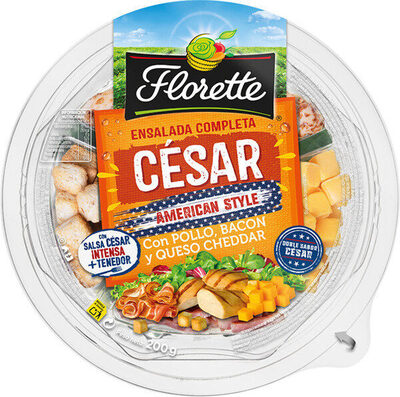
Ensalada César
Barcode 8414516123528
Florette

Ensalada César

200 g.
BARCODE:8414516123528
CATEGORIES:Meals, Prepared Salads, Salads
PACKAGING:Plastic
MANUFACTURING:España
COUNTRIES:Spain
STORES:Alcampo

Labels

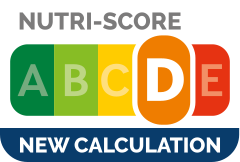
Nutri-Score
Nutri-ScorePoor nutritional quality
NOVA Group
NOVA GroupUltra-processed food and drink products
Green-Score
Green-ScoreGreen-Score not computed

Health

Nutrition

Label

DPoor nutritional quality

Nutrient levels

Fat in moderate quantity (14%)
What you need to know • A high consumption of fat, especially saturated fats, can raise cholesterol, which increases the risk of heart diseases. Recommendation: Limit the consumption of fat and saturated fat • Choose products with lower fat and saturated fat content. Source: National Health Service UK (NHS) - Fat: the facts
Saturated fat in moderate quantity (4.7%)
What you need to know • A high consumption of fat, especially saturated fats, can raise cholesterol, which increases the risk of heart diseases. Recommendation: Limit the consumption of fat and saturated fat • Choose products with lower fat and saturated fat content. Source: National Health Service UK (NHS) - Fat: the facts
Sugars in low quantity (1.9%)
What you need to know • A high consumption of sugar can cause weight gain and tooth decay. It also augments the risk of type 2 diabetes and cardio-vascular diseases. Recommendation: Limit the consumption of sugar and sugary drinks • Sugary drinks (such as sodas, fruit beverages, and fruit juices and nectars) should be limited as much as possible (no more than 1 glass a day). • Choose products with lower sugar content and reduce the consumption of products with added sugars. Source: National Health Service UK (NHS) - Sugar: the facts
Salt in moderate quantity (1.03%)
What you need to know • A high consumption of salt (or sodium) can cause raised blood pressure, which can increase the risk of heart disease and stroke. • Many people who have high blood pressure do not know it, as there are often no symptoms. • Most people consume too much salt (on average 9 to 12 grams per day), around twice the recommended maximum level of intake. Recommendation: Limit the consumption of salt and salted food • Reduce the quantity of salt used when cooking, and don't salt again at the table. • Limit the consumption of salty snacks and choose products with lower salt content. Source: World Health Organization (WHO) - Fact sheet - Salt reduction Source: National Health Service UK (NHS) - Salt: the facts

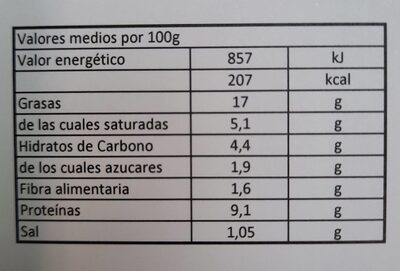
Nutrition label

Ensalada César nutrition label

Nutrition facts

Nutrition factsAs sold for 100 g / 100 ml
Energy~ 763.7 kJ (183 kcal)
FAT14 g
Saturated fat4.7 g
Carbohydrates4.6 g
Sugars1.9 g
Dietary fiber1.6 g
Proteins9.1 g
Salt1.03 g
Sodium0.41 g
Minerals
Fruits, vegetables and legumes~ 20.4 %

Nutrition facts (Detailed data)

Nutrition factsAs sold for 100 g / 100 mlAs sold Per 100 g (packaging)As sold Per 100 g (estimate)
Energy~ 763.7 kJ (183 kcal)? (183 kcal)?
FAT14 g14 g?
Saturated fat4.7 g4.7 g?
Carbohydrates4.6 g4.6 g?
Sugars1.9 g1.9 g?
Added sugars~ 0 g?~ 0 g
Dietary fiber1.6 g1.6 g?
Proteins9.1 g9.1 g?
Salt1.03 g1.03 g?
Sodium0.41 g0.41 g?
Minerals
Fruits, vegetables and legumes~ 20.4 %?~ 20.4 %

Serving size

1 bowl (200 g)

Estimated Activity Time

Approximate time needed to burn the energy in 100 g / 100 ml: 764 kJ. Reference adult weight: 70 kg. Energy density: Low.

Walking
45 min (~4,453 steps)
Swimming
27 min
Bicycling
21 min
Running
16 min

Ingredients

Ingredients image

Ensalada César ingredients image

Ingredients list

Mezcla de hortalizas en proporción variable (32%): brote de lechuga roja, brote de espinaca, escarola lisa. vinagreta de frambuesa (24%): agua, aceite de girasol, frambuesa (3,4%), azúcar, vinagre de vino tinto, sal, vinagre balsámico, almidón modificado de patata, espesante (e415), conservadores (e202, e211), colorante (e150a), especias. pollo (13%): pechuga de pollo, sal, dextrosa, aromas naturales, estabilizante (e451i), espesante (e407). QUESO blanco pasteurizado (13%): LECHE pasteurizada de vaca, sal, FERMENTOS LÁCTICOS, cuajo. remolacha roja en conserva (10%): remolacha roja, agua, vinagre de alcohol, sal, azúcar, aroma natural. cóctel de pipas (8%): pipa de girasol pelada, pipa de calabaza pelada.

Ingredient information

Vegetables In Variable Proportion
32.0%
Brote De Lechuga Roja
32% (estimate)
Brote De Espinaca
34% (estimate)
Broad Leaved Endive
17% (estimate)
Vinagreta De Frambuesa
24.0%
Water
17% (estimate)
Sunflower Oil
Unknown (not provided)
Raspberry
3.4%
Sugar
Unknown (not provided)
Red Wine Vinegar
Unknown (not provided)
Salt
Unknown (not provided)
Balsamic Vinegar
Unknown (not provided)
Modified Potato Starch
Unknown (not provided)
Thickener
Unknown (not provided)
E415
Unknown (not provided)
Preservative
Unknown (not provided)
E202
Unknown (not provided)
E211
Unknown (not provided)
Colour
Unknown (not provided)
E150a
Unknown (not provided)
Spice
Unknown (not provided)
Chicken
13.0%
Chicken Breast
Unknown (not provided)
Salt
Unknown (not provided)
Dextrose
Unknown (not provided)
Natural Flavouring
Unknown (not provided)
Stabiliser
Unknown (not provided)
E451i
Unknown (not provided)
Thickener
Unknown (not provided)
E407
Unknown (not provided)
Fromage Frais Au Lait Pasteurise
13.0%
Cow S Milk
Unknown (not provided)
Salt
Unknown (not provided)
Lactic Ferments
Unknown (not provided)
Rennet
Unknown (not provided)
Remolacha Roja En Conserva
10.0%
Red Beetroot
Unknown (not provided)
Water
Unknown (not provided)
Alcohol Vinegar
Unknown (not provided)
Salt
Unknown (not provided)
Sugar
Unknown (not provided)
Natural Flavouring
Unknown (not provided)
Coctel De Pipas
8.0%
Sunflower Seed
Unknown (not provided)
Pumpkin Seed
Unknown (not provided)

Allergens

MilkFermentos Lacticos

Ingredients analysis

Palm oil free
Yes

No ingredients containing palm oil.

Vegan
No

Contains non-vegan ingredients.

Unrecognized: es:brote-de-lechuga-roja, es:brote-de-espinaca

Vegetarian
No

Contains non-vegetarian ingredients.

Unrecognized: es:brote-de-lechuga-roja, es:brote-de-espinaca


Food Processing

NOVA group

4Ultra-processed food and drink products

Elements that indicate the product is in NOVA group 4

Additives
E150a - Plain caramel
Additives
E407 - Carrageenan
Additives
E415 - Xanthan gum
Additives
E451 - Triphosphates
Ingredients
Colour
Ingredients
Dextrose
Ingredients
Flavouring
Ingredients
Glucose
Ingredients
Thickener
Ingredients
Modified Starch

How NOVA works

The NOVA classification assigns food products into 4 groups based on their degree of processing: 1. Unprocessed or minimally processed foods 2. Processed culinary ingredients 3. Processed foods 4. Ultra-processed food and drink products

Additives

E150a - Plain caramelColour

Caramel color or caramel coloring is a water-soluble food coloring.

E202 - Potassium sorbatePreservative

Potassium sorbate (E202) is a synthetic food preservative commonly used to extend the shelf life of various food products.

It works by inhibiting the growth of molds, yeast, and some bacteria, preventing spoilage. When added to foods, it helps maintain their freshness and quality.

Some studies have shown that when combined with nitrites, potassium sorbate have genotoxic activity in vitro. However, potassium sorbate is generally recognized as safe (GRAS) by regulatory authorities.

E211 - Sodium benzoatePreservative

SODIUM BENZOATE is a substance which has the chemical formula NaC7H5O2

E407 - CarrageenanCarrierEmulsifierHumectantStabiliserThickener

Carrageenan (E407), derived from red seaweed, is widely employed in the food industry as a gelling, thickening, and stabilizing agent, notably in dairy and meat products.

It can exist in various forms, each imparting distinct textural properties to food.

However, its degraded form, often referred to as poligeenan, has raised health concerns due to its potential inflammatory effects and its classification as a possible human carcinogen (Group 2B) by the International Agency for Research on Cancer (IARC).

Nevertheless, food-grade carrageenan has been deemed safe by various regulatory bodies when consumed in amounts typically found in food.

E415 - Xanthan gumEmulsifierStabiliserThickener

Xanthan gum (E415) is a natural polysaccharide derived from fermented sugars, often used in the food industry as a thickening and stabilizing agent.

This versatile food additive enhances texture and prevents ingredient separation in a wide range of products, including salad dressings, sauces, and gluten-free baked goods.

It is considered safe for consumption even at high intake amounts.

E451 - TriphosphatesEmulsifierHumectantSequestrantStabiliserThickener

Sodium triphosphate (STP), also sodium tripolyphosphate (STPP), or tripolyphosphate (TPP),) is an inorganic compound with formula Na5P3O10. It is the sodium salt of the polyphosphate penta-anion, which is the conjugate base of triphosphoric acid. It is produced on a large scale as a component of many domestic and industrial products, especially detergents. Environmental problems associated with eutrophication are attributed to its widespread use.

E451i - Pentasodium triphosphateEmulsifierHumectantSequestrantStabiliserThickener

No additive description is available yet.

Environment

Green-Score, origins bonus, and transportation impact are shown for Worldwide .

Green Score

Overall grade

UnknownUnknown environmental impact

About Green-Score

The Green-Score is an experimental score that summarizes the environmental impacts of food products.

Current scope

The Green-Score was initially developed for France and it is being extended to other European countries. The Green-Score formula is subject to change as it is regularly improved to make it more precise and better suited to each country. Select a country to include the full impact of transportation in the final score.

Green-Score availability

We could not compute the Green-Score of this product because some data is missing. A more precise category, ingredients list, origins or packaging data can unlock the computation.

Bonuses and maluses

Declared origins

Origins of ingredients are missing for this product. Ingredients need to be completed before the transportation bonus can be computed precisely.

Packaging impact

Packaging with a medium impact Malus: -10 Packaging score: 0

Packaging

Packaging impact

Packaging with a medium impact Malus: -10 Packaging score: 0

Packaging materials

Material%Packaging weightPackaging weight per 100 g of product
Plastic
Total

Declared packaging

Plastic

Data precision

The packaging information is not sufficiently precise to compute the most accurate packaging impact. Exact shapes and materials of all packaging components help improve the Green-Score.

Transportation

Manufacturing locations

España

Declared origins

Origins of ingredients are missing for this product. Ingredients need to be completed before the transportation bonus can be computed precisely.

Forest footprint

Forest footprint

Total forest footprint: 0.00 m2 per kg of food This estimate highlights ingredients that depend on soy-linked animal feed and deforestation risk.

Ingredients linked to forest pressure

IngredientTypePercent in productForest footprint
Chicken BreastPoulet Importé0.00 %0.00

Data Source

Data presented on this page is sourced from the Open Food Facts database. This platform does not alter the original dataset; its purpose is solely to enhance data visualization and user accessibility.

Product added on July 22, 2019 at 9:08:38 PM UTC by elcoco .

Last edit on March 18, 2026 at 8:19:33 AM UTC by foodless .

Product page also edited by elcoco, elcoco.efa45dcd3b027b85528c430f2d23cac5, foodless, kiliweb, macrofactor, openfoodfacts-contributors, packbot, redspider, roboto-app, thaialagata, yuka.VGFRNlQ1azZvdFphcThCbDcwL1d3dTlWMWFHSFdUNlVPKzBZSVE9PQ.