

Tigretón
Labels
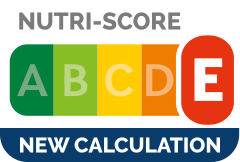 Bad nutritional quality
 Ultra-processed food and drink products
 Green-Score not computed
Health
Nutrition
Label
Bad nutritional qualityNutrient levels
Fat in moderate quantity (13%)
Saturated fat in high quantity (9.4%)
Sugars in high quantity (37%)
Salt in moderate quantity (0.63%)
Nutrition label

Nutrition facts
| Nutrition facts | As sold for 100 g / 100 ml |
|---|---|
| Energy | ~ 1,543.1 kJ (367 kcal) |
| FAT | 13 g |
| Saturated fat | 9.4 g |
| Carbohydrates | 56 g |
| Sugars | 37 g |
| Dietary fiber | 4.2 g |
| Proteins | 4.5 g |
| Salt | 0.63 g |
| Sodium | 0.25 g |
| Minerals | |
| Fruits, vegetables and legumes | ~ 0 % |
Nutrition facts (Detailed data)
| Nutrition facts | As sold for 100 g / 100 ml | As sold Per 100 g (packaging) | As sold Per 100 g (estimate) |
|---|---|---|---|
| Energy | ~ 1,543.1 kJ (367 kcal) | ? (367 kcal) | ? |
| FAT | 13 g | 13 g | ? |
| Saturated fat | 9.4 g | 9.4 g | ? |
| Carbohydrates | 56 g | 56 g | ? |
| Sugars | 37 g | 37 g | ? |
| Added sugars | ~ 0 g | ? | ~ 0 g |
| Dietary fiber | 4.2 g | 4.2 g | ? |
| Proteins | 4.5 g | 4.5 g | ? |
| Salt | 0.63 g | 0.63 g | ? |
| Sodium | 0.25 g | 0.25 g | ? |
| Minerals | |||
| Fruits, vegetables and legumes | ~ 0 % | ? | ~ 0 % |
Serving size
Estimated Activity Time
Approximate time needed to burn the energy in 100 g / 100 ml: 1,543 kJ. Reference adult weight: 70 kg. Energy density: Moderate.
Ingredients
Ingredients image

Ingredients list
Ingredient information
Allergens
Traces
Ingredients analysis
Palm oil content unknown
Vegan status unknown
Unrecognized: es:sugar, es:wheat-flour, es:water, es:pasteurized-liquid-egg, es:vegetable-fats-palm, es:coconut, es:palm-kernel, es:fruit-pulp-4-apple, es:peach, es:glucose-and-fructose-syrup, es:glucose-syrup, es:defatted-cocoa-powder-3-vegetable-oil-sunflower, es:flavourings, es:dextrose, es:gasifiers-e450, es:skimmed-milk-powder, es:modified-corn-starch, es:rice-starch, es:emulsifiers-sunflower-lecithin, es:dyes-e120, es:salt, es:stabilizers-e407, es:preservatives-e200, es:acidulante-330
Vegetarian status unknown
Unrecognized: es:sugar, es:wheat-flour, es:water, es:pasteurized-liquid-egg, es:vegetable-fats-palm, es:coconut, es:palm-kernel, es:fruit-pulp-4-apple, es:peach, es:glucose-and-fructose-syrup, es:glucose-syrup, es:defatted-cocoa-powder-3-vegetable-oil-sunflower, es:flavourings, es:dextrose, es:gasifiers-e450, es:skimmed-milk-powder, es:modified-corn-starch, es:rice-starch, es:emulsifiers-sunflower-lecithin, es:dyes-e120, es:salt, es:stabilizers-e407, es:preservatives-e200, es:acidulante-330
Food Processing
NOVA group
Ultra-processed food and drink productsElements that indicate the product is in NOVA group 4
How NOVA works
Additives
E150d - Sulphite ammonia caramelColour
No additive description is available yet.
E160a - caroteneColour
β-Carotene is an organic, strongly colored red-orange pigment abundant in plants and fruits. It is a member of the carotenes, which are terpenoids (isoprenoids), synthesized biochemically from eight isoprene units and thus having 40 carbons. Among the carotenes, β-carotene is distinguished by having beta-rings at both ends of the molecule. β-Carotene is biosynthesized from geranylgeranyl pyrophosphate.β-Carotene is the most common form of carotene in plants. When used as a food coloring, it has the E number E160a. The structure was deduced by Karrer et al. in 1930. In nature, β-carotene is a precursor (inactive form) to vitamin A via the action of beta-carotene 15,15'-monooxygenase.Isolation of β-carotene from fruits abundant in carotenoids is commonly done using column chromatography. It can also be extracted from the beta-carotene rich algae, Dunaliella salina. The separation of β-carotene from the mixture of other carotenoids is based on the polarity of a compound. β-Carotene is a non-polar compound, so it is separated with a non-polar solvent such as hexane. Being highly conjugated, it is deeply colored, and as a hydrocarbon lacking functional groups, it is very lipophilic.
E202 - Potassium sorbatePreservative
Potassium sorbate (E202) is a synthetic food preservative commonly used to extend the shelf life of various food products.
It works by inhibiting the growth of molds, yeast, and some bacteria, preventing spoilage. When added to foods, it helps maintain their freshness and quality.
Some studies have shown that when combined with nitrites, potassium sorbate have genotoxic activity in vitro. However, potassium sorbate is generally recognized as safe (GRAS) by regulatory authorities.
E410 - Locust bean gumEmulsifierStabiliserThickener
Locust bean gum (LBG, also known as carob gum, carob bean gum, carobin, E410) is a thickening agent and a gelling agent used in food technology.
E435 - Polyoxyethylene sorbitan monostearateEmulsifierStabiliser
No additive description is available yet.
E471 - Mono- and diglycerides of fatty acidsEmulsifierStabiliser
Mono- and diglycerides of fatty acids (E471), are food additives commonly used as emulsifiers in various processed foods.
These compounds consist of glycerol molecules linked to one or two fatty acid chains, which help stabilize and blend water and oil-based ingredients. E471 enhances the texture and shelf life of products like margarine, baked goods, and ice cream, ensuring a smooth and consistent texture.
It is generally considered safe for consumption within established regulatory limits.
E475 - Polyglycerol esters of fatty acidsEmulsifierStabiliser
No additive description is available yet.
E476 - Polyglycerol polyricinoleateEmulsifier
Polyglycerol polyricinoleate (PGPR), E476, is an emulsifier made from glycerol and fatty acids (usually from castor bean, but also from soybean oil). In chocolate, compound chocolate and similar coatings, PGPR is mainly used with another substance like lecithin to reduce viscosity. It is used at low levels (below 0.5%), and works by decreasing the friction between the solid particles (e.g. cacao, sugar, milk) in molten chocolate, reducing the yield stress so that it flows more easily, approaching the behaviour of a Newtonian fluid. It can also be used as an emulsifier in spreads and in salad dressings, or to improve the texture of baked goods. It is made up of a short chain of glycerol molecules connected by ether bonds, with ricinoleic acid side chains connected by ester bonds. PGPR is a yellowish, viscous liquid, and is strongly lipophilic: it is soluble in fats and oils and insoluble in water and ethanol.
E492 - Sorbitan tristearateEmulsifierStabiliser
Sorbitan tristearate is a nonionic surfactant. It is variously used as a dispersing agent, emulsifier, and stabilizer, in food and in aerosol sprays. As a food additive, it has the E number E492. Brand names for polysorbates include Alkest, Canarcel, and Span. The consistency of sorbitan tristearate is waxy; its color is light cream to tan.
E500 - Sodium carbonatesStabiliserThickener
Sodium carbonates (E500) are compounds commonly used in food preparation as leavening agents, helping baked goods rise by releasing carbon dioxide when they interact with acids.
Often found in baking soda, they regulate the pH of food, preventing it from becoming too acidic or too alkaline. In the culinary world, sodium carbonates can also enhance the texture and structure of foods, such as noodles, by modifying the gluten network.
Generally recognized as safe, sodium carbonates are non-toxic when consumed in typical amounts found in food.
Environment
Green-Score, origins bonus, and transportation impact are shown for Worldwide .
Green Score
Overall grade
Unknown environmental impactAbout Green-Score
Current scope
Green-Score availability
Bonuses and maluses
Origins of ingredients
Packaging impact
Packaging
Packaging impact
Packaging materials
| Material | % | Packaging weight | Packaging weight per 100 g of product |
|---|---|---|---|
| Plastic | |||
| Total |
Declared packaging
Data precision
Transportation
Manufacturing locations
Origins of ingredients
Origins breakdown
| Origin | Percent of ingredients | Impact |
|---|---|---|
| Spain | 100 % | Medium |
Data Source
Data presented on this page is sourced from the Open Food Facts database. This platform does not alter the original dataset; its purpose is solely to enhance data visualization and user accessibility.
Product added on November 24, 2018 at 2:28:15 PM UTC by kiliweb .
Last edit on March 17, 2026 at 11:29:25 AM UTC by new-nutrition-bot .
Product page also edited by acuario, eatshalal, foodless, inf, kiliweb, musarana, new-nutrition-bot, openfoodfacts-contributors, osimo, packbot, roboto-app, yuka.VnBzaEZ2d0tvZUlobHRzQi9Eemw1djE0MW9lUWNYNnVPN3RNSUE9PQ.