

Tiramisu Familienpackung
Health
Nutrition
Nutri-Score
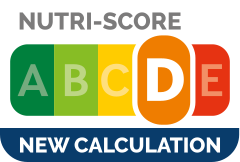 Lower nutritional quality
Nutri-Score data warning
Nutrient levels
Fat in moderate quantity (12%)
Saturated fat in high quantity (9.5%)
Sugars in high quantity (23%)
Salt in low quantity (0.19%)
Nutrition label

Nutrition facts
| Nutrition facts | As sold for 100 g / 100 ml | Compared to: Tiramisu |
|---|---|---|
| Energy | 1144 kJ (273 kcal) | 1,102.491 kJ (267 kcal) (+4%) |
| Fat | 12 g | 12.385 g (-3%) |
| Saturated fat | 9.5 g | 8.506 g (+12%) |
| Carbohydrates | 34 g | 32.155 g (+6%) |
| Sugars | 23 g | 21.314 g (+8%) |
| Dietary fiber | ? | ? |
| Proteins | 4 g | 4.165 g (-4%) |
| Salt | 0.19 g | 0.187 g (+2%) |
| Sodium | 0.076 g | 0.075 g (+1%) |
| Fruits, vegetables and legumes | ~ 0 % | ? |
Nutrition facts (Detailed data)
| Nutrition facts | As sold for 100 g / 100 ml | As sold Per 100 g (packaging) | As sold Per 100 g (estimate) |
|---|---|---|---|
| Energy | 1144 kJ (273 kcal) | 1144 kJ (273 kcal) | ? |
| Fat | 12 g | 12 g | ? |
| Saturated fat | 9.5 g | 9.5 g | ? |
| Carbohydrates | 34 g | 34 g | ? |
| Sugars | 23 g | 23 g | ? |
| Dietary fiber | ? | ? | ? |
| Proteins | 4 g | 4 g | ? |
| Salt | 0.19 g | 0.19 g | ? |
| Sodium | 0.076 g | 0.076 g | ? |
| Fruits, vegetables and legumes | ~ 0 % | ? | ~ 0 % |
Ingredients
Ingredients image

Ingredients list
Ingredient information
Added sugars
Allergens
Traces
Ingredients analysis
Palm oil content unknown
Contains non-vegan ingredients.
No non-vegetarian ingredients.
Food Processing
NOVA group
 Ultra-processed food and drink products
Elements that indicate the product is in NOVA group 4
How NOVA works
Additives
E270 - Lactic acid
LACTIC ACID is an organic compound with the formula CH3CH(OH)CO2H. In the form of its conjugate base called lactate (this is thus different and kept as a separate ingredient). Lactic acid is chiral, consisting of two optical isomers. One is known as L-(+)-lactic acid or (S)-lactic acid and the other, its mirror image, is D-(−)-lactic acid or (R)-lactic acid in food the L-variant is used
E407 - Carrageenan EFSA overexposure risk: highCarrierEmulsifierHumectantStabiliserThickener
Carrageenan (E407), derived from red seaweed, is widely employed in the food industry as a gelling, thickening, and stabilizing agent, notably in dairy and meat products.
It can exist in various forms, each imparting distinct textural properties to food.
However, its degraded form, often referred to as poligeenan, has raised health concerns due to its potential inflammatory effects and its classification as a possible human carcinogen (Group 2B) by the International Agency for Research on Cancer (IARC).
Nevertheless, food-grade carrageenan has been deemed safe by various regulatory bodies when consumed in amounts typically found in food.
E471 - Mono- and diglycerides of fatty acidsEmulsifierStabiliser
Mono- and diglycerides of fatty acids (E471), are food additives commonly used as emulsifiers in various processed foods.
These compounds consist of glycerol molecules linked to one or two fatty acid chains, which help stabilize and blend water and oil-based ingredients. E471 enhances the texture and shelf life of products like margarine, baked goods, and ice cream, ensuring a smooth and consistent texture.
It is generally considered safe for consumption within established regulatory limits.
E500 - Sodium carbonatesStabiliserThickener
Sodium carbonates (E500) are compounds commonly used in food preparation as leavening agents, helping baked goods rise by releasing carbon dioxide when they interact with acids.
Often found in baking soda, they regulate the pH of food, preventing it from becoming too acidic or too alkaline. In the culinary world, sodium carbonates can also enhance the texture and structure of foods, such as noodles, by modifying the gluten network.
Generally recognized as safe, sodium carbonates are non-toxic when consumed in typical amounts found in food.
E500ii - Sodium hydrogen carbonateStabiliserThickener
Sodium hydrogen carbonate, also known as E500ii, is a food additive commonly used as a leavening agent.
When added to recipes, it releases carbon dioxide gas upon exposure to heat or acids, causing dough to rise and resulting in a light, fluffy texture in baked goods.
It is generally recognized as safe (GRAS) by regulatory authorities when used in appropriate quantities and poses no significant health risks when consumed in typical food applications.
E503 - Ammonium carbonates
AMMONIUM BICARBONATE is an inorganic compound with formula (NH4)HCO3, simplified to NH5CO3. Ammonium bicarbonate is used in the food industry as a raising agent for flat baked goods, such as cookies and crackers, and in China in steamed buns and Chinese almond cookies. It was commonly used in the home before modern day baking powder was made available.
E503i - Ammonium carbonate
No additive description is available yet.
Environment
Green-Score, origins bonus, and transportation impact are shown for Worldwide .
Green Score
Overall grade
 Very high environmental impact
About Green-Score
Current scope
Life cycle analysis
Average impact of the category
Tiramisu, refrigerated • Score: 22/100Life-cycle reference
Overall environmental impact by stage (PEF)
The overall environmental impact figure (PEF) comes from ADEME's Agribalyse database, for the category: Tiramisu, refrigerated. Source: ADEME Agribalyse Database.
| Stage | Impact |
|---|---|
| Agriculture | 79.0 % |
| Processing | 14.2 % |
| Packaging | 2.8 % |
| Transportation | 3.0 % |
| Distribution | 0.7 % |
| Consumption | 0.2 % |
Bonuses and maluses
Production system
Declared origins
Packaging impact
Green-Score for this product
Green-Score for this product
Final score: 22/100Final score breakdown
Carbon footprint
Carbon footprint
Climate impact by stage (CO2e)
The carbon emission figure comes from ADEME's Agribalyse database, for the category: Tiramisu, refrigerated. Source: ADEME Agribalyse Database.
| Stage | Impact |
|---|---|
| Agriculture | 69.4 % |
| Processing | 20.3 % |
| Packaging | 4.8 % |
| Transportation | 4.5 % |
| Distribution | 0.4 % |
| Consumption | 0.1 % |
Packaging
Packaging impact
Packaging components
| Shape | Material | Recycling | Impact |
|---|---|---|---|
| BOX | Plastic | Unknown | High |
Declared packaging
Transportation
Manufacturing locations
Declared origins
Forest footprint
Forest footprint
Ingredients linked to forest pressure
| Ingredient | Type | Percent in product | Forest footprint |
|---|---|---|---|
| EGG Yolk | Oeufs Importés | 0.63 % | 0.00 |
| EGG White | Oeufs Importés | 0.31 % | 0.00 |
| EGG | Oeufs Importés | 2.47 % | 0.00 |
Data Source
Product data comes from Open Food Facts. Food Benchmark also adds translations, category comparisons and explanatory calculations.
The database is licensed under ODbL 1.0, individual contents under DbCL 1.0, and product photos under CC BY-SA 3.0.
Product added on September 18, 2019 at 8:06:22 PM UTC by kiliweb .
Last edit on March 14, 2026 at 4:03:10 PM UTC by new-nutrition-bot .
Product page also edited by auroralifescience, itsjustruby, kiliweb, marmotte73, musarana, new-nutrition-bot, nustiante, packbot, telperion87, teolemon, yuka.Wlp3SE1aZ0hsc2NWbXNFMDNUVG54ODlhbjVHclhXWHJFK29NSWc9PQ.