

Granola Barre Extra Cookie🍪
Health
Nutrition
Nutri-Score
 Lower nutritional quality
Nutri-Score data warning
Nutrient levels
Fat in high quantity (21.8%)
Saturated fat in high quantity (12.1%)
Sugars in high quantity (39.3%)
Salt in moderate quantity (0.893%)
Nutrition label

Nutrition facts
| Nutrition facts | As sold for 100 g / 100 ml | Compared to: chocolate-biscuity-bars |
|---|---|---|
| Energy | 2042.85714285714 kJ (485 kcal) | 2,166.056 kJ (518 kcal) (-6%) |
| Fat | 21.7857142857143 g | 27.621 g (-21%) |
| Saturated fat | 12.1428571428571 g | 15.159 g (-20%) |
| Carbohydrates | 64.2857142857143 g | 59.171 g (+9%) |
| Sugars | 39.2857142857143 g | 44.706 g (-12%) |
| Dietary fiber | 3.21428571428571 g | ? |
| Proteins | 6.42857142857143 g | 6.562 g (-2%) |
| Salt | 0.892857142857143 g | 0.286 g (+212%) |
| Sodium | 0.357142857142857 g | 0.113 g (+216%) |
| Fruits, vegetables and legumes | ~ 0 % | ? |
Nutrition facts (Detailed data)
| Nutrition facts | As sold for 100 g / 100 ml | As sold Per serving (28 g) (packaging) | As sold Per 100 g (estimate) |
|---|---|---|---|
| Energy | 2042.85714285714 kJ (485 kcal) | 572 kJ (136 kcal) | ? |
| Fat | 21.7857142857143 g | 6.1 g | ? |
| Saturated fat | 12.1428571428571 g | 3.4 g | ? |
| Carbohydrates | 64.2857142857143 g | 18 g | ? |
| Sugars | 39.2857142857143 g | 11 g | ? |
| Dietary fiber | 3.21428571428571 g | 0.9 g | ? |
| Proteins | 6.42857142857143 g | 1.8 g | ? |
| Salt | 0.892857142857143 g | 0.25 g | ? |
| Sodium | 0.357142857142857 g | 0.1 g | ? |
| Fruits, vegetables and legumes | ~ 0 % | ? | ~ 0 % |
Serving size
Ingredients
Ingredients image
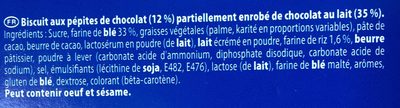
Ingredients list
Ingredient information
Added sugars
Allergens
Traces
Ingredients analysis
Contains ingredients containing palm oil.
Contains non-vegan ingredients.
Vegetarian status unknown
Food Processing
NOVA group
 Ultra-processed food and drink products
Elements that indicate the product is in NOVA group 4
How NOVA works
Additives
E160a - caroteneColour
β-Carotene is an organic, strongly colored red-orange pigment abundant in plants and fruits. It is a member of the carotenes, which are terpenoids (isoprenoids), synthesized biochemically from eight isoprene units and thus having 40 carbons. Among the carotenes, β-carotene is distinguished by having beta-rings at both ends of the molecule. β-Carotene is biosynthesized from geranylgeranyl pyrophosphate.β-Carotene is the most common form of carotene in plants. When used as a food coloring, it has the E number E160a. The structure was deduced by Karrer et al. in 1930. In nature, β-carotene is a precursor (inactive form) to vitamin A via the action of beta-carotene 15,15'-monooxygenase.Isolation of β-carotene from fruits abundant in carotenoids is commonly done using column chromatography. It can also be extracted from the beta-carotene rich algae, Dunaliella salina. The separation of β-carotene from the mixture of other carotenoids is based on the polarity of a compound. β-Carotene is a non-polar compound, so it is separated with a non-polar solvent such as hexane. Being highly conjugated, it is deeply colored, and as a hydrocarbon lacking functional groups, it is very lipophilic.
E160ai - Beta-caroteneColour
No additive description is available yet.
E322 - LecithinsAntioxidantEmulsifier
Lecithins are natural compounds commonly used in the food industry as emulsifiers and stabilizers.
Extracted from sources like soybeans and eggs, lecithins consist of phospholipids that enhance the mixing of oil and water, ensuring smooth textures in various products like chocolates, dressings, and baked goods.
They do not present any known health risks.
E322i - LecithinAntioxidantEmulsifier
Lecithins are natural compounds commonly used in the food industry as emulsifiers and stabilizers.
Extracted from sources like soybeans and eggs, lecithins consist of phospholipids that enhance the mixing of oil and water, ensuring smooth textures in various products like chocolates, dressings, and baked goods.
They do not present any known health risks.
E450 - Diphosphates EFSA overexposure risk: highEmulsifierHumectantSequestrantStabiliserThickener
Diphosphates (E450) are food additives often utilized to modify the texture of products, acting as leavening agents in baking and preventing the coagulation of canned food.
These salts can stabilize whipped cream and are also found in powdered products to maintain their flow properties. They are commonly present in baked goods, processed meats, and soft drinks.
Derived from phosphoric acid, they're part of our daily phosphate intake, which often surpasses recommended levels due to the prevalence of phosphates in processed foods and drinks.
Excessive phosphate consumption is linked to health issues, such as impaired kidney function and weakened bone health. Though diphosphates are generally regarded as safe when consumed within established acceptable daily intakes, it's imperative to monitor overall phosphate consumption to maintain optimal health.
E450i - Disodium diphosphateEmulsifierHumectantSequestrantStabiliserThickener
No additive description is available yet.
E476 - Polyglycerol polyricinoleateEmulsifier
Polyglycerol polyricinoleate (PGPR), E476, is an emulsifier made from glycerol and fatty acids (usually from castor bean, but also from soybean oil). In chocolate, compound chocolate and similar coatings, PGPR is mainly used with another substance like lecithin to reduce viscosity. It is used at low levels (below 0.5%), and works by decreasing the friction between the solid particles (e.g. cacao, sugar, milk) in molten chocolate, reducing the yield stress so that it flows more easily, approaching the behaviour of a Newtonian fluid. It can also be used as an emulsifier in spreads and in salad dressings, or to improve the texture of baked goods. It is made up of a short chain of glycerol molecules connected by ether bonds, with ricinoleic acid side chains connected by ester bonds. PGPR is a yellowish, viscous liquid, and is strongly lipophilic: it is soluble in fats and oils and insoluble in water and ethanol.
E482 - Calcium stearoyl-2-lactylate EFSA overexposure risk: highEmulsifierStabiliser
Calcium stearoyl-2-lactylate (calcium stearoyl lactylate or CSL) or E482 is a versatile, FDA approved food additive. It is one type of a commercially available lactylate. CSL is non-toxic, biodegradable, and typically manufactured using biorenewable feedstocks. Because CSL is a safe and highly effective food additive, it is used in a wide variety of products from baked goods and desserts to packaging.As described by the Food Chemicals Codex 7th edition, CSL is a cream-colored powder. CSL is currently manufactured by the esterification of stearic acid and lactic acid with partial neutralization using food-grade hydrated lime (calcium hydroxide). Commercial grade CSL is a mixture of calcium salts of stearoyl lactic acid, with minor proportions of other salts of related acids. The HLB for CSL is 5.1. It is slightly soluble in hot water. The pH of a 2% aqueous suspension is approximately 4.7.
E500 - Sodium carbonatesStabiliserThickener
Sodium carbonates (E500) are compounds commonly used in food preparation as leavening agents, helping baked goods rise by releasing carbon dioxide when they interact with acids.
Often found in baking soda, they regulate the pH of food, preventing it from becoming too acidic or too alkaline. In the culinary world, sodium carbonates can also enhance the texture and structure of foods, such as noodles, by modifying the gluten network.
Generally recognized as safe, sodium carbonates are non-toxic when consumed in typical amounts found in food.
E500ii - Sodium hydrogen carbonateStabiliserThickener
Sodium hydrogen carbonate, also known as E500ii, is a food additive commonly used as a leavening agent.
When added to recipes, it releases carbon dioxide gas upon exposure to heat or acids, causing dough to rise and resulting in a light, fluffy texture in baked goods.
It is generally recognized as safe (GRAS) by regulatory authorities when used in appropriate quantities and poses no significant health risks when consumed in typical food applications.
E503 - Ammonium carbonates
AMMONIUM BICARBONATE is an inorganic compound with formula (NH4)HCO3, simplified to NH5CO3. Ammonium bicarbonate is used in the food industry as a raising agent for flat baked goods, such as cookies and crackers, and in China in steamed buns and Chinese almond cookies. It was commonly used in the home before modern day baking powder was made available.
E503ii - Ammonium hydrogen carbonate
No additive description is available yet.
Environment
Green-Score, origins bonus, and transportation impact are shown for Worldwide .
Green Score
Overall grade
 Very high environmental impact
About Green-Score
Current scope
Life cycle analysis
Average impact of the category
 Chocolate bar with biscuit • Score: 50/100
Life-cycle reference
Overall environmental impact by stage (PEF)
The overall environmental impact figure (PEF) comes from ADEME's Agribalyse database, for the category: Chocolate bar with biscuit. Source: ADEME Agribalyse Database.
| Stage | Impact |
|---|---|
| Agriculture | 75.0 % |
| Processing | 7.2 % |
| Packaging | 13.6 % |
| Transportation | 3.4 % |
| Distribution | 0.9 % |
| Consumption | 0.0 % |
Bonuses and maluses
Declared origins
Threatened species risk
Packaging impact
Green-Score for this product
Green-Score for this product
Final score: 24/100Final score breakdown
Carbon footprint
Carbon footprint
Climate impact by stage (CO2e)
The carbon emission figure comes from ADEME's Agribalyse database, for the category: Chocolate bar with biscuit. Source: ADEME Agribalyse Database.
| Stage | Impact |
|---|---|
| Agriculture | 84.0 % |
| Processing | 3.0 % |
| Packaging | 9.7 % |
| Transportation | 3.1 % |
| Distribution | 0.3 % |
| Consumption | 0.0 % |
Packaging

Packaging impact
Packaging components
| Shape | Material | Recycling | Impact |
|---|---|---|---|
| 1 Sleeve | Cardboard | Recycle | Low |
| 6 BAG | Plastic | Discard | High |
Transportation
Declared origins
Forest footprint
Forest footprint
Deforestation risk details
Data Source
Product data comes from Open Food Facts. Food Benchmark also adds translations, category comparisons and explanatory calculations.
The database is licensed under ODbL 1.0, individual contents under DbCL 1.0, and product photos under CC BY-SA 3.0.
Product added on May 9, 2017 at 10:15:52 AM UTC by kiliweb .
Last edit on March 17, 2026 at 10:36:05 AM UTC by new-nutrition-bot .
Product page also edited by baboun78, chevalstar, dorado, driveoff, inf, kiliweb, laurette-s34, maelimi, magasins-u, mathone1, musarana, new-nutrition-bot, openfoodfacts-contributors, quechoisir, teolemon, theo38, yuka.VDRCUU1JUUVpT1V4cThjT29rUHYvc0JjNXNMekEySzJGdkJCSVE9PQ, yuka.sY2b0xO6T85zoF3NwEKvlkEWb4rysyrLOzDnnkzU2cbQHoTWYv9-zILGM6s.