ProductsBetty BossiCivet de chevreuil
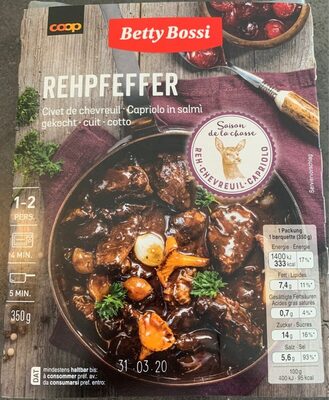
Civet de chevreuil
Barcode 7613356269156
Betty Bossi

Civet de chevreuil

350 g
BARCODE:7613356269156
CATEGORIES:Meats And Their Products, Meats, Game, Venison, Jugging, Civet De Cerf, Civet De Chevreuil, Viande Preparee
LABELS:Contains Alcohol
PACKAGING:Tray
ORIGIN:Europe
MANUFACTURING:Liechtenstein
WEBSITE:www.coop.ch
COUNTRIES:France, Switzerland
STORES:Coop

Labels

Nutri-Score
Nutri-ScoreModerate nutritional quality
NOVA Group
NOVA GroupUltra-processed food and drink products
Green-Score
Green-ScoreGreen-Score not computed

Health

Nutrition

Label

CModerate nutritional quality

Nutrient levels

Fat in low quantity (2.1%)
What you need to know • A high consumption of fat, especially saturated fats, can raise cholesterol, which increases the risk of heart diseases. Recommendation: Limit the consumption of fat and saturated fat • Choose products with lower fat and saturated fat content. Source: National Health Service UK (NHS) - Fat: the facts
Saturated fat in low quantity (0.2%)
What you need to know • A high consumption of fat, especially saturated fats, can raise cholesterol, which increases the risk of heart diseases. Recommendation: Limit the consumption of fat and saturated fat • Choose products with lower fat and saturated fat content. Source: National Health Service UK (NHS) - Fat: the facts
Sugars in low quantity (4%)
What you need to know • A high consumption of sugar can cause weight gain and tooth decay. It also augments the risk of type 2 diabetes and cardio-vascular diseases. Recommendation: Limit the consumption of sugar and sugary drinks • Sugary drinks (such as sodas, fruit beverages, and fruit juices and nectars) should be limited as much as possible (no more than 1 glass a day). • Choose products with lower sugar content and reduce the consumption of products with added sugars. Source: National Health Service UK (NHS) - Sugar: the facts
Salt in high quantity (1.6%)
What you need to know • A high consumption of salt (or sodium) can cause raised blood pressure, which can increase the risk of heart disease and stroke. • Many people who have high blood pressure do not know it, as there are often no symptoms. • Most people consume too much salt (on average 9 to 12 grams per day), around twice the recommended maximum level of intake. Recommendation: Limit the consumption of salt and salted food • Reduce the quantity of salt used when cooking, and don't salt again at the table. • Limit the consumption of salty snacks and choose products with lower salt content. Source: World Health Organization (WHO) - Fact sheet - Salt reduction Source: National Health Service UK (NHS) - Salt: the facts

Nutrition facts

Nutrition factsAs sold for 100 g / 100 ml
Energy~ 518.5 kJ (95 kcal)
FAT2.1 g
Saturated fat0.2 g
Carbohydrates6.4 g
Sugars4 g
Dietary fiber0 g
Proteins11 g
Salt1.6 g
Sodium0.64 g
Alcohol> 5 % vol
Minerals
Fruits, vegetables and legumes~ 0 %

Nutrition facts (Detailed data)

Nutrition factsAs sold for 100 g / 100 mlAs sold Per 100 g (packaging)As sold Per 100 g (estimate)
Energy~ 518.5 kJ (95 kcal)? (95 kcal)?
FAT2.1 g2.1 g?
Saturated fat0.2 g0.2 g?
Carbohydrates6.4 g6.4 g?
Sugars4 g4 g?
Added sugars~ 0.01 g?~ 0.01 g
Dietary fiber0 g0 g?
Proteins11 g11 g?
Salt1.6 g1.6 g?
Sodium0.64 g0.64 g?
Alcohol> 5 % vol> 5 % vol?
Minerals
Fruits, vegetables and legumes~ 0 %?~ 0 %

Serving size

350 g

Estimated Activity Time

Approximate time needed to burn the energy in 100 g / 100 ml: 519 kJ. Reference adult weight: 70 kg. Energy density: Low.

Walking
30 min (~3,023 steps)
Swimming
18 min
Bicycling
14 min
Running
11 min

Ingredients

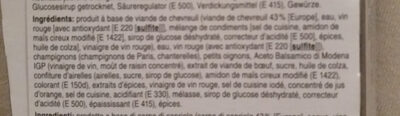
Ingredients image

Civet de chevreuil ingredients image

Ingredients list

produit à base de viande de chevreuil (viande de chevreuil 43% (Europe) eau, vin rouge (avec antioxydant (E 220 sulfitel, mélange de condiments (sel de cuisine, amidon de mais cireux modifié [E 14221, sirop de glucose déshydraté, correcteur d'acidité (E 500 épices huile de colzal, vinaigre de vin rouge), eau, vin rouge (avec antioxydant (E 220 sulfite). champignons (champignons de Paris, chanterelles). petits oignons, Aceto Balsamico di Modena IGP (vinaigre de vin, moût de raisin concentré), extrait de viande de baeuf, sucre, huile de colza, confiture d'airelles (airelles, sucre, sirop de glucose), amidon de mais cireux modifié (E 1422) colorant (E 150d), extraits d'épices, vinaigre de vin rouge, sel de cuisine iodé, concentré de jus d'orange, sel de cuisine, acidifiant (E 330), mélasse, sirop de glucose déshydraté, correcteur d'acidité (E 500), épaississant (E 415), épices. Contient de l'alcool.

Ingredient information

Produit A Base De Viande De Chevreuil
50% (estimate)
Venison
43.0%
Water
3.5% (estimate)
Red Wine
1.75% (estimate)
Antioxidant
0.88% (estimate)
E220 Sulfitel
0.44% (estimate)
Mixed Condiments
0.22% (estimate)
Salt
0.11% (estimate)
Modified Waxy Maize Starch
0.05% (estimate)
E 14221
0.03% (estimate)
Dehydrated Glucose Syrup
0.01% (estimate)
Acidity Regulator
0.01% (estimate)
E500 Epices Huile De Colzal
0% (estimate)
Red Wine Vinegar
0% (estimate)
Water
0% (estimate)
Red Wine
0% (estimate)
Antioxidant
0% (estimate)
E220 Sulfite
0% (estimate)
Mushroom
0% (estimate)
Cultivated Mushroom
0% (estimate)
Chanterelle
0% (estimate)
Small White Onions
0% (estimate)
Aceto Balsamico Di Modena
0% (estimate)
Wine Vinegar
0% (estimate)
Concentrated Grape Must
0% (estimate)
Extrait De Viande De Baeuf
0% (estimate)
Sugar
0% (estimate)
Colza Oil
0% (estimate)
Lingonberry Jam
0% (estimate)
Lingonberry
0% (estimate)
Sugar
0% (estimate)
Glucose Syrup
0% (estimate)
Modified Waxy Maize Starch
0% (estimate)
E1422
0% (estimate)
Colour
0% (estimate)
E150d
0% (estimate)
Spice Extract
0% (estimate)
Red Wine Vinegar
0% (estimate)
Iodised Salt
0% (estimate)
Concentrated Orange Juice
0% (estimate)
Salt
0% (estimate)
Acid
0% (estimate)
E330
0% (estimate)
Molasses
0% (estimate)
Dehydrated Glucose Syrup
0% (estimate)
Acidity Regulator
0% (estimate)
E500
0% (estimate)
Thickener
0% (estimate)
E415
0% (estimate)
Spice
0% (estimate)
Alcohol
0% (estimate)

Allergens

Sulphur Dioxide And SulphitesVin Rouge

Ingredients analysis

Palm oil free
Yes

No ingredients containing palm oil.

Vegan
No

Contains non-vegan ingredients.

Unrecognized: fr:produit-a-base-de-viande-de-chevreuil, fr:e220-sulfitel, fr:e-14221, fr:e500-epices-huile-de-colzal, fr:e220-sulfite, fr:extrait-de-viande-de-baeuf

Vegetarian
No

Contains non-vegetarian ingredients.

Unrecognized: fr:produit-a-base-de-viande-de-chevreuil, fr:e220-sulfitel, fr:e-14221, fr:e500-epices-huile-de-colzal, fr:e220-sulfite, fr:extrait-de-viande-de-baeuf


Food Processing

NOVA group

4Ultra-processed food and drink products

Elements that indicate the product is in NOVA group 4

Additives
E1422 - Acetylated distarch adipate
Additives
E150d - Sulphite ammonia caramel
Additives
E415 - Xanthan gum
Ingredients
Colour
Ingredients
Glucose
Ingredients
Glucose Syrup
Ingredients
Thickener
Ingredients
Modified Starch

How NOVA works

The NOVA classification assigns food products into 4 groups based on their degree of processing: 1. Unprocessed or minimally processed foods 2. Processed culinary ingredients 3. Processed foods 4. Ultra-processed food and drink products

Additives

E1422 - Acetylated distarch adipateEmulsifierStabiliserThickener

Acetylated distarch adipate (E1422), is a starch that is treated with acetic anhydride and adipic acid anhydride to resist high temperatures. It is used in foods as a bulking agent, stabilizer and a thickener. No acceptable daily intake for human consumption has been determined.

E150d - Sulphite ammonia caramelColour

No additive description is available yet.

E220 - Sulphur dioxideAntioxidantPreservative

SULPHUR DIOXIDE is the chemical compound with the formula SO2.

E330 - Citric acidAntioxidantSequestrant

Citric acid is a natural organic acid found in citrus fruits such as lemons, oranges, and limes.

It is widely used in the food industry as a flavor enhancer, acidulant, and preservative due to its tart and refreshing taste.

Citric acid is safe for consumption when used in moderation and is considered a generally recognized as safe (GRAS) food additive by regulatory agencies worldwide.

E415 - Xanthan gumEmulsifierStabiliserThickener

Xanthan gum (E415) is a natural polysaccharide derived from fermented sugars, often used in the food industry as a thickening and stabilizing agent.

This versatile food additive enhances texture and prevents ingredient separation in a wide range of products, including salad dressings, sauces, and gluten-free baked goods.

It is considered safe for consumption even at high intake amounts.

E500 - Sodium carbonatesStabiliserThickener

Sodium carbonates (E500) are compounds commonly used in food preparation as leavening agents, helping baked goods rise by releasing carbon dioxide when they interact with acids.

Often found in baking soda, they regulate the pH of food, preventing it from becoming too acidic or too alkaline. In the culinary world, sodium carbonates can also enhance the texture and structure of foods, such as noodles, by modifying the gluten network.

Generally recognized as safe, sodium carbonates are non-toxic when consumed in typical amounts found in food.

Environment

Green-Score, origins bonus, and transportation impact are shown for Worldwide .

Green Score

Overall grade

UnknownUnknown environmental impact

About Green-Score

The Green-Score is an experimental score that summarizes the environmental impacts of food products.

Current scope

The Green-Score was initially developed for France and it is being extended to other European countries. The Green-Score formula is subject to change as it is regularly improved to make it more precise and better suited to each country. Select a country to include the full impact of transportation in the final score.

Green-Score availability

We could not compute the Green-Score of this product because some data is missing. A more precise category, ingredients list, origins or packaging data can unlock the computation.

Bonuses and maluses

Origins of ingredients

Declared origins: Europe Origins malus: -2 Transportation (Worldwide): 0 Environmental policy adjustment: -2 Select a country to include the full impact of transportation.

Packaging impact

Packaging with a medium impact Malus: -10 Packaging score: 0

Packaging

Packaging impact

Packaging with a medium impact Malus: -10 Packaging score: 0

Packaging materials

Material%Packaging weightPackaging weight per 100 g of product
Unknown
Total

Declared packaging

Tray

Data precision

The packaging information is not sufficiently precise to compute the most accurate packaging impact. Exact shapes and materials of all packaging components help improve the Green-Score.

Transportation

Manufacturing locations

Liechtenstein

Origins of ingredients

Declared origins: Europe Origins malus: -2 Transportation (Worldwide): 0 Environmental policy adjustment: -2 Select a country to include the full impact of transportation.

Origins breakdown

OriginPercent of ingredientsImpact
Europe100 %High

Data Source

Data presented on this page is sourced from the Open Food Facts database. This platform does not alter the original dataset; its purpose is solely to enhance data visualization and user accessibility.

Product added on November 17, 2018 at 11:14:54 AM UTC by date-limite-app .

Last edit on March 17, 2026 at 9:48:49 PM UTC by new-nutrition-bot .

Product page also edited by aleene, date-limite-app, domeg, itsjustruby, kiliweb, laura-chaud, new-nutrition-bot, packbot, roboto-app, yuka.UXJBbVQ2OCtxdGtFdzhGdnp5blI4ZlZweXJYMmJVZVBkUG9RSVE9PQ.