
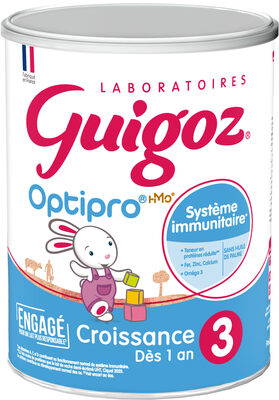
GUIGOZ 3 Lait de Croissance dès 1 an 900g
Health
Nutrition
Nutrition label
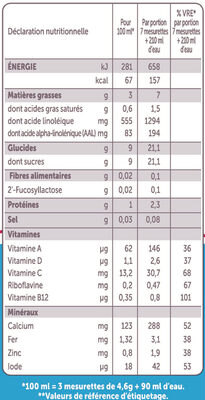
Nutrition facts
| Nutrition facts | Prepared for 100 g / 100 ml | Compared to: Ready to feed baby milks |
|---|---|---|
| Energy | 281 kJ (67 kcal) | 548.574 kJ (130 kcal) (-49%) |
| Fat | 3 g | 5.886 g (-49%) |
| Saturated fat | 0.6 g | 0.915 g (-34%) |
| Carbohydrates | 9 g | 14.505 g (-38%) |
| Sugars | 9 g | 9.123 g (-1%) |
| Dietary fiber | 0.02 g | ? |
| Proteins | 1 g | 2.584 g (-61%) |
| Salt | 0.03 g | 0.141 g (-79%) |
| Sodium | 0.012 g | 0.056 g (-79%) |
| Vitamin A | 0.000062 g | 92.544 µg (-33%) |
| Vitamin D | 0.0000011 g | 2.38 µg (-54%) |
| Vitamin C | 0.0132 g | ? |
| Calcium | 0.123 g | 88.01 mg (+40%) |
| Iron | 0.00132 g | 1.077 mg (+23%) |
| Zinc | 0.0008 g | 0.795 mg (+1%) |
| Iodine | 0.000018 g | 20.862 µg (-14%) |
| Fruits, vegetables and legumes | ? | ? |
Nutrition facts (Detailed data)
| Nutrition facts | Prepared for 100 g / 100 ml | Prepared Per 100 g (packaging) | As sold Per 100 g (packaging) | As sold Per 100 g (estimate) |
|---|---|---|---|---|
| Energy | 281 kJ (67 kcal) | 281 kJ (67 kcal) | ? (67 kcal) | ? |
| Fat | 3 g | 3 g | 3 g | ? |
| Saturated fat | 0.6 g | 0.6 g | 0.8 g | ? |
| Carbohydrates | 9 g | 9 g | 8.4 g | ? |
| Sugars | 9 g | 9 g | 5.5 g | ? |
| Dietary fiber | 0.02 g | 0.02 g | 0 g | ? |
| Proteins | 1 g | 1 g | 1.5 g | ? |
| Salt | 0.03 g | 0.03 g | 0.07 g | ? |
| Sodium | 0.012 g | 0.012 g | 0.028 g | ? |
| Vitamin A | 0.000062 g | 0.000062 g | ? | ? |
| Vitamin D | 0.0000011 g | 0.0000011 g | ? | ? |
| Vitamin C | 0.0132 g | 0.0132 g | ? | ? |
| Calcium | 0.123 g | 0.123 g | ? | ? |
| Iron | 0.00132 g | 0.00132 g | ? | ? |
| Zinc | 0.0008 g | 0.0008 g | ? | ? |
| Iodine | 0.000018 g | 0.000018 g | ? | ? |
| Fruits, vegetables and legumes | ? | ? | ? | ~ 0 % |
Serving size
Ingredients
Ingredients image
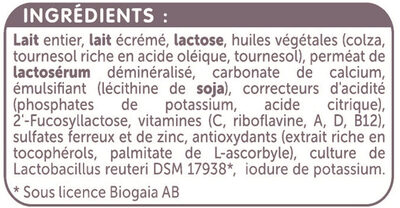
Ingredients list
Ingredient information
Allergens
Ingredients analysis
Palm oil content unknown
Contains non-vegan ingredients.
Unrecognized: fr:tournesol-riche-en-acide-oleique, fr:permeat-de-lactoserum-demineralise, fr:2-fucosyllactose, fr:culture-de-lactobacillus-reuteri-dsm-17938, fr:sous-licence-biogaia-ab
Vegetarian status unknown
Unrecognized: fr:tournesol-riche-en-acide-oleique, fr:permeat-de-lactoserum-demineralise, fr:2-fucosyllactose, fr:culture-de-lactobacillus-reuteri-dsm-17938, fr:sous-licence-biogaia-ab
Food Processing
NOVA group
 Ultra-processed food and drink products
Elements that indicate the product is in NOVA group 4
How NOVA works
Additives
E304 - Fatty acid esters of ascorbic acidAntioxidant
ASCORBYL PALMITATE is an ester formed from ascorbic acid and palmitic acid creating a fat-soluble form of vitamin C.
E304i - Ascorbyl palmitateAntioxidant
No additive description is available yet.
E306 - Tocopherol-rich extract
No additive description is available yet.
E322 - LecithinsAntioxidantEmulsifier
Lecithins are natural compounds commonly used in the food industry as emulsifiers and stabilizers.
Extracted from sources like soybeans and eggs, lecithins consist of phospholipids that enhance the mixing of oil and water, ensuring smooth textures in various products like chocolates, dressings, and baked goods.
They do not present any known health risks.
E322i - LecithinAntioxidantEmulsifier
Lecithins are natural compounds commonly used in the food industry as emulsifiers and stabilizers.
Extracted from sources like soybeans and eggs, lecithins consist of phospholipids that enhance the mixing of oil and water, ensuring smooth textures in various products like chocolates, dressings, and baked goods.
They do not present any known health risks.
E330 - Citric acidAntioxidantSequestrant
Citric acid is a natural organic acid found in citrus fruits such as lemons, oranges, and limes.
It is widely used in the food industry as a flavor enhancer, acidulant, and preservative due to its tart and refreshing taste.
Citric acid is safe for consumption when used in moderation and is considered a generally recognized as safe (GRAS) food additive by regulatory agencies worldwide.
E340 - Potassium phosphates EFSA overexposure risk: highEmulsifierHumectantSequestrantStabiliserThickener
Potassium phosphate is a generic term for the salts of potassium and phosphate ions including: Monopotassium phosphate (KH2PO4) (Molar mass approx: 136 g/mol) Dipotassium phosphate (K2HPO4) (Molar mass approx: 174 g/mol) Tripotassium phosphate (K3PO4) (Molar mass approx: 212.27 g/mol)As food additives, potassium phosphates have the E number E340.
Potassium iodide
No additive description is available yet.
Environment
Green-Score, origins bonus, and transportation impact are shown for Worldwide .
Green Score
Overall grade
 Very low environmental impact
About Green-Score
Current scope
Life cycle analysis
Average impact of the category
 Baby milk, first milk, ready to feed • Score: 98/100
Life-cycle reference
Overall environmental impact by stage (PEF)
The overall environmental impact figure (PEF) comes from ADEME's Agribalyse database, for the category: Baby milk, first milk, ready to feed. Source: ADEME Agribalyse Database.
| Stage | Impact |
|---|---|
| Agriculture | 48.7 % |
| Processing | 2.1 % |
| Packaging | 14.8 % |
| Transportation | 20.2 % |
| Distribution | 11.2 % |
| Consumption | 3.1 % |
Bonuses and maluses
Declared origins
Packaging impact
Green-Score for this product
Green-Score for this product
Final score: 78/100Final score breakdown
Carbon footprint
Carbon footprint
Climate impact by stage (CO2e)
The carbon emission figure comes from ADEME's Agribalyse database, for the category: Baby milk, first milk, ready to feed. Source: ADEME Agribalyse Database.
| Stage | Impact |
|---|---|
| Agriculture | 48.6 % |
| Processing | 1.7 % |
| Packaging | 16.5 % |
| Transportation | 27.8 % |
| Distribution | 4.6 % |
| Consumption | 0.9 % |
Packaging

Packaging impact
Packaging components
| Shape | Material | Recycling | Impact |
|---|---|---|---|
| 1 LID | Plastic | Discard | High |
| 1 BOX | Metal | Recycle | High |
| 1 Seal | Metal | Recycle | High |
| Drink CAN | Metal | Unknown | High |
Declared packaging
Data precision
Transportation
Manufacturing locations
Declared origins
Forest footprint
Forest footprint
Deforestation risk details
Additional information
- Preparation
- Dosages à respecter impérativement : une mesurette arasée (4,6 g) dans 30 ml d'eau. Utilisez exclusivement la mesurette contenue dans cette boîte. De 1 à 3 ans : 210 ml d'eau + 7 mesurettes. Une quantité inappropriée de poudre peut conduire à la déshydratation ou priver votre enfant d'une nutrition adéquate. La fréquence des biberons et les quantités à préparer sont des indications moyennes. Le volume et le nombre de biberons sont à ajuster par les professionnels de santé aux besoins de chaque enfant. Préparez le biberon juste avant le repas. Il est recommandé de donner le biberon dans l'heure qui suit sa préparation à température ambiante, dans la demi-heure s'il est tiédi. Pour tiédir l'eau, nous vous déconseillons l'emploi du four à micro-ondes en raison du risque de brûlures. Préférez le bain-marie ou le chauffe-biberon. Contrôlez la température sur la face interne de votre avant-bras. Jetez sans hésiter le reste d'un biberon non terminé.
- Conservation conditions
- Conservez la boîte fermée dans un endroit sec et frais, pas plus de 3 semaines après son ouverture.
- Customer service
- Guigoz, 34-40 rue de Guynemer 92130 Issy-les-Moulineaux
Data Source
Product data comes from Open Food Facts. Food Benchmark also adds translations, category comparisons and explanatory calculations.
The database is licensed under ODbL 1.0, individual contents under DbCL 1.0, and product photos under CC BY-SA 3.0.
Product added on October 4, 2016 at 6:15:22 AM UTC by lumytria .
Last edit on March 18, 2026 at 12:10:37 AM UTC by new-nutrition-bot .
Product page also edited by beniben, ecoscore-impact-estimator, gmlaa, jbp, kiliweb, lumytria, magasins-u, new-nutrition-bot, openfoodfacts-contributors, org-nestle-france, packbot, roboto-app, scanbot, tacite, teolemon.
Source List
- nestle-france