
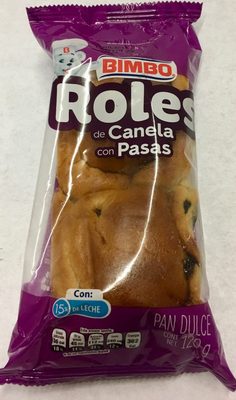
ROLES BIMBO
Health
Nutrition
Nutri-Score
 Lower nutritional quality
Nutri-Score data warning
Nutrient levels
Fat in moderate quantity (7.8%)
Saturated fat in moderate quantity (2.7%)
Sugars in high quantity (21%)
Salt in moderate quantity (0.56%)
Nutrition label
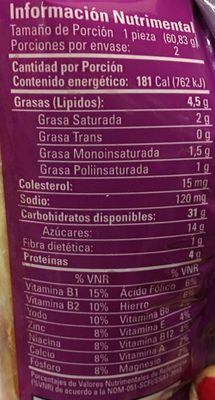
Nutrition facts
| Nutrition facts | As sold for 100 g / 100 ml |
|---|---|
| Energy | 1305 kcal (312 kcal) |
| Fat | 7.8 g |
| Saturated fat | 2.7 g |
| Monounsaturated fat | 2.9 g |
| Polyunsaturated fat | 1.9 g |
| Cholesterol | 0.03 g |
| Carbohydrates | 52.9 g |
| Sugars | 21 g |
| Dietary fiber | 1.8 g |
| Proteins | 7.5 g |
| Salt | 0.56 g |
| Sodium | 0.224 g |
| Vitamin PP | 0.0016 % DV |
| Zinc | 0.0015 g |
| Iodine | 0.000015 % DV |
| Fruits, vegetables and legumes | ? |
Nutrition facts (Detailed data)
| Nutrition facts | As sold for 100 g / 100 ml | As sold Per serving (legacy) |
|---|---|---|
| Energy | 1305 kcal (312 kcal) | 2350 kcal (562 kcal) |
| Fat | 7.8 g | 14 g |
| Saturated fat | 2.7 g | 4.86 g |
| Monounsaturated fat | 2.9 g | 5.22 g |
| Polyunsaturated fat | 1.9 g | 3.42 g |
| Cholesterol | 0.03 g | 0.054 g |
| Carbohydrates | 52.9 g | 95.2 g |
| Sugars | 21 g | 37.8 g |
| Dietary fiber | 1.8 g | 3.24 g |
| Proteins | 7.5 g | 13.5 g |
| Salt | 0.56 g | 1.01 g |
| Sodium | 0.224 g | 0.403 g |
| Vitamin PP | 0.0016 % DV | 0.00288 % DV |
| Zinc | 0.0015 g | 0.0027 g |
| Iodine | 0.000015 % DV | 0.000027 % DV |
| Fruits, vegetables and legumes | ? | ? |
Serving size
Ingredients
Ingredients image
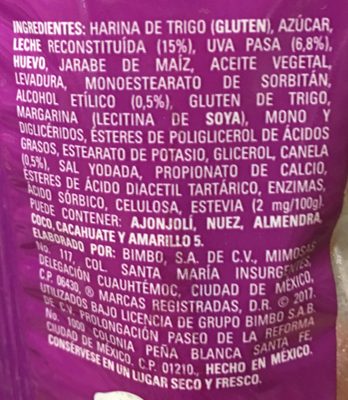
Ingredients list
Ingredient information
Added sugars
Allergens
Traces
Ingredients analysis
Palm oil content unknown
Contains non-vegan ingredients.
Unrecognized: es:azucar-leche-reconstitui̇da, es:monoestearato-de-sorbitan, en:margarine, es:mono-y-digliceridos, es:esteres-de-poliglicerol-de-acidos-grasos, es:estearato-de-potasio, es:gli̇cerol, es:esteres-de-acido-diacetil-tartarico, es:2-mg
Vegetarian status unknown
Unrecognized: es:azucar-leche-reconstitui̇da, es:monoestearato-de-sorbitan, en:margarine, es:mono-y-digliceridos, es:esteres-de-poliglicerol-de-acidos-grasos, es:estearato-de-potasio, es:gli̇cerol, es:esteres-de-acido-diacetil-tartarico, es:2-mg
Food Processing
NOVA group
 Ultra-processed food and drink products
Elements that indicate the product is in NOVA group 4
How NOVA works
Additives
E1510 - Ethanol
Ethanol, also called alcohol, ethyl alcohol, grain alcohol, and drinking alcohol, is a chemical compound, a simple alcohol with the chemical formula C2H5OH. Its formula can be also written as CH3−CH2−OH or C2H5−OH (an ethyl group linked to a hydroxyl group), and is often abbreviated as EtOH. Ethanol is a volatile, flammable, colorless liquid with a slight characteristic odor. It is a psychoactive substance and is the principal type of alcohol found in alcoholic drinks. Ethanol is naturally produced by the fermentation of sugars by yeasts or via petrochemical processes, and is most commonly consumed as a popular recreational drug. It also has medical applications as an antiseptic and disinfectant. The compound is widely used as a chemical solvent, either for scientific chemical testing or in synthesis of other organic compounds, and is a vital substance used across many different kinds of manufacturing industries. Ethanol is also used as a clean-burning fuel source.
E200 - Sorbic acid EFSA overexposure risk: highPreservative
SORBIC ACID, or 2,4-hexadienoic acid, is a natural organic compound used as a food preservative. It has the chemical formula CH3(CH)4CO2H.
E282 - calcium propionatePreservative
CALCIUM PROPIONATE has the formula Ca(C2H5COO)2. Calcium propionate is used as a preservative in a wide variety of products, including but not limited to:bread, other baked goods, processed meat, whey, and other dairy products.
E322 - LecithinsAntioxidantEmulsifier
Lecithins are natural compounds commonly used in the food industry as emulsifiers and stabilizers.
Extracted from sources like soybeans and eggs, lecithins consist of phospholipids that enhance the mixing of oil and water, ensuring smooth textures in various products like chocolates, dressings, and baked goods.
They do not present any known health risks.
E322i - LecithinAntioxidantEmulsifier
Lecithins are natural compounds commonly used in the food industry as emulsifiers and stabilizers.
Extracted from sources like soybeans and eggs, lecithins consist of phospholipids that enhance the mixing of oil and water, ensuring smooth textures in various products like chocolates, dressings, and baked goods.
They do not present any known health risks.
E460 - CelluloseCarrierEmulsifierHumectantStabiliserThickener
CELLULOSE is an organic compound with the formula (C6H10O5)n, a polysaccharide consisting of a linear chain of several hundred to many thousands of linked D-glucose units. Cellulose is used as emulsifier, thickener and stabilizer in processed foods. Cellulose powder is, for example, used in processed cheese to prevent caking inside the package.
E960 - Steviol glycosides EFSA overexposure risk: moderateSweetener
Steviol glycosides are the chemical compounds responsible for the sweet taste of the leaves of the South American plant Stevia rebaudiana (Asteraceae) and the main ingredients (or precursors) of many sweeteners marketed under the generic name stevia and several trade names. They also occur in the related species Stevia phlebophylla (but in no other species of Stevia) and in the plant Rubus chingii (Rosaceae).Steviol glycosides from Stevia rebaudiana have been reported to be between 30 and 320 times sweeter than sucrose, although there is some disagreement in the technical literature about these numbers. They are heat-stable, pH-stable, and do not ferment. Additionally, they do not induce a glycemic response when ingested, because humans can not metabolize stevia. This makes them attractive as natural sugar substitutes for diabetics and other people on carbohydrate-controlled diets. Steviol glycosides stimulate the insulin secretion through potentiation of the β-cell, preventing high blood glucose after a meal. The acceptable daily intake (ADI) for steviol glycosides, expressed as steviol equivalents, has been established to be 4 mg/kg body weight/day, and is based on no observed effects of a 100 fold higher dose in a rat study.
Environment
Green-Score, origins bonus, and transportation impact are shown for Worldwide .
Green Score
Overall grade
 Unknown environmental impact
About Green-Score
Current scope
Green-Score availability
Bonuses and maluses
Declared origins
Packaging impact
Packaging
Packaging impact
Packaging components
| Shape | Material | Recycling | Impact |
|---|---|---|---|
| BAG | Plastic | Unknown | High |
Declared packaging
Transportation
Manufacturing locations
Declared origins
Forest footprint
Forest footprint
Ingredients linked to forest pressure
| Ingredient | Type | Percent in product | Forest footprint |
|---|---|---|---|
| EGG | Oeufs Importés | 3.65 % | 0.00 |
Data Source
Product data comes from Open Food Facts. Food Benchmark also adds translations, category comparisons and explanatory calculations.
The database is licensed under ODbL 1.0, individual contents under DbCL 1.0, and product photos under CC BY-SA 3.0.
Product added on August 12, 2018 at 12:51:11 AM UTC by openfoodfacts-contributors .
Last edit on June 21, 2025 at 1:13:43 AM UTC by macrofactor .
Product page also edited by macrofactor, openfoodfacts-contributors, openfoodfactsmx, packbot.