
Full xylitol pastille
Health
Nutrition
Nutri-Score data warning
Nutrition facts
| Nutrition facts | As sold for 100 g / 100 ml | Compared to: Xylitol |
|---|---|---|
| Energy | ~ 1625.4 kJ (234 kcal) | 1,189.951 kJ (235 kcal) (+37%) |
| Fat | 1.2 g | 0.025 g (+4700%) |
| Saturated fat | 1.2 g | 0 g |
| Carbohydrates | 93 g | 96.004 g (-3%) |
| Sugars | 0 g | 0.077 g (-100%) |
| Dietary fiber | 0 g | ? |
| Proteins | 0 g | 0 g |
| Salt | 0 g | 0.003 g (-100%) |
| Sodium | 0 g | 0.001 g (-100%) |
| Fruits, vegetables and legumes | ~ 0 % | ? |
Nutrition facts (Detailed data)
| Nutrition facts | As sold for 100 g / 100 ml | As sold Per 100 g (packaging) | As sold Per 100 g (estimate) |
|---|---|---|---|
| Energy | ~ 1625.4 kJ (234 kcal) | ? (234 kcal) | ? |
| Fat | 1.2 g | 1.2 g | ? |
| Saturated fat | 1.2 g | 1.2 g | ? |
| Carbohydrates | 93 g | 93 g | ? |
| Sugars | 0 g | 0 g | ? |
| Dietary fiber | 0 g | 0 g | ? |
| Proteins | 0 g | 0 g | ? |
| Salt | 0 g | 0 g | ? |
| Sodium | 0 g | 0 g | ? |
| Fruits, vegetables and legumes | ~ 0 % | ? | ~ 0 % |
Ingredients
Ingredients image
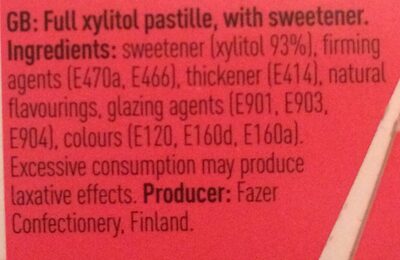
Ingredients list
Ingredient information
Ingredients analysis
Palm oil content unknown
Contains non-vegan ingredients.
Contains non-vegetarian ingredients.
Food Processing
NOVA group
 Ultra-processed food and drink products
Elements that indicate the product is in NOVA group 4
How NOVA works
Additives
E120 - CochinealColour
Cochineal extract or carmine (E120) is a natural red colorant derived from the dried bodies of the female cochineal insect.
It is widely used to impart a pink, red, or purple hue to various food and beverage products, including yogurts, ice creams, confectionery, and fruit juices.
Although it is a natural additive, E120 is known to cause severe allergic reactions, including anaphylaxis, in some individuals. It is also not suitable for vegetarians or vegans due to its insect origin.
E160a - caroteneColour
β-Carotene is an organic, strongly colored red-orange pigment abundant in plants and fruits. It is a member of the carotenes, which are terpenoids (isoprenoids), synthesized biochemically from eight isoprene units and thus having 40 carbons. Among the carotenes, β-carotene is distinguished by having beta-rings at both ends of the molecule. β-Carotene is biosynthesized from geranylgeranyl pyrophosphate.β-Carotene is the most common form of carotene in plants. When used as a food coloring, it has the E number E160a. The structure was deduced by Karrer et al. in 1930. In nature, β-carotene is a precursor (inactive form) to vitamin A via the action of beta-carotene 15,15'-monooxygenase.Isolation of β-carotene from fruits abundant in carotenoids is commonly done using column chromatography. It can also be extracted from the beta-carotene rich algae, Dunaliella salina. The separation of β-carotene from the mixture of other carotenoids is based on the polarity of a compound. β-Carotene is a non-polar compound, so it is separated with a non-polar solvent such as hexane. Being highly conjugated, it is deeply colored, and as a hydrocarbon lacking functional groups, it is very lipophilic.
E160d - LycopeneColour
Lycopene (from the neo-Latin Lycopersicum, the tomato species) is a bright red carotene and carotenoid pigment and phytochemical found in tomatoes and other red fruits and vegetables, such as red carrots, watermelons, gac, and papayas, but it is not in strawberries or cherries. Although lycopene is chemically a carotene, it has no vitamin A activity. Foods that are not red may also contain lycopene, such as asparagus and parsley.In plants, algae, and other photosynthetic organisms, lycopene is an intermediate in the biosynthesis of many carotenoids, including beta-carotene, which is responsible for yellow, orange, or red pigmentation, photosynthesis, and photoprotection. Like all carotenoids, lycopene is a tetraterpene. It is insoluble in water. Eleven conjugated double bonds give lycopene its deep red color. Owing to the strong color, lycopene is useful as a food coloring (registered as E160d) and is approved for use in the USA, Australia and New Zealand (registered as 160d) and the European Union.
E414 - Acacia gumCarrierEmulsifierStabiliserThickener
Gum arabic, also known as acacia gum, arabic gum, gum acacia, acacia, Senegal gum and Indian gum, and by other names, is a natural gum consisting of the hardened sap of various species of the acacia tree. Originally, gum arabic was collected from Acacia nilotica which was called the "gum arabic tree"; in the present day, gum arabic is collected from acacia species, predominantly Acacia senegal and Vachellia (Acacia) seyal; the term "gum arabic" does not indicate a particular botanical source. In a few cases so‐called "gum arabic" may not even have been collected from Acacia species, but may originate from Combretum, Albizia or some other genus. Producers harvest the gum commercially from wild trees, mostly in Sudan (80%) and throughout the Sahel, from Senegal to Somalia—though it is historically cultivated in Arabia and West Asia. Gum arabic is a complex mixture of glycoproteins and polysaccharides. It is the original source of the sugars arabinose and ribose, both of which were first discovered and isolated from it, and are named after it. Gum arabic is soluble in water. It is edible, and used primarily in the food industry as a stabilizer, with EU E number E414. Gum arabic is a key ingredient in traditional lithography and is used in printing, paint production, glue, cosmetics and various industrial applications, including viscosity control in inks and in textile industries, though less expensive materials compete with it for many of these roles. While gum arabic is now produced throughout the African Sahel, it is still harvested and used in the Middle East.
E466 - Sodium carboxy methyl celluloseEmulsifierHumectantStabiliserThickener
Carboxymethyl cellulose (CMC) or cellulose gum or tylose powder is a cellulose derivative with carboxymethyl groups (-CH2-COOH) bound to some of the hydroxyl groups of the glucopyranose monomers that make up the cellulose backbone. It is often used as its sodium salt, sodium carboxymethyl cellulose.
E470a - Sodium/potassium and calcium salts of fatty acidsEmulsifierStabiliserThickener
No additive description is available yet.
E901 - white and yellow beeswaxCarrierEmulsifierStabiliserThickener
Beeswax (cera alba) is a natural wax produced by honey bees of the genus Apis. The wax is formed into "scales" by eight wax-producing glands in the abdominal segments of worker bees, which discard it in or at the hive. The hive workers collect and use it to form cells for honey storage and larval and pupal protection within the beehive. Chemically, beeswax consists mainly of esters of fatty acids and various long-chain alcohols. Beeswax has long-standing applications in human food and flavoring. For example, it is used as a glazing agent or as a light/heat source. It is edible, in the sense of having similar negligible toxicity to plant waxes, and is approved for food use in most countries and the European Union under the E number E901. However, the wax monoesters in beeswax are poorly hydrolysed in the guts of humans and other mammals, so they have insignificant nutritional value. Some birds, such as honeyguides, can digest beeswax. Beeswax is the main diet of wax moth larvae.
E903 - Carnauba waxCarrier
Carnauba (; Portuguese: carnaúba [kaʁnɐˈubɐ]), also called Brazil wax and palm wax, is a wax of the leaves of the palm Copernicia prunifera (Synonym: Copernicia cerifera), a plant native to and grown only in the northeastern Brazilian states of Piauí, Ceará, Maranhão, Bahia, and Rio Grande do Norte. It is known as "queen of waxes" and in its pure state, usually comes in the form of hard yellow-brown flakes. It is obtained from the leaves of the carnauba palm by collecting and drying them, beating them to loosen the wax, then refining and bleaching the wax.
E904 - Shellac
Shellac is a resin secreted by the female lac bug, on trees in the forests of India and Thailand. It is processed and sold as dry flakes (pictured) and dissolved in alcohol to make liquid shellac, which is used as a brush-on colorant, food glaze and wood finish. Shellac functions as a tough natural primer, sanding sealant, tannin-blocker, odour-blocker, stain, and high-gloss varnish. Shellac was once used in electrical applications as it possesses good insulation qualities and it seals out moisture. Phonograph and 78 rpm gramophone records were made of it until they were replaced by vinyl long-playing records from the 1950s onwards. From the time it replaced oil and wax finishes in the 19th century, shellac was one of the dominant wood finishes in the western world until it was largely replaced by nitrocellulose lacquer in the 1920s and 1930s.
Environment
Green-Score, origins bonus, and transportation impact are shown for Worldwide .
Green Score
Overall grade
 Unknown environmental impact
About Green-Score
Current scope
Green-Score availability
Bonuses and maluses
Declared origins
Packaging impact
Packaging
Packaging impact
Data precision
Transportation
Manufacturing locations
Declared origins
Forest footprint
Forest footprint
Deforestation risk details
Data Source
Product data comes from Open Food Facts. Food Benchmark also adds translations, category comparisons and explanatory calculations.
The database is licensed under ODbL 1.0, individual contents under DbCL 1.0, and product photos under CC BY-SA 3.0.
Product added on December 17, 2017 at 9:48:39 PM UTC by kiliweb .
Last edit on March 17, 2026 at 9:36:31 PM UTC by new-nutrition-bot .
Product page also edited by arc2, hungergames, jumati, kiliweb, new-nutrition-bot, openfoodfacts-contributors, refueling2134, tuukka, yuka.ZjZJN05JUS9oY0pRa01GaXhRakhxdjhzbmFXQ0JsbnJDT05PSVE9PQ.