
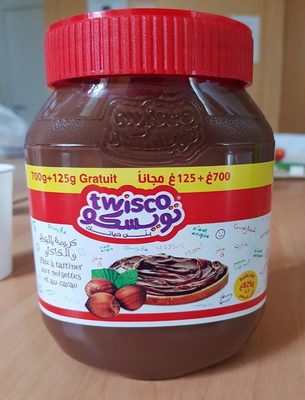
Pâte à tartiner
Health
Nutrition
Nutri-Score
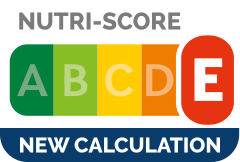 Lower nutritional quality
Nutri-Score data warning
Nutrient levels
Fat in high quantity (34.3%)
Saturated fat in high quantity (24%)
Sugars in high quantity (40%)
Salt in low quantity (0%)
Nutrition facts
| Nutrition facts | As sold for 100 g / 100 ml |
|---|---|
| Energy | ~ 2272.1 kJ (541 kcal) |
| Fat | 34.3 g |
| Saturated fat | 24 g |
| Carbohydrates | 53.8 g |
| Sugars | 40 g |
| Dietary fiber | ? |
| Proteins | 5.2 g |
| Salt | 0 g |
| Sodium | 0 g |
| Fruits, vegetables and legumes | ~ 0 % |
Nutrition facts (Detailed data)
| Nutrition facts | As sold for 100 g / 100 ml | As sold Per 100 g (packaging) | As sold Per 100 g (estimate) |
|---|---|---|---|
| Energy | ~ 2272.1 kJ (541 kcal) | ? (541 kcal) | ? |
| Fat | 34.3 g | 34.3 g | ? |
| Saturated fat | 24 g | 24 g | ? |
| Carbohydrates | 53.8 g | 53.8 g | ? |
| Sugars | 40 g | 40 g | ? |
| Dietary fiber | ? | ? | ? |
| Proteins | 5.2 g | 5.2 g | ? |
| Salt | 0 g | 0 g | ? |
| Sodium | 0 g | 0 g | ? |
| Fruits, vegetables and legumes | ~ 0 % | ? | ~ 0 % |
Ingredients
Ingredients image
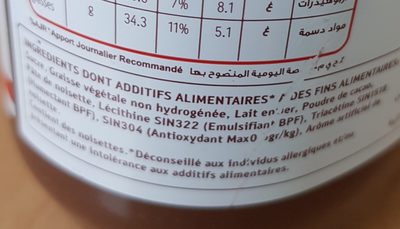
Ingredients list
Ingredient information
Allergens
Ingredients analysis
Palm oil content unknown
Contains non-vegan ingredients.
Unrecognized: fr:emulsifian-bpf, fr:humectant-bpf, fr:arome-noisettes
Vegetarian status unknown
Unrecognized: fr:emulsifian-bpf, fr:humectant-bpf, fr:arome-noisettes
Food Processing
NOVA group
 Ultra-processed food and drink products
Elements that indicate the product is in NOVA group 4
How NOVA works
Additives
E1518 - Glyceryl triacetateCarrierEmulsifierHumectant
The triglyceride 1,2,3-triacetoxypropane is more generally known as triacetin and glycerin triacetate. It is the triester of glycerol and acetylating agents, such as acetic acid and acetic anhydride. It is a colorless, viscous and odorless liquid with a high boiling point. Triacetin was first prepared in 1854 by the French chemist Marcellin Berthelot.
E304 - Fatty acid esters of ascorbic acidAntioxidant
ASCORBYL PALMITATE is an ester formed from ascorbic acid and palmitic acid creating a fat-soluble form of vitamin C.
E322 - LecithinsAntioxidantEmulsifier
Lecithins are natural compounds commonly used in the food industry as emulsifiers and stabilizers.
Extracted from sources like soybeans and eggs, lecithins consist of phospholipids that enhance the mixing of oil and water, ensuring smooth textures in various products like chocolates, dressings, and baked goods.
They do not present any known health risks.
E322i - LecithinAntioxidantEmulsifier
Lecithins are natural compounds commonly used in the food industry as emulsifiers and stabilizers.
Extracted from sources like soybeans and eggs, lecithins consist of phospholipids that enhance the mixing of oil and water, ensuring smooth textures in various products like chocolates, dressings, and baked goods.
They do not present any known health risks.
Environment
Green-Score, origins bonus, and transportation impact are shown for Worldwide .
Green Score
Overall grade
 Very high environmental impact
About Green-Score
Current scope
Life cycle analysis
Average impact of the category
 Chocolate spread with hazelnuts • Score: 42/100
Life-cycle reference
Overall environmental impact by stage (PEF)
The overall environmental impact figure (PEF) comes from ADEME's Agribalyse database, for the category: Chocolate spread with hazelnuts. Source: ADEME Agribalyse Database.
| Stage | Impact |
|---|---|
| Agriculture | 84.1 % |
| Processing | 6.1 % |
| Packaging | 5.6 % |
| Transportation | 3.5 % |
| Distribution | 0.7 % |
| Consumption | 0.0 % |
Bonuses and maluses
Declared origins
Packaging impact
Green-Score for this product
Green-Score for this product
Final score: 22/100Final score breakdown
Carbon footprint
Carbon footprint
Climate impact by stage (CO2e)
The carbon emission figure comes from ADEME's Agribalyse database, for the category: Chocolate spread with hazelnuts. Source: ADEME Agribalyse Database.
| Stage | Impact |
|---|---|
| Agriculture | 88.4 % |
| Processing | 2.9 % |
| Packaging | 5.4 % |
| Transportation | 3.2 % |
| Distribution | 0.2 % |
| Consumption | 0.0 % |
Packaging
Packaging impact
Data precision
Transportation
Declared origins
Data Source
Product data comes from Open Food Facts. Food Benchmark also adds translations, category comparisons and explanatory calculations.
The database is licensed under ODbL 1.0, individual contents under DbCL 1.0, and product photos under CC BY-SA 3.0.
Product added on March 13, 2018 at 8:16:28 AM UTC by openfoodfacts-contributors .
Last edit on March 17, 2026 at 11:10:57 PM UTC by new-nutrition-bot .
Product page also edited by amea01, kiliweb, new-nutrition-bot, openfoodfacts-contributors, yuka.Uks4ck1aZ2hwL1lybGNjYjlDclM4WXBNM0kra2VFM3FkclFKSVE9PQ.