

Koko Krunch
Health
Nutrition
Nutri-Score
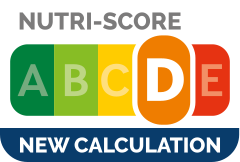 Lower nutritional quality
Nutri-Score data warning
Nutrient levels
Fat in moderate quantity (14%)
Saturated fat in high quantity (6.6%)
Sugars in high quantity (25%)
Salt in moderate quantity (0.38%)
Nutrition label

Nutrition facts
| Nutrition facts | As sold for 100 g / 100 ml | Compared to: Chocolate cereal bars |
|---|---|---|
| Energy | 1623 kJ (372 kcal) | 1,756.41 kJ (416 kcal) (-8%) |
| Fat | 14 g | 13.915 g (+1%) |
| Saturated fat | 6.6 g | 5.752 g (+15%) |
| Monounsaturated fat | 6 g | 5.3 g (+13%) |
| Polyunsaturated fat | 1 g | 2.197 g (-54%) |
| Carbohydrates | 54 g | 63.061 g (-14%) |
| Sugars | 25 g | 24.193 g (+3%) |
| Added sugars | 0 g | 21.727 g (-100%) |
| Starch | 0 g | 10.572 g (-100%) |
| Dietary fiber | ? | ? |
| Proteins | 7.7 g | 7.334 g (+5%) |
| Salt | 0.38 g | 0.419 g (-9%) |
| Sodium | 0.152 g | 0.167 g (-9%) |
| Fruits, vegetables and legumes | ~ 0 % | ? |
Nutrition facts (Detailed data)
| Nutrition facts | As sold for 100 g / 100 ml | As sold Per 100 g (packaging) | As sold Per 100 g (estimate) |
|---|---|---|---|
| Energy | 1623 kJ (372 kcal) | 1623 kJ (372 kcal) | ? |
| Fat | 14 g | 14 g | ? |
| Saturated fat | 6.6 g | 6.6 g | ? |
| Monounsaturated fat | 6 g | 6 g | ? |
| Polyunsaturated fat | 1 g | 1 g | ? |
| Carbohydrates | 54 g | 54 g | ? |
| Sugars | 25 g | 25 g | ? |
| Added sugars | 0 g | 0 g | ~ 5 g |
| Starch | 0 g | 0 g | ? |
| Dietary fiber | ? | ? | ? |
| Proteins | 7.7 g | 7.7 g | ? |
| Salt | 0.38 g | 0.38 g | ? |
| Sodium | 0.152 g | 0.152 g | ? |
| Fruits, vegetables and legumes | ~ 0 % | ? | ~ 0 % |
Serving size
Ingredients
Ingredients image

Ingredients list
Ingredient information
Added sugars
Allergens
Traces
Ingredients analysis
Palm oil content unknown
Unrecognized: th:ข้าวสาลีเต็มเมล็ด, th:คอนเฟกชั่นนารี-โค็ตติ้ง, th:กลูโคสไซร้ป, th:sem-น้ำเชื่อมน้ำตาลอินเวิร์ต, th:น้ำมันพื้ช, th:mal-แm-2se-พงโกโก้, th:นมผงขาดมันเนย, th:ข้าวโพดบด, th:แป้งข้าวเจ้า, th:lat-22, th:มอลต์สกัดจากข้าวบาร์เลย์, th:วัตถุเจือปนอาหาร, th:e307d, th:6-แilk-e420i, th:มอลโตเด็กซ์ตรั่น-แad-ข้อมูลผู้แพ้อาหาร, th:มีข้าวสาลี-บาร์เลย์-และ-เลซิตีนจากถั่วเหลือง-le-อาจมีถั่วเปลือกแข็ง, th:อัลมอนด์-เฮเซลนัท, th:และนม
Contains non-vegan ingredients.
Unrecognized: th:ข้าวสาลีเต็มเมล็ด, th:คอนเฟกชั่นนารี-โค็ตติ้ง, th:กลูโคสไซร้ป, th:sem-น้ำเชื่อมน้ำตาลอินเวิร์ต, th:น้ำมันพื้ช, th:mal-แm-2se-พงโกโก้, th:นมผงขาดมันเนย, th:ข้าวโพดบด, th:แป้งข้าวเจ้า, th:lat-22, th:มอลต์สกัดจากข้าวบาร์เลย์, th:วัตถุเจือปนอาหาร, th:e307d, th:6-แilk-e420i, th:อัลมอนด์-เฮเซลนัท, th:และนม
Vegetarian status unknown
Unrecognized: th:ข้าวสาลีเต็มเมล็ด, th:คอนเฟกชั่นนารี-โค็ตติ้ง, th:กลูโคสไซร้ป, th:sem-น้ำเชื่อมน้ำตาลอินเวิร์ต, th:น้ำมันพื้ช, th:mal-แm-2se-พงโกโก้, th:นมผงขาดมันเนย, th:ข้าวโพดบด, th:แป้งข้าวเจ้า, th:lat-22, th:มอลต์สกัดจากข้าวบาร์เลย์, th:วัตถุเจือปนอาหาร, th:e307d, th:6-แilk-e420i, th:อัลมอนด์-เฮเซลนัท, th:และนม
Food Processing
NOVA group
 Ultra-processed food and drink products
Elements that indicate the product is in NOVA group 4
How NOVA works
Additives
E322 - LecithinsAntioxidantEmulsifier
Lecithins are natural compounds commonly used in the food industry as emulsifiers and stabilizers.
Extracted from sources like soybeans and eggs, lecithins consist of phospholipids that enhance the mixing of oil and water, ensuring smooth textures in various products like chocolates, dressings, and baked goods.
They do not present any known health risks.
E422 - GlycerolHumectantThickener
Glycerol (; also called glycerine or glycerin; see spelling differences) is a simple polyol compound. It is a colorless, odorless, viscous liquid that is sweet-tasting and non-toxic. The glycerol backbone is found in all lipids known as triglycerides. It is widely used in the food industry as a sweetener and humectant and in pharmaceutical formulations. Glycerol has three hydroxyl groups that are responsible for its solubility in water and its hygroscopic nature.
Environment
Green-Score, origins bonus, and transportation impact are shown for Worldwide .
Green Score
Overall grade
 High environmental impact
About Green-Score
Current scope
Life cycle analysis
Average impact of the category
 Chocolate cereal bar • Score: 52/100
Life-cycle reference
Overall environmental impact by stage (PEF)
The overall environmental impact figure (PEF) comes from ADEME's Agribalyse database, for the category: Chocolate cereal bar. Source: ADEME Agribalyse Database.
| Stage | Impact |
|---|---|
| Agriculture | 73.6 % |
| Processing | 7.6 % |
| Packaging | 13.6 % |
| Transportation | 4.0 % |
| Distribution | 1.0 % |
| Consumption | 0.0 % |
Bonuses and maluses
Declared origins
Packaging impact
Green-Score for this product
Green-Score for this product
Final score: 37/100Final score breakdown
Carbon footprint
Carbon footprint
Climate impact by stage (CO2e)
The carbon emission figure comes from ADEME's Agribalyse database, for the category: Chocolate cereal bar. Source: ADEME Agribalyse Database.
| Stage | Impact |
|---|---|
| Agriculture | 77.1 % |
| Processing | 3.0 % |
| Packaging | 15.8 % |
| Transportation | 3.7 % |
| Distribution | 0.4 % |
| Consumption | 0.0 % |
Packaging
Packaging impact
Packaging components
| Shape | Material | Recycling | Impact |
|---|---|---|---|
| BAG | Unknown | Unknown | High |
Declared packaging
Data precision
Transportation
Declared origins
Data Source
Product data comes from Open Food Facts. Food Benchmark also adds translations, category comparisons and explanatory calculations.
The database is licensed under ODbL 1.0, individual contents under DbCL 1.0, and product photos under CC BY-SA 3.0.
Product added on August 19, 2019 at 8:47:57 AM UTC by bank-pc .
Last edit on March 5, 2026 at 12:32:53 PM UTC by roboto-app .
Product page also edited by bank-pc, foodless, macrofactor, municorn-calorie-counter-app, openfoodfacts-contributors, packbot, pox, roboto-app, thfoodeditor, zixianglim.