

Cappy PULPY
Labels
 Bad nutritional quality
 Ultra-processed food and drink products
 Low environmental impact
Health
Nutrition
Label
Bad nutritional qualityNutrient levels
Fat in low quantity (0%)
Saturated fat in low quantity (0%)
Sugars in high quantity (7%)
Salt in low quantity (0.126%)
Nutrition label
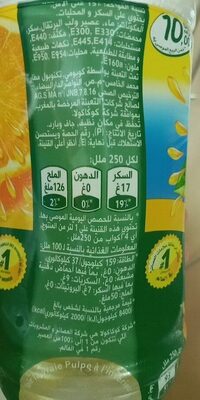
Nutrition facts
| Nutrition facts | As sold for 100 ml |
|---|---|
| Energy | 165 kJ (39 kcal) |
| FAT | 0 g |
| Saturated fat | 0 g |
| Carbohydrates | 9 g |
| Sugars | 7 g |
| Dietary fiber | ? |
| Proteins | 0 g |
| Salt | 0.13 g |
| Sodium | 0.05 g |
| Alcohol | 0 % vol |
| Minerals | |
| Fruits, vegetables and legumes | ~ 11.61 % |
Nutrition facts (Detailed data)
| Nutrition facts | As sold for 100 ml | As sold Per 100 ml (packaging) | As sold Per 100 g (estimate) |
|---|---|---|---|
| Energy | 165 kJ (39 kcal) | 165 kJ (39 kcal) | ? |
| FAT | 0 g | 0 g | ? |
| Saturated fat | 0 g | 0 g | ? |
| Carbohydrates | 9 g | 9 g | ? |
| Sugars | 7 g | 7 g | ? |
| Added sugars | ~ 3.5 g | ? | ~ 3.5 g |
| Dietary fiber | ? | ? | ? |
| Proteins | 0 g | 0 g | ? |
| Salt | 0.13 g | 0.13 g | ? |
| Sodium | 0.05 g | 0.05 g | ? |
| Alcohol | 0 % vol | 0 % vol | ? |
| Minerals | |||
| Fruits, vegetables and legumes | ~ 11.61 % | ? | ~ 11.61 % |
Estimated Activity Time
Approximate time needed to burn the energy in 100 g / 100 ml: 165 kJ. Reference adult weight: 70 kg. Energy density: Moderate.
Ingredients
Ingredients image

Ingredients list
Ingredient information
Ingredients analysis
Palm oil content unknown
Vegan status unknown
Unrecognized: fr:identiques-aux-naturels
Vegetarian status unknown
Unrecognized: fr:identiques-aux-naturels
Food Processing
NOVA group
Ultra-processed food and drink productsElements that indicate the product is in NOVA group 4
How NOVA works
Additives
E160a - caroteneColour
β-Carotene is an organic, strongly colored red-orange pigment abundant in plants and fruits. It is a member of the carotenes, which are terpenoids (isoprenoids), synthesized biochemically from eight isoprene units and thus having 40 carbons. Among the carotenes, β-carotene is distinguished by having beta-rings at both ends of the molecule. β-Carotene is biosynthesized from geranylgeranyl pyrophosphate.β-Carotene is the most common form of carotene in plants. When used as a food coloring, it has the E number E160a. The structure was deduced by Karrer et al. in 1930. In nature, β-carotene is a precursor (inactive form) to vitamin A via the action of beta-carotene 15,15'-monooxygenase.Isolation of β-carotene from fruits abundant in carotenoids is commonly done using column chromatography. It can also be extracted from the beta-carotene rich algae, Dunaliella salina. The separation of β-carotene from the mixture of other carotenoids is based on the polarity of a compound. β-Carotene is a non-polar compound, so it is separated with a non-polar solvent such as hexane. Being highly conjugated, it is deeply colored, and as a hydrocarbon lacking functional groups, it is very lipophilic.
E300 - Ascorbic acidAntioxidantSequestrant
No additive description is available yet.
E330 - Citric acidAntioxidantSequestrant
Citric acid is a natural organic acid found in citrus fruits such as lemons, oranges, and limes.
It is widely used in the food industry as a flavor enhancer, acidulant, and preservative due to its tart and refreshing taste.
Citric acid is safe for consumption when used in moderation and is considered a generally recognized as safe (GRAS) food additive by regulatory agencies worldwide.
E414 - Acacia gumCarrierEmulsifierStabiliserThickener
Gum arabic, also known as acacia gum, arabic gum, gum acacia, acacia, Senegal gum and Indian gum, and by other names, is a natural gum consisting of the hardened sap of various species of the acacia tree. Originally, gum arabic was collected from Acacia nilotica which was called the "gum arabic tree"; in the present day, gum arabic is collected from acacia species, predominantly Acacia senegal and Vachellia (Acacia) seyal; the term "gum arabic" does not indicate a particular botanical source. In a few cases so‐called "gum arabic" may not even have been collected from Acacia species, but may originate from Combretum, Albizia or some other genus. Producers harvest the gum commercially from wild trees, mostly in Sudan (80%) and throughout the Sahel, from Senegal to Somalia—though it is historically cultivated in Arabia and West Asia. Gum arabic is a complex mixture of glycoproteins and polysaccharides. It is the original source of the sugars arabinose and ribose, both of which were first discovered and isolated from it, and are named after it. Gum arabic is soluble in water. It is edible, and used primarily in the food industry as a stabilizer, with EU E number E414. Gum arabic is a key ingredient in traditional lithography and is used in printing, paint production, glue, cosmetics and various industrial applications, including viscosity control in inks and in textile industries, though less expensive materials compete with it for many of these roles. While gum arabic is now produced throughout the African Sahel, it is still harvested and used in the Middle East.
E440 - PectinsEmulsifierStabiliserThickener
Pectins (E440) are natural carbohydrates, predominantly found in fruits, that act as gelling agents in the food industry, creating the desirable jelly-like texture in jams, jellies, and marmalades.
Pectins stabilize and thicken various food products, such as desserts, confectioneries, and beverages, ensuring a uniform consistency and quality.
Recognized as safe by various health authorities, pectins have been widely used without notable adverse effects when consumed in typical dietary amounts.
E445 - Glycerol esters of wood rosinEmulsifierStabiliser
Glycerol ester of wood rosin, also known as glyceryl abietate or ester gum, is an oil-soluble food additive (E number E445). The food-grade material is used in foods, beverages, and cosmetics to keep oils in suspension in water, and its name may be shortened in the ingredient list as glycerol ester of rosin. It is also used as an ingredient in the production of chewing-gum and ice cream. Similar, less pure materials (glycerol ester of gum rosin) are used as a component of certain low-cost adhesives.To make the glycerol ester of wood rosin, refined wood rosin is reacted with glycerin to produce the glycerol ester. Glycerol ester of wood rosin is an alternative to brominated vegetable oil in citrus oil-flavored soft drinks. In some cases, both ingredients are used together.
E950 - Acesulfame kSweetener
Acesulfame potassium ( AY-see-SUL-faym), also known as acesulfame K (K is the symbol for potassium) or Ace K, is a calorie-free sugar substitute (artificial sweetener) often marketed under the trade names Sunett and Sweet One. In the European Union, it is known under the E number (additive code) E950. It was discovered accidentally in 1967 by German chemist Karl Clauss at Hoechst AG (now Nutrinova). In chemical structure, acesulfame potassium is the potassium salt of 6-methyl-1,2,3-oxathiazine-4(3H)-one 2,2-dioxide. It is a white crystalline powder with molecular formula C4H4KNO4S and a molecular weight of 201.24 g/mol.
E954 - saccharin and its saltsSweetener
Sodium saccharin (benzoic sulfimide) is an artificial sweetener with effectively no food energy. It is about 300–400 times as sweet as sucrose but has a bitter or metallic aftertaste, especially at high concentrations. Saccharin is used to sweeten products such as drinks, candies, cookies, and medicines.
Environment
Green-Score, origins bonus, and transportation impact are shown for Worldwide .
Green Score
Overall grade
Low environmental impactAbout Green-Score
Current scope
Life cycle analysis
Average impact of the category
Fruit soft drink, still (fruit juice content unspecified), with sugar • Score: 69/100Life-cycle reference
Overall environmental impact by stage (PEF)
The overall environmental impact figure (PEF) comes from ADEME's Agribalyse database, for the category: Fruit soft drink, still (fruit juice content unspecified), with sugar. Source: ADEME Agribalyse Database.
| Stage | Impact |
|---|---|
| Agriculture | 41.7 % |
| Processing | 0.1 % |
| Packaging | 27.0 % |
| Transportation | 17.1 % |
| Distribution | 11.0 % |
| Consumption | 3.1 % |
Bonuses and maluses
Origins of ingredients
Packaging impact
Green-Score for this product
Green-Score for this product
Final score: 65/100Final score breakdown
Carbon footprint
Carbon footprint
Climate impact by stage (CO2e)
The carbon emission figure comes from ADEME's Agribalyse database, for the category: Fruit soft drink, still (fruit juice content unspecified), with sugar. Source: ADEME Agribalyse Database.
| Stage | Impact |
|---|---|
| Agriculture | 33.6 % |
| Processing | 0.0 % |
| Packaging | 24.4 % |
| Transportation | 34.5 % |
| Distribution | 6.4 % |
| Consumption | 1.2 % |
Packaging

Packaging impact
Packaging materials
| Material | % | Packaging weight | Packaging weight per 100 g of product |
|---|---|---|---|
| Plastic | |||
| Total |
Declared packaging
Transportation
Origins of ingredients
Origins breakdown
| Origin | Percent of ingredients | Impact |
|---|---|---|
| United States | 100 % | Medium |
Data Source
Data presented on this page is sourced from the Open Food Facts database. This platform does not alter the original dataset; its purpose is solely to enhance data visualization and user accessibility.
Product added on June 25, 2018 at 5:31:06 PM UTC by kiliweb .
Last edit on March 17, 2026 at 11:11:25 PM UTC by new-nutrition-bot .
Product page also edited by aleene, alexdim, annelotte, autorotate-bot, chiara-dimaria89, domigmr, ecoscore-impact-estimator, foodless, gala-nafikova, gmlaa, halal-app-chakib, inf, kiliweb, mohammedhaddadi, new-nutrition-bot, off.03606f1a-0d69-4616-94c5-9f6cf7638e31, off.881d2e3a-f204-4faf-897a-82b2e41b4c4e, oliver2810, openfoodfacts-contributors, packbot, prepperapp, quentinbrd, roto, scanbot, sebleouf, toufi9, yuka.DbRfE_zaPpcEE_DR_poU02KADOqwDNMHCWEpog, yuka.U3FjQVFib3hqTjhYcTlveXhFMzg2c3BPenErc2VES1ZCN01USVE9PQ, yuka.YVAxUU5ic2hyL2hhaWRnWjVoVDUwTTFmekp1RWNGeUdkOEZQSUE9PQ, yusefgenus.