ProductsHCHC Brown Sauce
HC Brown Sauce
Barcode 5060180035815
HC

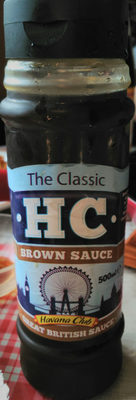
HC Brown Sauce

500ml
BARCODE:5060180035815
CATEGORIES:Condiments, Sauces, Brown Sauces, Groceries
LABELS:Vegetarian
PACKAGING:Bouteille Plastique
MANUFACTURING:Angleterre
COUNTRIES:France, United Kingdom

Health

Nutrition

Nutri-Score data warning

Warning: the amount of fruits, vegetables and nuts is not specified on the label, it was estimated from the list of ingredients: 7

Nutrient levels

Fat in low quantity (0.1%)
What you need to know • A high consumption of fat, especially saturated fats, can raise cholesterol, which increases the risk of heart diseases. Recommendation: Limit the consumption of fat and saturated fat • Choose products with lower fat and saturated fat content. Source: National Health Service UK (NHS) - Fat: the facts
Saturated fat in low quantity (0.0047%)
What you need to know • A high consumption of fat, especially saturated fats, can raise cholesterol, which increases the risk of heart diseases. Recommendation: Limit the consumption of fat and saturated fat • Choose products with lower fat and saturated fat content. Source: National Health Service UK (NHS) - Fat: the facts
Sugars in high quantity (13.1%)
What you need to know • A high consumption of sugar can cause weight gain and tooth decay. It also augments the risk of type 2 diabetes and cardio-vascular diseases. Recommendation: Limit the consumption of sugar and sugary drinks • Sugary drinks (such as sodas, fruit beverages, and fruit juices and nectars) should be limited as much as possible (no more than 1 glass a day). • Choose products with lower sugar content and reduce the consumption of products with added sugars. Source: National Health Service UK (NHS) - Sugar: the facts
Salt in moderate quantity (1.45%)
What you need to know • A high consumption of salt (or sodium) can cause raised blood pressure, which can increase the risk of heart disease and stroke. • Many people who have high blood pressure do not know it, as there are often no symptoms. • Most people consume too much salt (on average 9 to 12 grams per day), around twice the recommended maximum level of intake. Recommendation: Limit the consumption of salt and salted food • Reduce the quantity of salt used when cooking, and don't salt again at the table. • Limit the consumption of salty snacks and choose products with lower salt content. Source: World Health Organization (WHO) - Fact sheet - Salt reduction Source: National Health Service UK (NHS) - Salt: the facts

Nutrition label

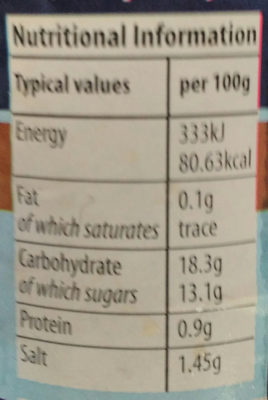
HC Brown Sauce nutrition label

Nutrition facts

Nutrition factsAs sold for 100 mlCompared to: Brown sauces
Energy333 kJ (77 kcal)412.644 kJ (96 kcal) (-19%)
Fat0.1 g0.751 g (-87%)
Saturated fat~ 0.00469677091899671 g0.255 g (-98%)
Carbohydrates18.3 g20.544 g (-11%)
Sugars13.1 g12.432 g (+5%)
Dietary fiber~ 0.191202585320724 g?
Proteins0.9 g1.129 g (-20%)
Salt1.45 g1.852 g (-22%)
Sodium0.58 g0.745 g (-22%)
Fruits, vegetables and legumes~ 7.40131578947368 %?

Nutrition facts (Detailed data)

Nutrition factsAs sold for 100 mlAs sold Per 100 ml (packaging)As sold Per 100 g (estimate)
Energy333 kJ (77 kcal)333 kJ (79 kcal)~ 276.29285599558 kJ (64 kcal)
Fat0.1 g0.1 g~ 0.072003816303454 g
Saturated fat~ 0.00469677091899671 g?~ 0.00469677091899671 g
Carbohydrates18.3 g18.3 g~ 14.7596507504112 g
Sugars13.1 g13.1 g~ 4.00371532239412 g
Dietary fiber~ 0.191202585320724 g?~ 0.191202585320724 g
Proteins0.9 g0.9 g~ 0.121888467889084 g
Salt1.45 g1.45 g~ 0.195725728245786 g
Sodium0.58 g0.58 g~ 0.0781998343698603 g
Fruits, vegetables and legumes~ 7.40131578947368 %?~ 7.40131578947368 %

Ingredients

Ingredients image

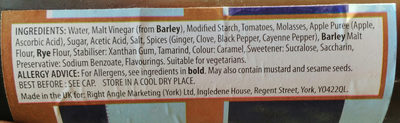
HC Brown Sauce ingredients image

Ingredients list

Water, malt vinegar (from barley), modified starch, tomatoes, molasses, apple puree (apple, ascorbic acid), sugar, acetic acid, salt, spices (ginger, clove, black pepper, cayenne pepper), barley malt flour, rye flour, stabiliser: xanthan gum, tamarind, colour: caramel, sweetener: sucralose, saccharin, preservative: sodium benzoate, flavourings, suitable for vegetarians, allergy advice: for allergens, see ingredients in bold, may also contain mustard and sesame seeds,

Ingredient information

Water
52.63% (estimate)
Malt Vinegar
23.68% (estimate)
Barley Malt Vinegar
23.68% (estimate)
Modified Starch
11.84% (estimate)
Tomato
5.92% (estimate)
Molasses
2.96% (estimate)
Apple Puree
1.48% (estimate)
Apple
0.74% (estimate)
E300
0.74% (estimate)
Sugar
0.74% (estimate)
E260
0.37% (estimate)
Salt
0.19% (estimate)
Spice
0.09% (estimate)
Ginger
0.05% (estimate)
Clove
0.02% (estimate)
Black Pepper
0.01% (estimate)
Cayenne Pepper
0.01% (estimate)
Barley Malt Flour
0.05% (estimate)
Rye Flour
0.02% (estimate)
Stabiliser
0.01% (estimate)
E415
0.01% (estimate)
Tamarind
0.01% (estimate)
Colour
0% (estimate)
E150a
0% (estimate)
Sweetener
0% (estimate)
E955
0% (estimate)
E954
0% (estimate)
Preservative
0% (estimate)
E211
0% (estimate)
Flavouring
0% (estimate)

Added sugars

Contains added sugars (3%) Added sugars: molasses, sugar Quantity of added sugars: 3%

Allergens

AppleGluten

Traces

MustardSesame Seeds

Ingredients analysis

Palm oil free
Yes

No ingredients containing palm oil.

Vegan
Unknown

Vegan status unknown

Vegetarian
Yes

No non-vegetarian ingredients.


Food Processing

NOVA group

4Ultra-processed food and drink products

Elements that indicate the product is in NOVA group 4

Additives
E14XX - Modified Starch
Additives
E150 - Caramel
Additives
E415 - Xanthan gum
Additives
E954 - saccharin and its salts
Additives
E955 - Sucralose
Ingredients
Colour
Ingredients
Flavouring
Ingredients
Sweetener
Ingredients
Modified Starch

How NOVA works

The NOVA classification assigns food products into 4 groups based on their degree of processing: 1. Unprocessed or minimally processed foods 2. Processed culinary ingredients 3. Processed foods 4. Ultra-processed food and drink products

Additives

E14XX - Modified StarchEmulsifierStabiliserThickener

No additive description is available yet.

E150 - Caramel

CARAMEL is a medium to dark-orange confectionery product made by heating a variety of sugars.

E211 - Sodium benzoate EFSA overexposure risk: highPreservative

SODIUM BENZOATE is a substance which has the chemical formula NaC7H5O2

E260 - Acetic acidPreservative

ACETIC ACID, systematically named ethanoic acid, is a colourless liquid organic compound with the chemical formula CH3COOH (also written as CH3CO2H or C2H4O2).

E415 - Xanthan gumEmulsifierStabiliserThickener

Xanthan gum (E415) is a natural polysaccharide derived from fermented sugars, often used in the food industry as a thickening and stabilizing agent.

This versatile food additive enhances texture and prevents ingredient separation in a wide range of products, including salad dressings, sauces, and gluten-free baked goods.

It is considered safe for consumption even at high intake amounts.

E954 - saccharin and its saltsSweetener

Sodium saccharin (benzoic sulfimide) is an artificial sweetener with effectively no food energy. It is about 300–400 times as sweet as sucrose but has a bitter or metallic aftertaste, especially at high concentrations. Saccharin is used to sweeten products such as drinks, candies, cookies, and medicines.

E955 - SucraloseSweetener

Sucralose is an artificial sweetener and sugar substitute. The majority of ingested sucralose is not broken down by the body, so it is noncaloric. In the European Union, it is also known under the E number E955. It is produced by chlorination of sucrose. Sucralose is about 320 to 1,000 times sweeter than sucrose, three times as sweet as both aspartame and acesulfame potassium, and twice as sweet as sodium saccharin. Evidence of benefit is lacking for long-term weight loss with some data supporting weight gain and heart disease risks.It is stable under heat and over a broad range of pH conditions. Therefore, it can be used in baking or in products that require a long shelf life. The commercial success of sucralose-based products stems from its favorable comparison to other low-calorie sweeteners in terms of taste, stability, and safety. Common brand names of sucralose-based sweeteners are Splenda, Zerocal, Sukrana, SucraPlus, Candys, Cukren, and Nevella. Canderel Yellow also contains sucralose, but the original Canderel and Green Canderel do not.

Environment

Green-Score, origins bonus, and transportation impact are shown for Worldwide .

Green Score

Overall grade

UnknownUnknown environmental impact

About Green-Score

The Green-Score is an experimental score that summarizes the environmental impacts of food products.

Current scope

The Green-Score was initially developed for France and it is being extended to other European countries. The Green-Score formula is subject to change as it is regularly improved to make it more precise and better suited to each country. Select a country to include the full impact of transportation in the final score.

Green-Score availability

We could not compute the Green-Score of this product because some data is missing. A more precise category, ingredients list, origins or packaging data can unlock the computation.

Bonuses and maluses

Declared origins

Origins of ingredients are missing for this product. Ingredients need to be completed before the transportation bonus can be computed precisely.

Packaging impact

Packaging with a medium impact Malus: -10 Packaging score: 0

Packaging

Packaging impact

Packaging with a medium impact Malus: -10 Packaging score: 0

Packaging components

ShapeMaterialRecyclingImpact
BottlePlasticUnknownHigh

Declared packaging

Bouteille Plastique

Transportation

Manufacturing locations

Angleterre

Declared origins

Origins of ingredients are missing for this product. Ingredients need to be completed before the transportation bonus can be computed precisely.

Forest footprint

Forest footprint

No deforestation risk No ingredient associated with a deforestation risk. Forest Footprint The Forest Footprint is a methodology developed by the association Envol Vert to estimate the risk of deforestation related to our consumption. → More information on the methodology Forest Footprint grade: A No ingredient associated with a deforestation risk. Total Forest Footprint: 0.000 m² per kg of food

Deforestation risk details

Labels The presence of certain labels can greatly help reduce the risk of deforestation, through the presence of environmental criteria and/or through better remuneration of producers.

Data Source

Product data comes from Open Food Facts. Food Benchmark also adds translations, category comparisons and explanatory calculations.

The database is licensed under ODbL 1.0, individual contents under DbCL 1.0, and product photos under CC BY-SA 3.0.

Product added on February 16, 2019 at 1:43:39 PM UTC by openfoodfacts-contributors .

Last edit on March 17, 2026 at 11:11:46 AM UTC by new-nutrition-bot .

Product page also edited by inf, new-nutrition-bot, openfoodfacts-contributors, packbot, sebleouf.