

PROTEIN BAR KÓKUSZ
Labels
 Not computed
 Ultra-processed food and drink products
 Green-Score not computed
Health
Nutrition
Nutrient levels
Fat in moderate quantity (11.4%)
Saturated fat in high quantity (7%)
Sugars in low quantity (1.8%)
Salt in moderate quantity (0.59%)
Nutrition label
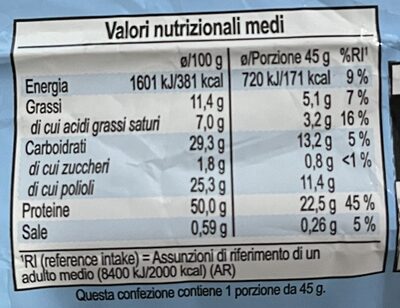
Nutrition facts
| Nutrition facts | As sold for 100 g / 100 ml |
|---|---|
| Energy | 1,601 kJ (381 kcal) |
| FAT | 11.4 g |
| Saturated fat | 7 g |
| Carbohydrates | 29.3 g |
| Sugars | 1.8 g |
| Added sugars | 0 g |
| Starch | 0 g |
| Polyols | 25.3 g |
| Dietary fiber | ? |
| Proteins | 50 g |
| Salt | 0.59 g |
| Sodium | 0.24 g |
| Vitamins | |
| Vitamin A | 0 g |
| Vitamin E | 0 g |
| Vitamin K | 0 g |
| Vitamin C | 0 g |
| Minerals | |
| Phosphorus | 0 g |
| Iron | 0 g |
| Magnesium | 0 g |
| Zinc | 0 g |
| Copper | 0 g |
| Manganese | 0 g |
| Selenium | 0 g |
| Caffeine | 0 g |
| Fruits, vegetables and legumes | ~ 0 % |
| Choline | 0 g |
Nutrition facts (Detailed data)
| Nutrition facts | As sold for 100 g / 100 ml | As sold Per 100 g (packaging) | As sold Per 100 g (estimate) |
|---|---|---|---|
| Energy | 1,601 kJ (381 kcal) | 1,601 kJ (381 kcal) | ? |
| FAT | 11.4 g | 11.4 g | ? |
| Saturated fat | 7 g | 7 g | ? |
| Carbohydrates | 29.3 g | 29.3 g | ? |
| Sugars | 1.8 g | 1.8 g | ? |
| Added sugars | 0 g | 0 g | ~ 0 g |
| Starch | 0 g | 0 g | ? |
| Polyols | 25.3 g | 25.3 g | ? |
| Dietary fiber | ? | ? | ? |
| Proteins | 50 g | 50 g | ? |
| Salt | 0.59 g | 0.59 g | ? |
| Sodium | 0.24 g | 0.24 g | ? |
| Vitamins | |||
| Vitamin A | 0 g | 0 g | ? |
| Vitamin E | 0 g | 0 g | ? |
| Vitamin K | 0 g | 0 g | ? |
| Vitamin C | 0 g | 0 g | ? |
| Minerals | |||
| Phosphorus | 0 g | 0 g | ? |
| Iron | 0 g | 0 g | ? |
| Magnesium | 0 g | 0 g | ? |
| Zinc | 0 g | 0 g | ? |
| Copper | 0 g | 0 g | ? |
| Manganese | 0 g | 0 g | ? |
| Selenium | 0 g | 0 g | ? |
| Caffeine | 0 g | 0 g | ? |
| Fruits, vegetables and legumes | ~ 0 % | ? | ~ 0 % |
| Choline | 0 g | 0 g | ? |
Serving size
Estimated Activity Time
Approximate time needed to burn the energy in 100 g / 100 ml: 1,601 kJ. Reference adult weight: 70 kg. Energy density: Moderate.
Ingredients
Ingredients image

Ingredients list
Ingredient information
Allergens
Traces
Ingredients analysis
Contains ingredients containing palm oil.
Contains non-vegan ingredients.
Unrecognized: de:molkeneiweißisolat, de:a4-kokosflocken, de:natriume-hat, de:emulator-lecithine, de:hoher-proteingehalt-zuckerarm, de:kohlenhydratreduziert, de:da
Contains non-vegetarian ingredients.
Unrecognized: de:molkeneiweißisolat, de:a4-kokosflocken, de:natriume-hat, de:emulator-lecithine, de:hoher-proteingehalt-zuckerarm, de:kohlenhydratreduziert, de:da
Food Processing
NOVA group
Ultra-processed food and drink productsElements that indicate the product is in NOVA group 4
How NOVA works
Additives
E307 - Alpha-tocopherol
α-Tocopherol is a type of vitamin E. It has E number "E307". Vitamin E exists in eight different forms, four tocopherols and four tocotrienols. All feature a chromane ring, with a hydroxyl group that can donate a hydrogen atom to reduce free radicals and a hydrophobic side chain which allows for penetration into biological membranes. Compared to the others, α-tocopherol is preferentially absorbed and accumulated in humans.
E322 - LecithinsAntioxidantEmulsifier
Lecithins are natural compounds commonly used in the food industry as emulsifiers and stabilizers.
Extracted from sources like soybeans and eggs, lecithins consist of phospholipids that enhance the mixing of oil and water, ensuring smooth textures in various products like chocolates, dressings, and baked goods.
They do not present any known health risks.
E330 - Citric acidAntioxidantSequestrant
Citric acid is a natural organic acid found in citrus fruits such as lemons, oranges, and limes.
It is widely used in the food industry as a flavor enhancer, acidulant, and preservative due to its tart and refreshing taste.
Citric acid is safe for consumption when used in moderation and is considered a generally recognized as safe (GRAS) food additive by regulatory agencies worldwide.
E422 - GlycerolHumectantThickener
Glycerol (; also called glycerine or glycerin; see spelling differences) is a simple polyol compound. It is a colorless, odorless, viscous liquid that is sweet-tasting and non-toxic. The glycerol backbone is found in all lipids known as triglycerides. It is widely used in the food industry as a sweetener and humectant and in pharmaceutical formulations. Glycerol has three hydroxyl groups that are responsible for its solubility in water and its hygroscopic nature.
E955 - SucraloseSweetener
Sucralose is an artificial sweetener and sugar substitute. The majority of ingested sucralose is not broken down by the body, so it is noncaloric. In the European Union, it is also known under the E number E955. It is produced by chlorination of sucrose. Sucralose is about 320 to 1,000 times sweeter than sucrose, three times as sweet as both aspartame and acesulfame potassium, and twice as sweet as sodium saccharin. Evidence of benefit is lacking for long-term weight loss with some data supporting weight gain and heart disease risks.It is stable under heat and over a broad range of pH conditions. Therefore, it can be used in baking or in products that require a long shelf life. The commercial success of sucralose-based products stems from its favorable comparison to other low-calorie sweeteners in terms of taste, stability, and safety. Common brand names of sucralose-based sweeteners are Splenda, Zerocal, Sukrana, SucraPlus, Candys, Cukren, and Nevella. Canderel Yellow also contains sucralose, but the original Canderel and Green Canderel do not.
E965 - maltitolEmulsifierHumectantStabiliserSweetenerThickener
MALTITOL is a sugar alcohol (a polyol) used as a sugar substitute. It has 75–90% of the sweetness of sucrose (table sugar) and nearly identical properties, except for browning. Maltitol's high sweetness allows it to be used without being mixed with other sweeteners. It is used in candy manufacture, particularly sugar-free hard candy, chewing gum, chocolates, baked goods, and ice cream.
Environment
Green-Score, origins bonus, and transportation impact are shown for Worldwide .
Green Score
Overall grade
Unknown environmental impactAbout Green-Score
Current scope
Green-Score availability
Bonuses and maluses
Production system
Declared origins
Packaging impact
Packaging
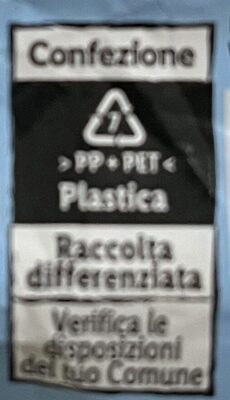
Packaging impact
Packaging materials
| Material | % | Packaging weight | Packaging weight per 100 g of product |
|---|---|---|---|
| Plastic | 100 % | 0.79 g | 1.76 g |
| Total | 100 % | 0.79 g | 1.76 g |
Declared packaging
Transportation
Manufacturing locations
Declared origins
Data Source
Data presented on this page is sourced from the Open Food Facts database. This platform does not alter the original dataset; its purpose is solely to enhance data visualization and user accessibility.
Product added on December 1, 2019 at 5:15:17 PM UTC by openfoodfacts-contributors .
Last edit on March 17, 2026 at 9:11:55 PM UTC by new-nutrition-bot .
Product page also edited by aleene, anonymous-aprcqziqxi, benbenben, bot-tags-and-languages, domauskas, feat, halal-app-chakib, inf, kiliweb, moncoachigbas, municorn-calorie-counter-app, new-nutrition-bot, ompopo, openfoodfacts-contributors, owes-jb, roboto-app, scanbot, segundo, setomi, spotter, thaialagata, yuka.Pb5ZBcClM84YJ8fx36IG-TeETL7PWf9kGV0Xog, yuka.sY2b0xO6T85zoF3NwEKvllF9fPyHiC3hNSPnlBOAneqjIZzobeFI8IffMqs, yuka.sY2b0xO6T85zoF3NwEKvllR6Wf7viTnoCCPnhFHT98qRdp7HOYx_7YamYqo, yuka.sY2b0xO6T85zoF3NwEKvlmV8a9birmPoBw3ToW-t1-iIFMTCcfxCwo_4OKs.