

Taboulet au poulet
Health
Nutrition
Nutri-Score
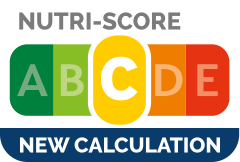 Average nutritional quality
Nutri-Score data warning
Nutrient levels
Fat in moderate quantity (7.4%)
Saturated fat in low quantity (0.9%)
Sugars in low quantity (0.9%)
Salt in moderate quantity (1.3%)
Nutrition label

Nutrition facts
| Nutrition facts | As sold for 100 g / 100 ml | Compared to: Chicken Tabbouleh |
|---|---|---|
| Energy | 766 kJ (165 kcal) | 714.74 kJ (171 kcal) (+7%) |
| Fat | 7.4 g | 6.898 g (+7%) |
| Saturated fat | 0.9 g | 0.74 g (+22%) |
| Carbohydrates | 17.9 g | 20.218 g (-11%) |
| Sugars | 0.9 g | 2.527 g (-64%) |
| Dietary fiber | 1.5 g | ? |
| Proteins | 6.1 g | 6.071 g (~0%) |
| Salt | 1.3 g | 0.966 g (+35%) |
| Sodium | 0.52 g | 0.386 g (+35%) |
| Fruits, vegetables and legumes | ~ 32.85 % | ? |
Nutrition facts (Detailed data)
| Nutrition facts | As sold for 100 g / 100 ml | As sold Per 100 g (packaging) | As sold Per 100 g (estimate) |
|---|---|---|---|
| Energy | 766 kJ (165 kcal) | 766 kJ (165 kcal) | ~ 400.0846 kJ (96 kcal) |
| Fat | 7.4 g | 7.4 g | ~ 7.11083 g |
| Saturated fat | 0.9 g | 0.9 g | ~ 0.713504 g |
| Carbohydrates | 17.9 g | 17.9 g | ~ 37.71559 g |
| Sugars | 0.9 g | 0.9 g | ~ 5.08289 g |
| Dietary fiber | 1.5 g | 1.5 g | ~ 2.20424 g |
| Proteins | 6.1 g | 6.1 g | ~ 8.28066 g |
| Salt | 1.3 g | 1.3 g | ~ 0.0554944 g |
| Sodium | 0.52 g | 0.52 g | ~ 0.02218327 g |
| Fruits, vegetables and legumes | ~ 32.85 % | ? | ~ 32.85 % |
Ingredients
Ingredients image

Ingredients list
Ingredient information
Added sugars
Allergens
Traces
Ingredients analysis
Palm oil content unknown
Contains non-vegan ingredients.
Unrecognized: fr:epices-marocaine
Contains non-vegetarian ingredients.
Unrecognized: fr:epices-marocaine
Food Processing
NOVA group
 Ultra-processed food and drink products
Elements that indicate the product is in NOVA group 4
How NOVA works
Additives
E14XX - Modified StarchEmulsifierStabiliserThickener
No additive description is available yet.
E202 - Potassium sorbate EFSA overexposure risk: highPreservative
Potassium sorbate (E202) is a synthetic food preservative commonly used to extend the shelf life of various food products.
It works by inhibiting the growth of molds, yeast, and some bacteria, preventing spoilage. When added to foods, it helps maintain their freshness and quality.
Some studies have shown that when combined with nitrites, potassium sorbate have genotoxic activity in vitro. However, potassium sorbate is generally recognized as safe (GRAS) by regulatory authorities.
E262 - Sodium acetatesPreservativeSequestrant
SODIUM ACETATE, also abbreviated NaOAc,[8] is the sodium salt of acetic acid.
E325 - sodium lactateAntioxidantEmulsifierHumectantThickener
SODIUM LACTATE is the sodium salt of lactic acid, and has a mild saline taste. It is produced by fermentation of a sugar source, such as corn or beets. It acts as a preservative, acidity regulator, and bulking agent.
E451 - Triphosphates EFSA overexposure risk: highEmulsifierHumectantSequestrantStabiliserThickener
Sodium triphosphate (STP), also sodium tripolyphosphate (STPP), or tripolyphosphate (TPP),) is an inorganic compound with formula Na5P3O10. It is the sodium salt of the polyphosphate penta-anion, which is the conjugate base of triphosphoric acid. It is produced on a large scale as a component of many domestic and industrial products, especially detergents. Environmental problems associated with eutrophication are attributed to its widespread use.
E452 - Polyphosphates EFSA overexposure risk: highEmulsifierHumectantSequestrantStabiliserThickener
No additive description is available yet.
E470a - Sodium/potassium and calcium salts of fatty acidsEmulsifierStabiliserThickener
No additive description is available yet.
Environment
Green-Score, origins bonus, and transportation impact are shown for Worldwide .
Green Score
Overall grade
 Moderate environmental impact
About Green-Score
Current scope
Life cycle analysis
Average impact of the category
Tabbouleh with chicken, prepacked • Score: 59/100Life-cycle reference
Overall environmental impact by stage (PEF)
The overall environmental impact figure (PEF) comes from ADEME's Agribalyse database, for the category: Tabbouleh with chicken, prepacked. Source: ADEME Agribalyse Database.
| Stage | Impact |
|---|---|
| Agriculture | 46.0 % |
| Processing | 7.3 % |
| Packaging | 37.9 % |
| Transportation | 6.1 % |
| Distribution | 2.2 % |
| Consumption | 0.6 % |
Bonuses and maluses
Origins of ingredients
Packaging impact
Green-Score for this product
Green-Score for this product
Final score: 47/100Final score breakdown
Carbon footprint
Carbon footprint
Climate impact by stage (CO2e)
The carbon emission figure comes from ADEME's Agribalyse database, for the category: Tabbouleh with chicken, prepacked. Source: ADEME Agribalyse Database.
| Stage | Impact |
|---|---|
| Agriculture | 31.7 % |
| Processing | 11.3 % |
| Packaging | 44.1 % |
| Transportation | 11.3 % |
| Distribution | 1.3 % |
| Consumption | 0.2 % |
Packaging
Packaging impact
Packaging components
| Shape | Material | Recycling | Impact |
|---|---|---|---|
| Tray | PET 1 Polyethylene Terephthalate | Recycle | High |
Declared packaging
Transportation
Manufacturing locations
Origins of ingredients
Origins breakdown
| Origin | Percent of ingredients | Impact |
|---|---|---|
| Unknown | 90 % | High |
| France | 10 % | High |
Forest footprint
Forest footprint
Ingredients linked to forest pressure
| Ingredient | Type | Percent in product | Forest footprint |
|---|---|---|---|
| Roast Chicken | Poulet Standard | 10.00 % | 0.24 |
Data Source
Product data comes from Open Food Facts. Food Benchmark also adds translations, category comparisons and explanatory calculations.
The database is licensed under ODbL 1.0, individual contents under DbCL 1.0, and product photos under CC BY-SA 3.0.
Product added on July 6, 2018 at 10:26:37 AM UTC by kiliweb .
Last edit on March 17, 2026 at 6:27:24 AM UTC by new-nutrition-bot .
Product page also edited by antuanm7, kiliweb, new-nutrition-bot, openfoodfacts-contributors, packbot, roboto-app, sebleouf, yuka.BrtzGO7RMc46Ecve6qUm8WmlDNW_OKdTEWRUow, yuka.SGZFZ0FhTURpc2tCeTg4Q3Jqbk00OEpING8yeERWNnJjK0F3SVE9PQ, yuka.WWZFTUZxTVJxY0FZaWZGdTJFblBwOVZLMWJ5TFFUN3FCOXNOSWc9PQ.