
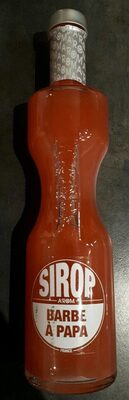
Sirop Arom Barbe à Papa
Health
Nutrition
Nutrient levels
Fat in low quantity (0%)
Saturated fat in low quantity (0%)
Sugars in high quantity (84%)
Salt in low quantity (0%)
Nutrition label
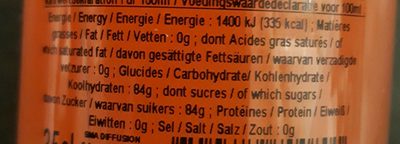
Nutrition facts
| Nutrition facts | As sold for 100 ml | Compared to: Flavoured syrups |
|---|---|---|
| Energy | ~ 1428 kJ (335 kcal) | 920.12 kJ (212 kcal) (+55%) |
| Fat | 0 g | 0.099 g (-100%) |
| Saturated fat | 0 g | 0.021 g (-100%) |
| Carbohydrates | 84 g | 53.536 g (+57%) |
| Sugars | 84 g | 50.162 g (+67%) |
| Dietary fiber | ? | ? |
| Proteins | 0 g | 0.111 g (-100%) |
| Salt | 0 g | 0.023 g (-100%) |
| Sodium | 0 g | 0.009 g (-100%) |
| Fruits, vegetables and legumes | ~ 0 % | ? |
| Carbon footprint | 0 g | 27.692 g (-100%) |
Nutrition facts (Detailed data)
| Nutrition facts | As sold for 100 ml | As sold Per 100 ml (packaging) | As sold Per 100 g (estimate) |
|---|---|---|---|
| Energy | ~ 1428 kJ (335 kcal) | ? (335 kcal) | ? |
| Fat | 0 g | 0 g | ? |
| Saturated fat | 0 g | 0 g | ? |
| Carbohydrates | 84 g | 84 g | ? |
| Sugars | 84 g | 84 g | ? |
| Dietary fiber | ? | ? | ? |
| Proteins | 0 g | 0 g | ? |
| Salt | 0 g | 0 g | ? |
| Sodium | 0 g | 0 g | ? |
| Fruits, vegetables and legumes | ~ 0 % | ? | ~ 0 % |
| Carbon footprint | 0 g | 0 g | ? |
Ingredients
Ingredients image

Ingredients list
Ingredient information
Added sugars
Allergens
Traces
Ingredients analysis
No ingredients containing palm oil.
Vegan status unknown
Vegetarian status unknown
Food Processing
NOVA group
 Ultra-processed food and drink products
Elements that indicate the product is in NOVA group 4
How NOVA works
Additives
E124 - Ponceau 4rColour
Ponceau 4R (known by more than 100 synonyms, including as C.I. 16255, Cochineal Red A, C.I. Acid Red 18, Brilliant Scarlet 3R, Brilliant Scarlet 4R, New Coccine, is a synthetic colourant that may be used as a food colouring. It is denoted by E Number E124. Its chemical name is 1-(4-sulpho-1-napthylazo)- 2-napthol- 6,8-disulphonic acid, trisodium salt. Ponceau (17th century French for "poppy-coloured") is the generic name for a family of azo dyes. Ponceau 4R is a strawberry red azo dye which can be used in a variety of food products, and is usually synthesized from aromatic hydrocarbons; it is stable to light, heat, and acid but fades in the presence of ascorbic acid.It is used in Europe, Asia and Australia, but has not been approved by the US FDA.
E171 - Titanium dioxideColour
Titanium dioxide, also known as titanium(IV) oxide or titania, is the naturally occurring oxide of titanium, chemical formula TiO2. When used as a pigment, it is called titanium white, Pigment White 6 (PW6), or CI 77891. Generally, it is sourced from ilmenite, rutile and anatase. It has a wide range of applications, including paint, sunscreen and food coloring. When used as a food coloring, it has E number E171. World production in 2014 exceeded 9 million metric tons. It has been estimated that titanium dioxide is used in two-thirds of all pigments, and the oxide has been valued at $13.2 billion.
E202 - Potassium sorbate EFSA overexposure risk: highPreservative
Potassium sorbate (E202) is a synthetic food preservative commonly used to extend the shelf life of various food products.
It works by inhibiting the growth of molds, yeast, and some bacteria, preventing spoilage. When added to foods, it helps maintain their freshness and quality.
Some studies have shown that when combined with nitrites, potassium sorbate have genotoxic activity in vitro. However, potassium sorbate is generally recognized as safe (GRAS) by regulatory authorities.
Environment
Green-Score, origins bonus, and transportation impact are shown for Worldwide .
Green Score
Overall grade
 Very low environmental impact
About Green-Score
Current scope
Life cycle analysis
Average impact of the category
Syrup (mint, strawberries flavouredetc.), with sugar diluted in water • Score: 100/100Life-cycle reference
Overall environmental impact by stage (PEF)
The overall environmental impact figure (PEF) comes from ADEME's Agribalyse database, for the category: Syrup (mint, strawberries flavouredetc.), with sugar diluted in water. Source: ADEME Agribalyse Database.
| Stage | Impact |
|---|---|
| Agriculture | 64.4 % |
| Processing | 1.0 % |
| Packaging | 20.8 % |
| Transportation | 9.3 % |
| Distribution | 3.8 % |
| Consumption | 0.5 % |
Bonuses and maluses
Origins of ingredients
Packaging impact
Green-Score for this product
Green-Score for this product
Final score: 100/100Final score breakdown
Carbon footprint
Carbon footprint
Climate impact by stage (CO2e)
The carbon emission figure comes from ADEME's Agribalyse database, for the category: Syrup (mint, strawberries flavouredetc.), with sugar diluted in water. Source: ADEME Agribalyse Database.
| Stage | Impact |
|---|---|
| Agriculture | 49.3 % |
| Processing | 2.3 % |
| Packaging | 28.8 % |
| Transportation | 17.3 % |
| Distribution | 1.9 % |
| Consumption | 0.2 % |
Packaging
Packaging impact
Packaging components
| Shape | Material | Recycling | Impact |
|---|---|---|---|
| Bottle | Glass | Unknown | Low |
Declared packaging
Transportation
Manufacturing locations
Origins of ingredients
Origins breakdown
| Origin | Percent of ingredients | Impact |
|---|---|---|
| France | 100 % | Medium |
Forest footprint
Forest footprint
Deforestation risk details
Data Source
Product data comes from Open Food Facts. Food Benchmark also adds translations, category comparisons and explanatory calculations.
The database is licensed under ODbL 1.0, individual contents under DbCL 1.0, and product photos under CC BY-SA 3.0.
Product added on May 17, 2012 at 8:52:48 PM UTC by malikele .
Last edit on March 18, 2026 at 12:54:11 AM UTC by new-nutrition-bot .
Product page also edited by beniben, itsjustruby, kiliweb, malikele, new-nutrition-bot, openfoodfacts-contributors, osteng, packbot, roboto-app, tacite, teolemon, yuka.WjZFZk5vVmNyYWswdE1Nei93SFl4LzB2bUpTN2RrZVpEc2NOSVE9PQ, yuka.WkkxZUs1UlF0K1V6aGZNVjN5M3Y5dlZGNHJIMGMxK3pBZWdWSVE9PQ.