

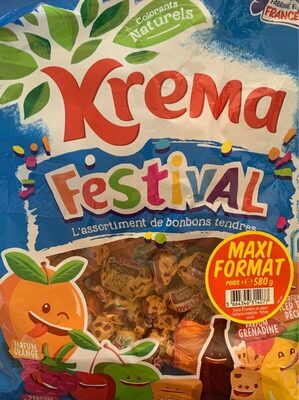
Krema festival
Labels
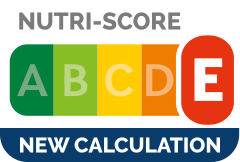 Bad nutritional quality
 Ultra-processed food and drink products
 Low environmental impact
Health
Nutrition
Label
Bad nutritional qualityNutrient levels
Fat in moderate quantity (7.4%)
Saturated fat in moderate quantity (3.6%)
Sugars in high quantity (62%)
Salt in low quantity (0.08%)
Nutrition label
Nutrition facts
| Nutrition facts | As sold for 100 g / 100 ml |
|---|---|
| Energy | 1,715 kJ (406 kcal) |
| FAT | 7.4 g |
| Saturated fat | 3.6 g |
| Carbohydrates | 83 g |
| Sugars | 62 g |
| Dietary fiber | ? |
| Proteins | 1.5 g |
| Salt | 0.08 g |
| Sodium | 0.03 g |
| Minerals | |
| Fruits, vegetables and legumes | ~ 0.2 % |
Nutrition facts (Detailed data)
| Nutrition facts | As sold for 100 g / 100 ml | As sold Per 100 g (packaging) | As sold Per 100 g (estimate) |
|---|---|---|---|
| Energy | 1,715 kJ (406 kcal) | 1,715 kJ (406 kcal) | ? |
| FAT | 7.4 g | 7.4 g | ? |
| Saturated fat | 3.6 g | 3.6 g | ? |
| Carbohydrates | 83 g | 83 g | ? |
| Sugars | 62 g | 62 g | ? |
| Added sugars | ~ 77.08 g | ? | ~ 77.08 g |
| Dietary fiber | ? | ? | ? |
| Proteins | 1.5 g | 1.5 g | ? |
| Salt | 0.08 g | 0.08 g | ? |
| Sodium | 0.03 g | 0.03 g | ? |
| Minerals | |||
| Fruits, vegetables and legumes | ~ 0.2 % | ? | ~ 0.2 % |
Serving size
Estimated Activity Time
Approximate time needed to burn the energy in 100 g / 100 ml: 1,715 kJ. Reference adult weight: 70 kg. Energy density: Moderate.
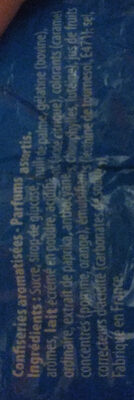
Ingredients
Ingredients image
Ingredients list
Ingredient information
Allergens
Ingredients analysis
Contains ingredients containing palm oil.
Contains non-vegan ingredients.
Contains non-vegetarian ingredients.
Food Processing
NOVA group
Ultra-processed food and drink productsElements that indicate the product is in NOVA group 4
How NOVA works
Additives
E140 - Chlorophylls and ChlorophyllinsColour
CHLOROPHYLL is any of several related green pigments found in cyanobacteria and the chloroplasts of algae and plants. Chefs use chlorophyll to color a variety of foods and beverages green, such as pasta and spirits.
E140i - ChlorophyllsColour
No additive description is available yet.
E150a - Plain caramelColour
Caramel color or caramel coloring is a water-soluble food coloring.
E160c - Paprika extractColour
No additive description is available yet.
E161b - LuteinColour
LUTEIN is a xanthophyll and one of 600 known naturally occurring carotenoids. Lutein is extracted from the petals of African marigold (Tagetes erecta). It is approved for use in the EU and Australia and New Zealand. In the United States lutein may not be used as a food coloring for foods intended for human consumption, but can be added to animal feed.
E163 - AnthocyaninsColour
Anthocyanins (also anthocyans; from Greek: ἄνθος (anthos) "flower" and κυάνεος/κυανοῦς kyaneos/kyanous "dark blue") are water-soluble vacuolar pigments that, depending on their pH, may appear red, purple, or blue. Food plants rich in anthocyanins include the blueberry, raspberry, black rice, and black soybean, among many others that are red, blue, purple, or black. Some of the colors of autumn leaves are derived from anthocyanins.Anthocyanins belong to a parent class of molecules called flavonoids synthesized via the phenylpropanoid pathway. They occur in all tissues of higher plants, including leaves, stems, roots, flowers, and fruits. Anthocyanins are derived from anthocyanidins by adding sugars. They are odorless and moderately astringent. Although approved to color foods and beverages in the European Union, anthocyanins are not approved for use as a food additive because they have not been verified as safe when used as food or supplement ingredients. There is no conclusive evidence anthocyanins have any effect on human biology or diseases.
E322 - LecithinsAntioxidantEmulsifier
Lecithins are natural compounds commonly used in the food industry as emulsifiers and stabilizers.
Extracted from sources like soybeans and eggs, lecithins consist of phospholipids that enhance the mixing of oil and water, ensuring smooth textures in various products like chocolates, dressings, and baked goods.
They do not present any known health risks.
E322i - LecithinAntioxidantEmulsifier
Lecithins are natural compounds commonly used in the food industry as emulsifiers and stabilizers.
Extracted from sources like soybeans and eggs, lecithins consist of phospholipids that enhance the mixing of oil and water, ensuring smooth textures in various products like chocolates, dressings, and baked goods.
They do not present any known health risks.
E330 - Citric acidAntioxidantSequestrant
Citric acid is a natural organic acid found in citrus fruits such as lemons, oranges, and limes.
It is widely used in the food industry as a flavor enhancer, acidulant, and preservative due to its tart and refreshing taste.
Citric acid is safe for consumption when used in moderation and is considered a generally recognized as safe (GRAS) food additive by regulatory agencies worldwide.
E428 - Gelatine
No additive description is available yet.
E471 - Mono- and diglycerides of fatty acidsEmulsifierStabiliser
Mono- and diglycerides of fatty acids (E471), are food additives commonly used as emulsifiers in various processed foods.
These compounds consist of glycerol molecules linked to one or two fatty acid chains, which help stabilize and blend water and oil-based ingredients. E471 enhances the texture and shelf life of products like margarine, baked goods, and ice cream, ensuring a smooth and consistent texture.
It is generally considered safe for consumption within established regulatory limits.
E500 - Sodium carbonatesStabiliserThickener
Sodium carbonates (E500) are compounds commonly used in food preparation as leavening agents, helping baked goods rise by releasing carbon dioxide when they interact with acids.
Often found in baking soda, they regulate the pH of food, preventing it from becoming too acidic or too alkaline. In the culinary world, sodium carbonates can also enhance the texture and structure of foods, such as noodles, by modifying the gluten network.
Generally recognized as safe, sodium carbonates are non-toxic when consumed in typical amounts found in food.
Environment
Green-Score, origins bonus, and transportation impact are shown for Worldwide .
Green Score
Overall grade
Low environmental impactAbout Green-Score
Current scope
Life cycle analysis
Average impact of the category
 Candies, all types • Score: 88/100
Life-cycle reference
Overall environmental impact by stage (PEF)
The overall environmental impact figure (PEF) comes from ADEME's Agribalyse database, for the category: Candies, all types. Source: ADEME Agribalyse Database.
| Stage | Impact |
|---|---|
| Agriculture | 47.6 % |
| Processing | 28.1 % |
| Packaging | 17.3 % |
| Transportation | 4.5 % |
| Distribution | 2.3 % |
| Consumption | 0.0 % |
Bonuses and maluses
Declared origins
Threatened species risk
Packaging impact
Green-Score for this product
Green-Score for this product
Final score: 62/100Final score breakdown
Carbon footprint
Carbon footprint
Climate impact by stage (CO2e)
The carbon emission figure comes from ADEME's Agribalyse database, for the category: Candies, all types. Source: ADEME Agribalyse Database.
| Stage | Impact |
|---|---|
| Agriculture | 46.7 % |
| Processing | 27.1 % |
| Packaging | 16.4 % |
| Transportation | 8.7 % |
| Distribution | 1.5 % |
| Consumption | 0.0 % |
Packaging
Packaging impact
Packaging materials
| Material | % | Packaging weight | Packaging weight per 100 g of product |
|---|---|---|---|
| Paper or cardboard | |||
| Plastic | |||
| Total |
Declared packaging
Data precision
Transportation
Declared origins
Data Source
Data presented on this page is sourced from the Open Food Facts database. This platform does not alter the original dataset; its purpose is solely to enhance data visualization and user accessibility.
Product added on September 20, 2019 at 11:13:57 AM UTC by kiliweb .
Last edit on March 17, 2026 at 8:25:44 PM UTC by new-nutrition-bot .
Product page also edited by kiliweb, new-nutrition-bot, openfoodfacts-contributors, org-carambar-co, packbot, piloub, roboto-app, teolemon, thepainofeating, yuka.J6IYM_SAMvF-Idzg35lt0AOyJNbRHdh8JXQIog, yuka.YVo5YkhhY2E5cVloblAwWXpnbkY1NHgxM0k2N2JWS0xFKzRwSVE9PQ.
Source List
- carambar-co