
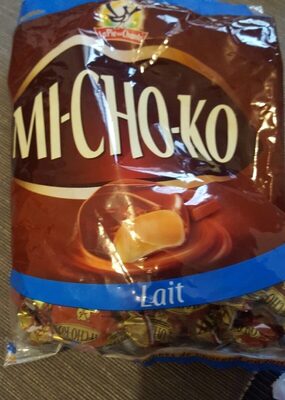
Mi-Cho-Ko lait
Labels
 Bad nutritional quality
 Ultra-processed food and drink products
 Green-Score not computed
Health
Nutrition
Label
Bad nutritional qualityNutrient levels
Fat in moderate quantity (19%)
Saturated fat in high quantity (15%)
Sugars in high quantity (56%)
Salt in moderate quantity (0.3%)
Nutrition label

Nutrition facts
| Nutrition facts | As sold for 100 g / 100 ml |
|---|---|
| Energy | 1,908 kJ (457 kcal) |
| FAT | 19 g |
| Saturated fat | 15 g |
| Carbohydrates | 69 g |
| Sugars | 56 g |
| Dietary fiber | ? |
| Proteins | 3.2 g |
| Salt | 0.3 g |
| Sodium | 0.12 g |
| Minerals | |
| Fruits, vegetables and legumes | ~ 0 % |
Nutrition facts (Detailed data)
| Nutrition facts | As sold for 100 g / 100 ml | As sold Per 100 g (packaging) | As sold Per 100 g (estimate) |
|---|---|---|---|
| Energy | 1,908 kJ (457 kcal) | 1,908 kJ (457 kcal) | ? |
| FAT | 19 g | 19 g | ? |
| Saturated fat | 15 g | 15 g | ? |
| Carbohydrates | 69 g | 69 g | ? |
| Sugars | 56 g | 56 g | ? |
| Added sugars | ~ 78.13 g | ? | ~ 78.13 g |
| Dietary fiber | ? | ? | ? |
| Proteins | 3.2 g | 3.2 g | ? |
| Salt | 0.3 g | 0.3 g | ? |
| Sodium | 0.12 g | 0.12 g | ? |
| Minerals | |||
| Fruits, vegetables and legumes | ~ 0 % | ? | ~ 0 % |
Estimated Activity Time
Approximate time needed to burn the energy in 100 g / 100 ml: 1,908 kJ. Reference adult weight: 70 kg. Energy density: Moderate.
Ingredients
Ingredients image
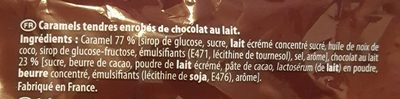
Ingredients list
Ingredient information
Allergens
Traces
Ingredients analysis
Palm oil content unknown
Contains non-vegan ingredients.
Vegetarian status unknown
Food Processing
NOVA group
Ultra-processed food and drink productsElements that indicate the product is in NOVA group 4
How NOVA works
Additives
E322 - LecithinsAntioxidantEmulsifier
Lecithins are natural compounds commonly used in the food industry as emulsifiers and stabilizers.
Extracted from sources like soybeans and eggs, lecithins consist of phospholipids that enhance the mixing of oil and water, ensuring smooth textures in various products like chocolates, dressings, and baked goods.
They do not present any known health risks.
E322i - LecithinAntioxidantEmulsifier
Lecithins are natural compounds commonly used in the food industry as emulsifiers and stabilizers.
Extracted from sources like soybeans and eggs, lecithins consist of phospholipids that enhance the mixing of oil and water, ensuring smooth textures in various products like chocolates, dressings, and baked goods.
They do not present any known health risks.
E471 - Mono- and diglycerides of fatty acidsEmulsifierStabiliser
Mono- and diglycerides of fatty acids (E471), are food additives commonly used as emulsifiers in various processed foods.
These compounds consist of glycerol molecules linked to one or two fatty acid chains, which help stabilize and blend water and oil-based ingredients. E471 enhances the texture and shelf life of products like margarine, baked goods, and ice cream, ensuring a smooth and consistent texture.
It is generally considered safe for consumption within established regulatory limits.
E476 - Polyglycerol polyricinoleateEmulsifier
Polyglycerol polyricinoleate (PGPR), E476, is an emulsifier made from glycerol and fatty acids (usually from castor bean, but also from soybean oil). In chocolate, compound chocolate and similar coatings, PGPR is mainly used with another substance like lecithin to reduce viscosity. It is used at low levels (below 0.5%), and works by decreasing the friction between the solid particles (e.g. cacao, sugar, milk) in molten chocolate, reducing the yield stress so that it flows more easily, approaching the behaviour of a Newtonian fluid. It can also be used as an emulsifier in spreads and in salad dressings, or to improve the texture of baked goods. It is made up of a short chain of glycerol molecules connected by ether bonds, with ricinoleic acid side chains connected by ester bonds. PGPR is a yellowish, viscous liquid, and is strongly lipophilic: it is soluble in fats and oils and insoluble in water and ethanol.
Environment
Green-Score, origins bonus, and transportation impact are shown for Worldwide .
Green Score
Overall grade
Unknown environmental impactAbout Green-Score
Current scope
Green-Score availability
Bonuses and maluses
Declared origins
Packaging impact
Packaging
Packaging impact
Data precision
Transportation
Declared origins
Data Source
Data presented on this page is sourced from the Open Food Facts database. This platform does not alter the original dataset; its purpose is solely to enhance data visualization and user accessibility.
Product added on June 25, 2018 at 7:45:33 PM UTC by kiliweb .
Last edit on March 17, 2026 at 9:01:04 PM UTC by new-nutrition-bot .
Product page also edited by foodless, kiliweb, magasins-u, mrhalal, new-nutrition-bot, openfoodfacts-contributors, org-carambar-co, roboto-app, yuka.UppgOPXUNMciQtzCydM08CnkE7ncEdYDH3MIoQ, yuka.YWZBR0NQNVppK1kwdDhCaG9CanBwY0pWbHJLMloxMmNMY3NUSWc9PQ, yuka.sY2b0xO6T85zoF3NwEKvlnQZa4bgiRbEHTf6gxyon8uoFrnFO95Tva77E6s.
Source List
- carambar-co